

242
B. J. Holzer et al.
ultra-relativistic case, when the particle speed is very close to the speed of light,
β ≈ c, most of the radiation is emitted in the forward direction [48] into a cone
centred on the tangent to the trajectory and with an opening angle of 1/γ , where γ
is the Lorentz factor (since for a few GeV electron or a few TeV proton, γ ≈ 1000,
the photon emission angles are within a milliradian of the tangent to the trajectory).
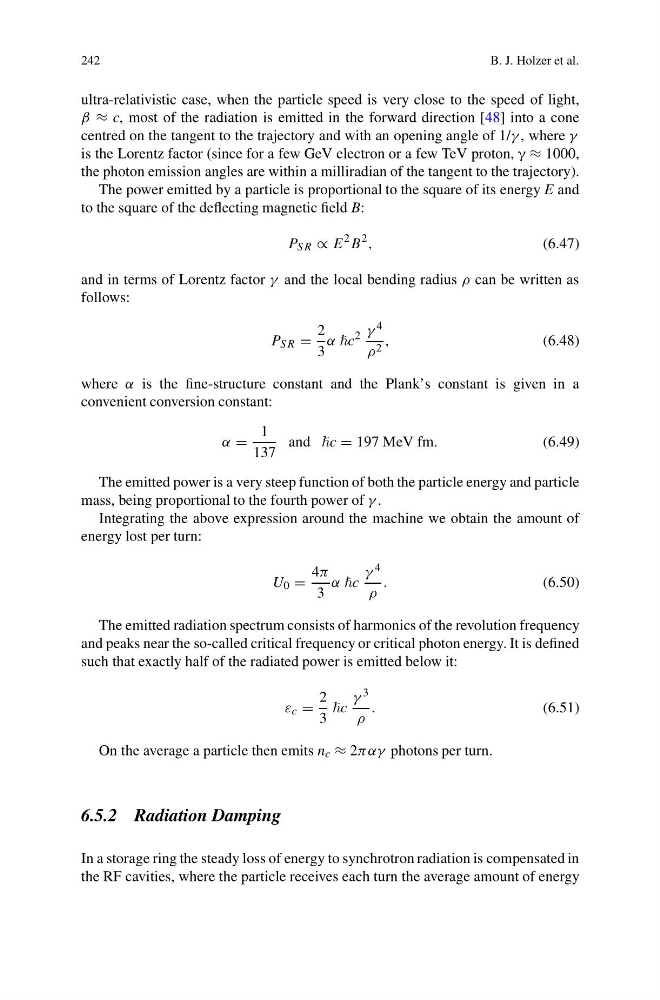
The power emitted by a particle is proportional to the square of its energy E and
to the square of the deflecting magnetic field B:
P SR ∝ E
2 B
2 ,
(6.47)
and in terms of Lorentz factor γ and the local bending radius ρ can be written as
follows:
P SR =
2
3
α
2 γ 4
ρ 2 ,
(6.48)
where α is the fine-structure constant and the Plank’s constant is given in a
convenient conversion constant:
α =
1
137
and = 197 MeV fm.
(6.49)
The emitted power is a very steep function of both the particle energy and particle
mass, being proportional to the fourth power of γ .
Integrating the above expression around the machine we obtain the amount of
energy lost per turn:
U 0 =
4π
3
α
γ 4
ρ
.
(6.50)
The emitted radiation spectrum consists of harmonics of the revolution frequency
and peaks near the so-called critical frequency or critical photon energy. It is defined
such that exactly half of the radiated power is emitted below it:
ε c =
2
3
γ 3
ρ
.
(6.51)
On the average a particle then emits n c ≈ 2παγ photons per turn.
6.5.2 Radiation Damping
In a storage ring the steady loss of energy to synchrotron radiation is compensated in
the RF cavities, where the particle receives each turn the average amount of energy
B. J. Holzer et al.
ultra-relativistic case, when the particle speed is very close to the speed of light,
β ≈ c, most of the radiation is emitted in the forward direction [48] into a cone
centred on the tangent to the trajectory and with an opening angle of 1/γ , where γ
is the Lorentz factor (since for a few GeV electron or a few TeV proton, γ ≈ 1000,
the photon emission angles are within a milliradian of the tangent to the trajectory).
The power emitted by a particle is proportional to the square of its energy E and
to the square of the deflecting magnetic field B:
P SR ∝ E
2 B
2 ,
(6.47)
and in terms of Lorentz factor γ and the local bending radius ρ can be written as
follows:
P SR =
2
3
α
2 γ 4
ρ 2 ,
(6.48)
where α is the fine-structure constant and the Plank’s constant is given in a
convenient conversion constant:
α =
1
137
and = 197 MeV fm.
(6.49)
The emitted power is a very steep function of both the particle energy and particle
mass, being proportional to the fourth power of γ .
Integrating the above expression around the machine we obtain the amount of
energy lost per turn:
U 0 =
4π
3
α
γ 4
ρ
.
(6.50)
The emitted radiation spectrum consists of harmonics of the revolution frequency
and peaks near the so-called critical frequency or critical photon energy. It is defined
such that exactly half of the radiated power is emitted below it:
ε c =
2
3
γ 3
ρ
.
(6.51)
On the average a particle then emits n c ≈ 2παγ photons per turn.
6.5.2 Radiation Damping
In a storage ring the steady loss of energy to synchrotron radiation is compensated in
the RF cavities, where the particle receives each turn the average amount of energy