

228
B. J. Holzer et al.
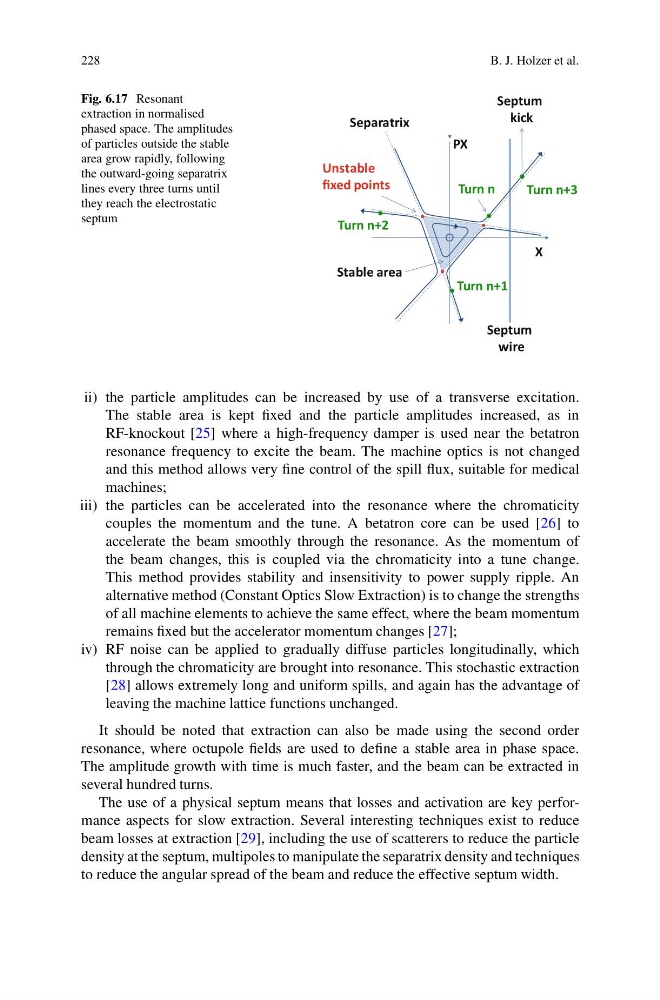
Fig. 6.17 Resonant
extraction in normalised
phased space. The amplitudes
of particles outside the stable
area grow rapidly, following
the outward-going separatrix
lines every three turns until
they reach the electrostatic
septum
PX
X
Turn n
Turn n+3
Turn n+1
Turn n+2
Septum
wire
Septum
kick
Unstable
fixed points
Stable area
Separatrix
ii) the particle amplitudes can be increased by use of a transverse excitation.
The stable area is kept fixed and the particle amplitudes increased, as in
RF-knockout [25] where a high-frequency damper is used near the betatron
resonance frequency to excite the beam. The machine optics is not changed
and this method allows very fine control of the spill flux, suitable for medical
machines;
iii) the particles can be accelerated into the resonance where the chromaticity
couples the momentum and the tune. A betatron core can be used [26] to
accelerate the beam smoothly through the resonance. As the momentum of
the beam changes, this is coupled via the chromaticity into a tune change.
This method provides stability and insensitivity to power supply ripple. An
alternative method (Constant Optics Slow Extraction) is to change the strengths
of all machine elements to achieve the same effect, where the beam momentum
remains fixed but the accelerator momentum changes [27];
iv) RF noise can be applied to gradually diffuse particles longitudinally, which
through the chromaticity are brought into resonance. This stochastic extraction
[28] allows extremely long and uniform spills, and again has the advantage of
leaving the machine lattice functions unchanged.
It should be noted that extraction can also be made using the second order
resonance, where octupole fields are used to define a stable area in phase space.
The amplitude growth with time is much faster, and the beam can be extracted in
several hundred turns.
The use of a physical septum means that losses and activation are key performance aspects for slow extraction. Several interesting techniques exist to reduce
beam losses at extraction [29], including the use of scatterers to reduce the particle
density at the septum, multipoles to manipulate the separatrix density and techniques
to reduce the angular spread of the beam and reduce the effective septum width.
B. J. Holzer et al.
Fig. 6.17 Resonant
extraction in normalised
phased space. The amplitudes
of particles outside the stable
area grow rapidly, following
the outward-going separatrix
lines every three turns until
they reach the electrostatic
septum
PX
X
Turn n
Turn n+3
Turn n+1
Turn n+2
Septum
wire
Septum
kick
Unstable
fixed points
Stable area
Separatrix
ii) the particle amplitudes can be increased by use of a transverse excitation.
The stable area is kept fixed and the particle amplitudes increased, as in
RF-knockout [25] where a high-frequency damper is used near the betatron
resonance frequency to excite the beam. The machine optics is not changed
and this method allows very fine control of the spill flux, suitable for medical
machines;
iii) the particles can be accelerated into the resonance where the chromaticity
couples the momentum and the tune. A betatron core can be used [26] to
accelerate the beam smoothly through the resonance. As the momentum of
the beam changes, this is coupled via the chromaticity into a tune change.
This method provides stability and insensitivity to power supply ripple. An
alternative method (Constant Optics Slow Extraction) is to change the strengths
of all machine elements to achieve the same effect, where the beam momentum
remains fixed but the accelerator momentum changes [27];
iv) RF noise can be applied to gradually diffuse particles longitudinally, which
through the chromaticity are brought into resonance. This stochastic extraction
[28] allows extremely long and uniform spills, and again has the advantage of
leaving the machine lattice functions unchanged.
It should be noted that extraction can also be made using the second order
resonance, where octupole fields are used to define a stable area in phase space.
The amplitude growth with time is much faster, and the beam can be extracted in
several hundred turns.
The use of a physical septum means that losses and activation are key performance aspects for slow extraction. Several interesting techniques exist to reduce
beam losses at extraction [29], including the use of scatterers to reduce the particle
density at the septum, multipoles to manipulate the separatrix density and techniques
to reduce the angular spread of the beam and reduce the effective septum width.