

6 Design and Principles of Synchrotrons and Circular Colliders
207
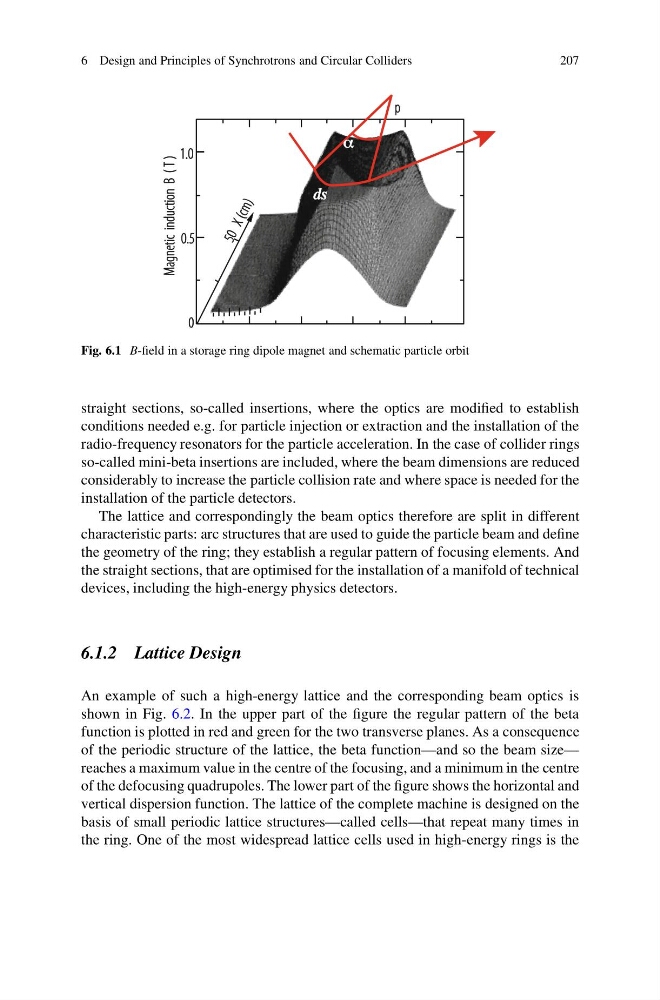
Fig. 6.1 B-field in a storage ring dipole magnet and schematic particle orbit
straight sections, so-called insertions, where the optics are modified to establish
conditions needed e.g. for particle injection or extraction and the installation of the
radio-frequency resonators for the particle acceleration. In the case of collider rings
so-called mini-beta insertions are included, where the beam dimensions are reduced
considerably to increase the particle collision rate and where space is needed for the
installation of the particle detectors.
The lattice and correspondingly the beam optics therefore are split in different
characteristic parts: arc structures that are used to guide the particle beam and define
the geometry of the ring; they establish a regular pattern of focusing elements. And
the straight sections, that are optimised for the installation of a manifold of technical
devices, including the high-energy physics detectors.
6.1.2 Lattice Design
An example of such a high-energy lattice and the corresponding beam optics is
shown in Fig. 6.2. In the upper part of the figure the regular pattern of the beta
function is plotted in red and green for the two transverse planes. As a consequence
of the periodic structure of the lattice, the beta function—and so the beam size—
reaches a maximum value in the centre of the focusing, and a minimum in the centre
of the defocusing quadrupoles. The lower part of the figure shows the horizontal and
vertical dispersion function. The lattice of the complete machine is designed on the
basis of small periodic lattice structures—called cells—that repeat many times in
the ring. One of the most widespread lattice cells used in high-energy rings is the
207
Fig. 6.1 B-field in a storage ring dipole magnet and schematic particle orbit
straight sections, so-called insertions, where the optics are modified to establish
conditions needed e.g. for particle injection or extraction and the installation of the
radio-frequency resonators for the particle acceleration. In the case of collider rings
so-called mini-beta insertions are included, where the beam dimensions are reduced
considerably to increase the particle collision rate and where space is needed for the
installation of the particle detectors.
The lattice and correspondingly the beam optics therefore are split in different
characteristic parts: arc structures that are used to guide the particle beam and define
the geometry of the ring; they establish a regular pattern of focusing elements. And
the straight sections, that are optimised for the installation of a manifold of technical
devices, including the high-energy physics detectors.
6.1.2 Lattice Design
An example of such a high-energy lattice and the corresponding beam optics is
shown in Fig. 6.2. In the upper part of the figure the regular pattern of the beta
function is plotted in red and green for the two transverse planes. As a consequence
of the periodic structure of the lattice, the beta function—and so the beam size—
reaches a maximum value in the centre of the focusing, and a minimum in the centre
of the defocusing quadrupoles. The lower part of the figure shows the horizontal and
vertical dispersion function. The lattice of the complete machine is designed on the
basis of small periodic lattice structures—called cells—that repeat many times in
the ring. One of the most widespread lattice cells used in high-energy rings is the