

1 Accelerators, Colliders and Their Application
11
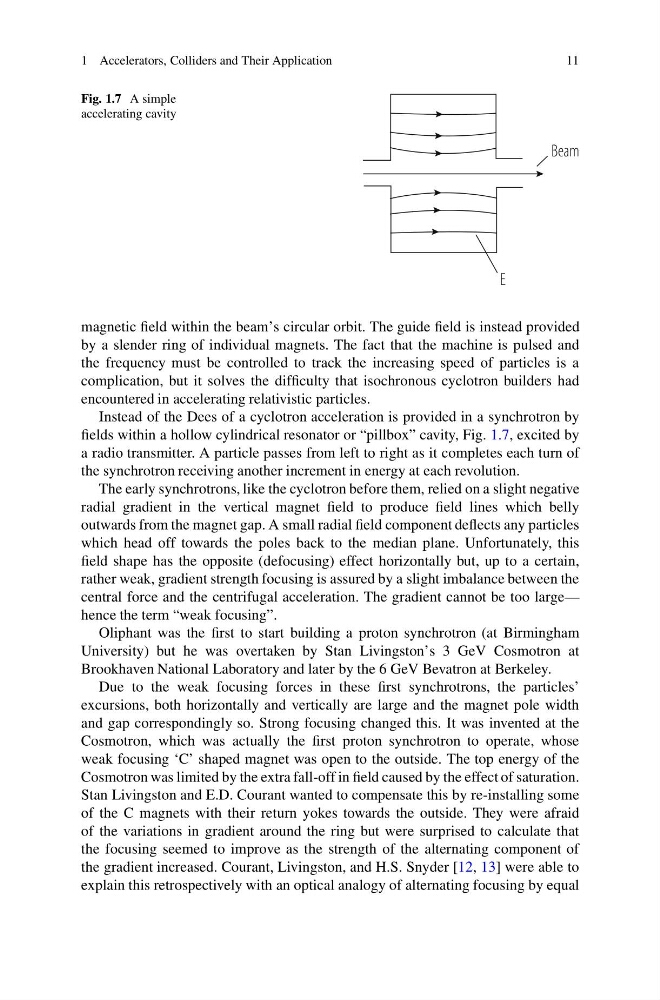
Fig. 1.7 A simple
accelerating cavity
magnetic field within the beam’s circular orbit. The guide field is instead provided
by a slender ring of individual magnets. The fact that the machine is pulsed and
the frequency must be controlled to track the increasing speed of particles is a
complication, but it solves the difficulty that isochronous cyclotron builders had
encountered in accelerating relativistic particles.
Instead of the Dees of a cyclotron acceleration is provided in a synchrotron by
fields within a hollow cylindrical resonator or “pillbox” cavity, Fig. 1.7, excited by
a radio transmitter. A particle passes from left to right as it completes each turn of
the synchrotron receiving another increment in energy at each revolution.
The early synchrotrons, like the cyclotron before them, relied on a slight negative
radial gradient in the vertical magnet field to produce field lines which belly
outwards from the magnet gap. A small radial field component deflects any particles
which head off towards the poles back to the median plane. Unfortunately, this
field shape has the opposite (defocusing) effect horizontally but, up to a certain,
rather weak, gradient strength focusing is assured by a slight imbalance between the
central force and the centrifugal acceleration. The gradient cannot be too large—
hence the term “weak focusing”.
Oliphant was the first to start building a proton synchrotron (at Birmingham
University) but he was overtaken by Stan Livingston’s 3 GeV Cosmotron at
Brookhaven National Laboratory and later by the 6 GeV Bevatron at Berkeley.
Due to the weak focusing forces in these first synchrotrons, the particles’
excursions, both horizontally and vertically are large and the magnet pole width
and gap correspondingly so. Strong focusing changed this. It was invented at the
Cosmotron, which was actually the first proton synchrotron to operate, whose
weak focusing ‘C’ shaped magnet was open to the outside. The top energy of the
Cosmotron was limited by the extra fall-off in field caused by the effect of saturation.
Stan Livingston and E.D. Courant wanted to compensate this by re-installing some
of the C magnets with their return yokes towards the outside. They were afraid
of the variations in gradient around the ring but were surprised to calculate that
the focusing seemed to improve as the strength of the alternating component of
the gradient increased. Courant, Livingston, and H.S. Snyder [12, 13] were able to
explain this retrospectively with an optical analogy of alternating focusing by equal
11
Fig. 1.7 A simple
accelerating cavity
magnetic field within the beam’s circular orbit. The guide field is instead provided
by a slender ring of individual magnets. The fact that the machine is pulsed and
the frequency must be controlled to track the increasing speed of particles is a
complication, but it solves the difficulty that isochronous cyclotron builders had
encountered in accelerating relativistic particles.
Instead of the Dees of a cyclotron acceleration is provided in a synchrotron by
fields within a hollow cylindrical resonator or “pillbox” cavity, Fig. 1.7, excited by
a radio transmitter. A particle passes from left to right as it completes each turn of
the synchrotron receiving another increment in energy at each revolution.
The early synchrotrons, like the cyclotron before them, relied on a slight negative
radial gradient in the vertical magnet field to produce field lines which belly
outwards from the magnet gap. A small radial field component deflects any particles
which head off towards the poles back to the median plane. Unfortunately, this
field shape has the opposite (defocusing) effect horizontally but, up to a certain,
rather weak, gradient strength focusing is assured by a slight imbalance between the
central force and the centrifugal acceleration. The gradient cannot be too large—
hence the term “weak focusing”.
Oliphant was the first to start building a proton synchrotron (at Birmingham
University) but he was overtaken by Stan Livingston’s 3 GeV Cosmotron at
Brookhaven National Laboratory and later by the 6 GeV Bevatron at Berkeley.
Due to the weak focusing forces in these first synchrotrons, the particles’
excursions, both horizontally and vertically are large and the magnet pole width
and gap correspondingly so. Strong focusing changed this. It was invented at the
Cosmotron, which was actually the first proton synchrotron to operate, whose
weak focusing ‘C’ shaped magnet was open to the outside. The top energy of the
Cosmotron was limited by the extra fall-off in field caused by the effect of saturation.
Stan Livingston and E.D. Courant wanted to compensate this by re-installing some
of the C magnets with their return yokes towards the outside. They were afraid
of the variations in gradient around the ring but were surprised to calculate that
the focusing seemed to improve as the strength of the alternating component of
the gradient increased. Courant, Livingston, and H.S. Snyder [12, 13] were able to
explain this retrospectively with an optical analogy of alternating focusing by equal