

198
M. Brugger et al.
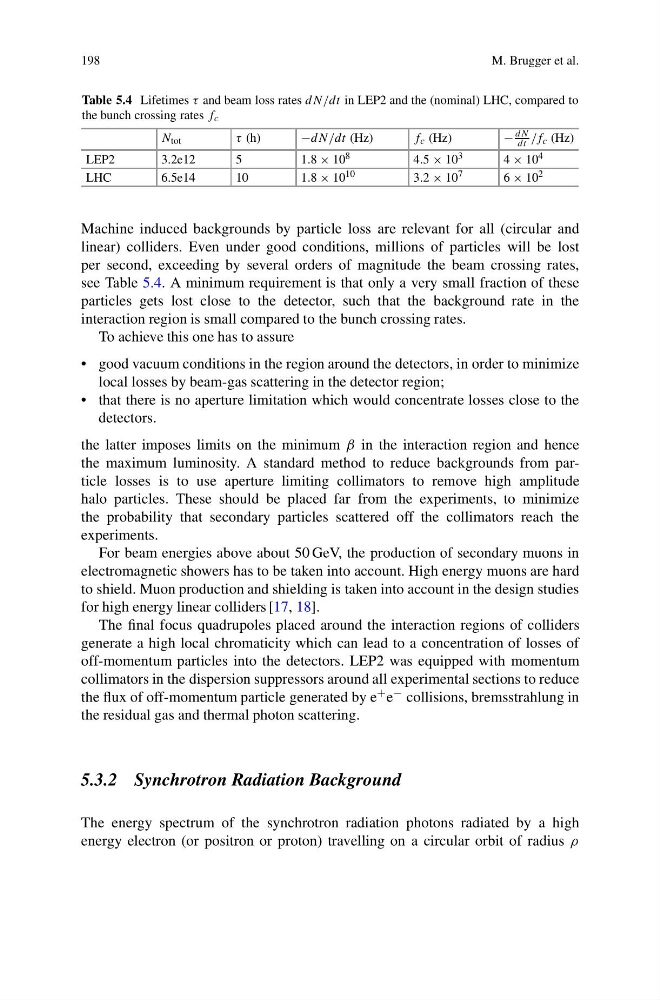
Table 5.4 Lifetimes τ and beam loss rates dN/dt in LEP2 and the (nominal) LHC, compared to
the bunch crossing rates f c
N tot
τ (h)
−dN/dt (Hz)
f c (Hz)
−
dN
dt /f c (Hz)
LEP2
3.2e12
5
1.8 × 10 8
4.5 × 10 3
4 × 10 4
LHC
6.5e14
10
1.8 × 10 10
3.2 × 10 7
6 × 10 2
Machine induced backgrounds by particle loss are relevant for all (circular and
linear) colliders. Even under good conditions, millions of particles will be lost
per second, exceeding by several orders of magnitude the beam crossing rates,
see Table 5.4. A minimum requirement is that only a very small fraction of these
particles gets lost close to the detector, such that the background rate in the
interaction region is small compared to the bunch crossing rates.
To achieve this one has to assure
• good vacuum conditions in the region around the detectors, in order to minimize
local losses by beam-gas scattering in the detector region;
• that there is no aperture limitation which would concentrate losses close to the
detectors.
the latter imposes limits on the minimum β in the interaction region and hence
the maximum luminosity. A standard method to reduce backgrounds from particle losses is to use aperture limiting collimators to remove high amplitude
halo particles. These should be placed far from the experiments, to minimize
the probability that secondary particles scattered off the collimators reach the
experiments.
For beam energies above about 50 GeV, the production of secondary muons in
electromagnetic showers has to be taken into account. High energy muons are hard
to shield. Muon production and shielding is taken into account in the design studies
for high energy linear colliders [17, 18].
The final focus quadrupoles placed around the interaction regions of colliders
generate a high local chromaticity which can lead to a concentration of losses of
off-momentum particles into the detectors. LEP2 was equipped with momentum
collimators in the dispersion suppressors around all experimental sections to reduce
the flux of off-momentum particle generated by e + e − collisions, bremsstrahlung in
the residual gas and thermal photon scattering.
5.3.2 Synchrotron Radiation Background
The energy spectrum of the synchrotron radiation photons radiated by a high
energy electron (or positron or proton) travelling on a circular orbit of radius ρ
M. Brugger et al.
Table 5.4 Lifetimes τ and beam loss rates dN/dt in LEP2 and the (nominal) LHC, compared to
the bunch crossing rates f c
N tot
τ (h)
−dN/dt (Hz)
f c (Hz)
−
dN
dt /f c (Hz)
LEP2
3.2e12
5
1.8 × 10 8
4.5 × 10 3
4 × 10 4
LHC
6.5e14
10
1.8 × 10 10
3.2 × 10 7
6 × 10 2
Machine induced backgrounds by particle loss are relevant for all (circular and
linear) colliders. Even under good conditions, millions of particles will be lost
per second, exceeding by several orders of magnitude the beam crossing rates,
see Table 5.4. A minimum requirement is that only a very small fraction of these
particles gets lost close to the detector, such that the background rate in the
interaction region is small compared to the bunch crossing rates.
To achieve this one has to assure
• good vacuum conditions in the region around the detectors, in order to minimize
local losses by beam-gas scattering in the detector region;
• that there is no aperture limitation which would concentrate losses close to the
detectors.
the latter imposes limits on the minimum β in the interaction region and hence
the maximum luminosity. A standard method to reduce backgrounds from particle losses is to use aperture limiting collimators to remove high amplitude
halo particles. These should be placed far from the experiments, to minimize
the probability that secondary particles scattered off the collimators reach the
experiments.
For beam energies above about 50 GeV, the production of secondary muons in
electromagnetic showers has to be taken into account. High energy muons are hard
to shield. Muon production and shielding is taken into account in the design studies
for high energy linear colliders [17, 18].
The final focus quadrupoles placed around the interaction regions of colliders
generate a high local chromaticity which can lead to a concentration of losses of
off-momentum particles into the detectors. LEP2 was equipped with momentum
collimators in the dispersion suppressors around all experimental sections to reduce
the flux of off-momentum particle generated by e + e − collisions, bremsstrahlung in
the residual gas and thermal photon scattering.
5.3.2 Synchrotron Radiation Background
The energy spectrum of the synchrotron radiation photons radiated by a high
energy electron (or positron or proton) travelling on a circular orbit of radius ρ