

8
E. Wilson and B. J. Holzer
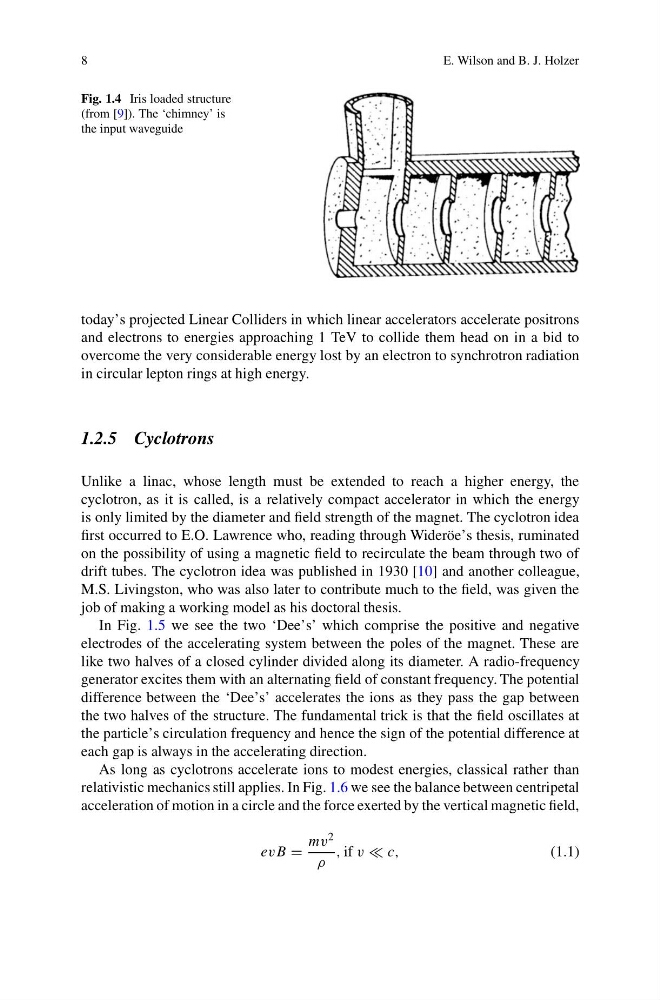
Fig. 1.4 Iris loaded structure
(from [9]). The ‘chimney’ is
the input waveguide
today’s projected Linear Colliders in which linear accelerators accelerate positrons
and electrons to energies approaching 1 TeV to collide them head on in a bid to
overcome the very considerable energy lost by an electron to synchrotron radiation
in circular lepton rings at high energy.
1.2.5 Cyclotrons
Unlike a linac, whose length must be extended to reach a higher energy, the
cyclotron, as it is called, is a relatively compact accelerator in which the energy
is only limited by the diameter and field strength of the magnet. The cyclotron idea
first occurred to E.O. Lawrence who, reading through Wideröe’s thesis, ruminated
on the possibility of using a magnetic field to recirculate the beam through two of
drift tubes. The cyclotron idea was published in 1930 [10] and another colleague,
M.S. Livingston, who was also later to contribute much to the field, was given the
job of making a working model as his doctoral thesis.
In Fig. 1.5 we see the two ‘Dee’s’ which comprise the positive and negative
electrodes of the accelerating system between the poles of the magnet. These are
like two halves of a closed cylinder divided along its diameter. A radio-frequency
generator excites them with an alternating field of constant frequency. The potential
difference between the ‘Dee’s’ accelerates the ions as they pass the gap between
the two halves of the structure. The fundamental trick is that the field oscillates at
the particle’s circulation frequency and hence the sign of the potential difference at
each gap is always in the accelerating direction.
As long as cyclotrons accelerate ions to modest energies, classical rather than
relativistic mechanics still applies. In Fig. 1.6 we see the balance between centripetal
acceleration of motion in a circle and the force exerted by the vertical magnetic field,
evB =
mv 2
ρ
, if v c,
(1.1)
E. Wilson and B. J. Holzer
Fig. 1.4 Iris loaded structure
(from [9]). The ‘chimney’ is
the input waveguide
today’s projected Linear Colliders in which linear accelerators accelerate positrons
and electrons to energies approaching 1 TeV to collide them head on in a bid to
overcome the very considerable energy lost by an electron to synchrotron radiation
in circular lepton rings at high energy.
1.2.5 Cyclotrons
Unlike a linac, whose length must be extended to reach a higher energy, the
cyclotron, as it is called, is a relatively compact accelerator in which the energy
is only limited by the diameter and field strength of the magnet. The cyclotron idea
first occurred to E.O. Lawrence who, reading through Wideröe’s thesis, ruminated
on the possibility of using a magnetic field to recirculate the beam through two of
drift tubes. The cyclotron idea was published in 1930 [10] and another colleague,
M.S. Livingston, who was also later to contribute much to the field, was given the
job of making a working model as his doctoral thesis.
In Fig. 1.5 we see the two ‘Dee’s’ which comprise the positive and negative
electrodes of the accelerating system between the poles of the magnet. These are
like two halves of a closed cylinder divided along its diameter. A radio-frequency
generator excites them with an alternating field of constant frequency. The potential
difference between the ‘Dee’s’ accelerates the ions as they pass the gap between
the two halves of the structure. The fundamental trick is that the field oscillates at
the particle’s circulation frequency and hence the sign of the potential difference at
each gap is always in the accelerating direction.
As long as cyclotrons accelerate ions to modest energies, classical rather than
relativistic mechanics still applies. In Fig. 1.6 we see the balance between centripetal
acceleration of motion in a circle and the force exerted by the vertical magnetic field,
evB =
mv 2
ρ
, if v c,
(1.1)