

4 Impedance and Collective Effects
141
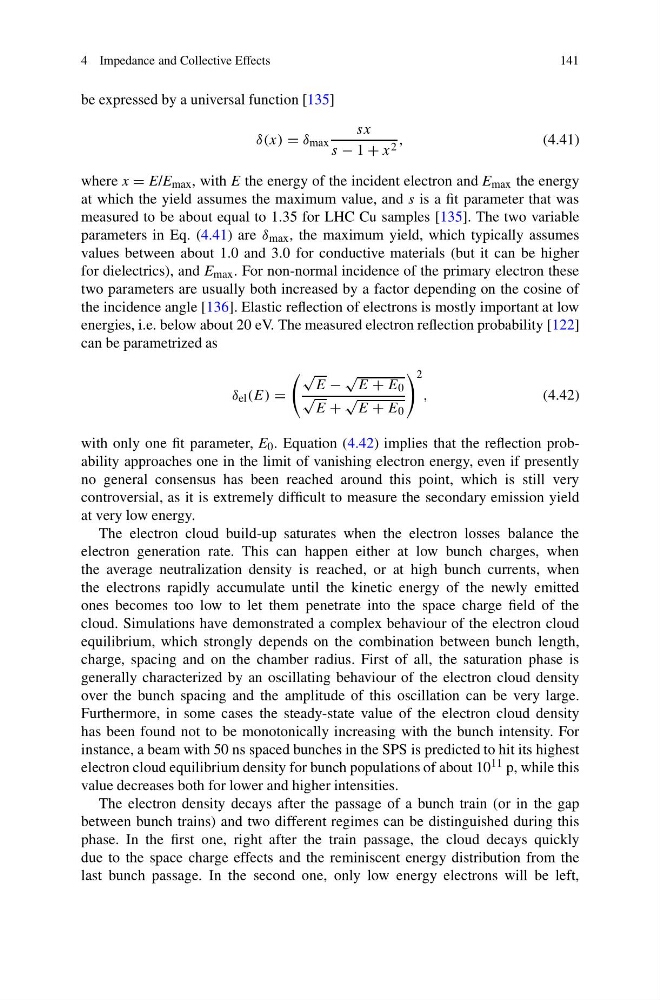
be expressed by a universal function [135]
δ(x) = δ max
sx
s − 1 + x 2 ,
(4.41)
where x = E/E max , with E the energy of the incident electron and E max the energy
at which the yield assumes the maximum value, and s is a fit parameter that was
measured to be about equal to 1.35 for LHC Cu samples [135]. The two variable
parameters in Eq. (4.41) are δ max , the maximum yield, which typically assumes
values between about 1.0 and 3.0 for conductive materials (but it can be higher
for dielectrics), and E max . For non-normal incidence of the primary electron these
two parameters are usually both increased by a factor depending on the cosine of
the incidence angle [136]. Elastic reflection of electrons is mostly important at low
energies, i.e. below about 20 eV. The measured electron reflection probability [122]
can be parametrized as
δ el (E) =
√
E −
√
E + E 0
√
E +
√
E + E 0
2
,
(4.42)
with only one fit parameter, E 0 . Equation (4.42) implies that the reflection probability approaches one in the limit of vanishing electron energy, even if presently
no general consensus has been reached around this point, which is still very
controversial, as it is extremely difficult to measure the secondary emission yield
at very low energy.
The electron cloud build-up saturates when the electron losses balance the
electron generation rate. This can happen either at low bunch charges, when
the average neutralization density is reached, or at high bunch currents, when
the electrons rapidly accumulate until the kinetic energy of the newly emitted
ones becomes too low to let them penetrate into the space charge field of the
cloud. Simulations have demonstrated a complex behaviour of the electron cloud
equilibrium, which strongly depends on the combination between bunch length,
charge, spacing and on the chamber radius. First of all, the saturation phase is
generally characterized by an oscillating behaviour of the electron cloud density
over the bunch spacing and the amplitude of this oscillation can be very large.
Furthermore, in some cases the steady-state value of the electron cloud density
has been found not to be monotonically increasing with the bunch intensity. For
instance, a beam with 50 ns spaced bunches in the SPS is predicted to hit its highest
electron cloud equilibrium density for bunch populations of about 10 11 p, while this
value decreases both for lower and higher intensities.
The electron density decays after the passage of a bunch train (or in the gap
between bunch trains) and two different regimes can be distinguished during this
phase. In the first one, right after the train passage, the cloud decays quickly
due to the space charge effects and the reminiscent energy distribution from the
last bunch passage. In the second one, only low energy electrons will be left,
141
be expressed by a universal function [135]
δ(x) = δ max
sx
s − 1 + x 2 ,
(4.41)
where x = E/E max , with E the energy of the incident electron and E max the energy
at which the yield assumes the maximum value, and s is a fit parameter that was
measured to be about equal to 1.35 for LHC Cu samples [135]. The two variable
parameters in Eq. (4.41) are δ max , the maximum yield, which typically assumes
values between about 1.0 and 3.0 for conductive materials (but it can be higher
for dielectrics), and E max . For non-normal incidence of the primary electron these
two parameters are usually both increased by a factor depending on the cosine of
the incidence angle [136]. Elastic reflection of electrons is mostly important at low
energies, i.e. below about 20 eV. The measured electron reflection probability [122]
can be parametrized as
δ el (E) =
√
E −
√
E + E 0
√
E +
√
E + E 0
2
,
(4.42)
with only one fit parameter, E 0 . Equation (4.42) implies that the reflection probability approaches one in the limit of vanishing electron energy, even if presently
no general consensus has been reached around this point, which is still very
controversial, as it is extremely difficult to measure the secondary emission yield
at very low energy.
The electron cloud build-up saturates when the electron losses balance the
electron generation rate. This can happen either at low bunch charges, when
the average neutralization density is reached, or at high bunch currents, when
the electrons rapidly accumulate until the kinetic energy of the newly emitted
ones becomes too low to let them penetrate into the space charge field of the
cloud. Simulations have demonstrated a complex behaviour of the electron cloud
equilibrium, which strongly depends on the combination between bunch length,
charge, spacing and on the chamber radius. First of all, the saturation phase is
generally characterized by an oscillating behaviour of the electron cloud density
over the bunch spacing and the amplitude of this oscillation can be very large.
Furthermore, in some cases the steady-state value of the electron cloud density
has been found not to be monotonically increasing with the bunch intensity. For
instance, a beam with 50 ns spaced bunches in the SPS is predicted to hit its highest
electron cloud equilibrium density for bunch populations of about 10 11 p, while this
value decreases both for lower and higher intensities.
The electron density decays after the passage of a bunch train (or in the gap
between bunch trains) and two different regimes can be distinguished during this
phase. In the first one, right after the train passage, the cloud decays quickly
due to the space charge effects and the reminiscent energy distribution from the
last bunch passage. In the second one, only low energy electrons will be left,