

110
E. Metral et al.
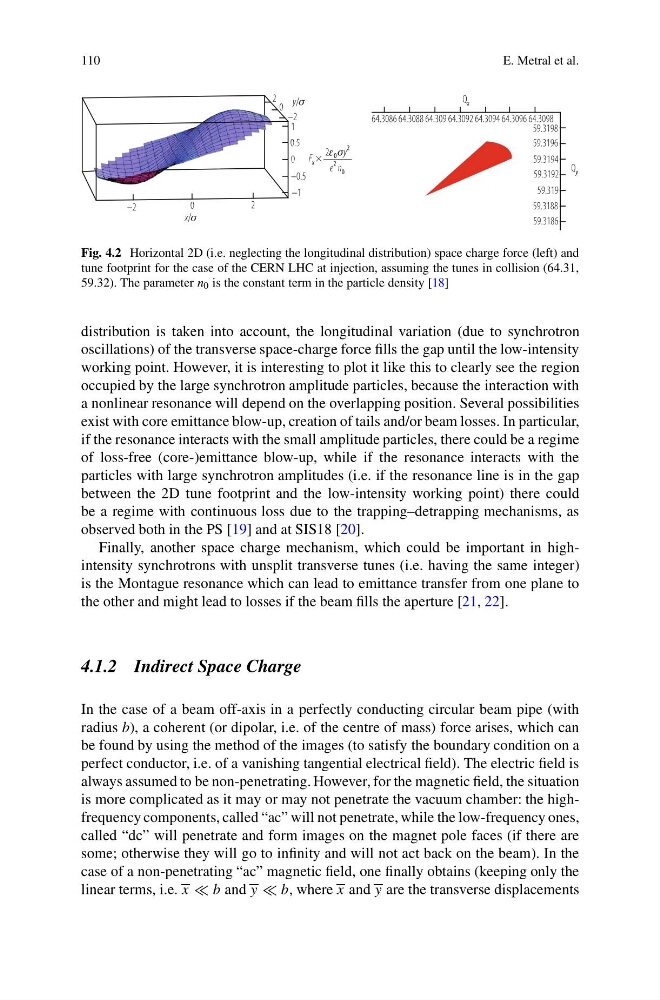
Fig. 4.2 Horizontal 2D (i.e. neglecting the longitudinal distribution) space charge force (left) and
tune footprint for the case of the CERN LHC at injection, assuming the tunes in collision (64.31,
59.32). The parameter n 0 is the constant term in the particle density [18]
distribution is taken into account, the longitudinal variation (due to synchrotron
oscillations) of the transverse space-charge force fills the gap until the low-intensity
working point. However, it is interesting to plot it like this to clearly see the region
occupied by the large synchrotron amplitude particles, because the interaction with
a nonlinear resonance will depend on the overlapping position. Several possibilities
exist with core emittance blow-up, creation of tails and/or beam losses. In particular,
if the resonance interacts with the small amplitude particles, there could be a regime
of loss-free (core-)emittance blow-up, while if the resonance interacts with the
particles with large synchrotron amplitudes (i.e. if the resonance line is in the gap
between the 2D tune footprint and the low-intensity working point) there could
be a regime with continuous loss due to the trapping–detrapping mechanisms, as
observed both in the PS [19] and at SIS18 [20].
Finally, another space charge mechanism, which could be important in highintensity synchrotrons with unsplit transverse tunes (i.e. having the same integer)
is the Montague resonance which can lead to emittance transfer from one plane to
the other and might lead to losses if the beam fills the aperture [21, 22].
4.1.2 Indirect Space Charge
In the case of a beam off-axis in a perfectly conducting circular beam pipe (with
radius b), a coherent (or dipolar, i.e. of the centre of mass) force arises, which can
be found by using the method of the images (to satisfy the boundary condition on a
perfect conductor, i.e. of a vanishing tangential electrical field). The electric field is
always assumed to be non-penetrating. However, for the magnetic field, the situation
is more complicated as it may or may not penetrate the vacuum chamber: the highfrequency components, called “ac” will not penetrate, while the low-frequency ones,
called “dc” will penetrate and form images on the magnet pole faces (if there are
some; otherwise they will go to infinity and will not act back on the beam). In the
case of a non-penetrating “ac” magnetic field, one finally obtains (keeping only the
linear terms, i.e. x b and y b, where x and y are the transverse displacements
E. Metral et al.
Fig. 4.2 Horizontal 2D (i.e. neglecting the longitudinal distribution) space charge force (left) and
tune footprint for the case of the CERN LHC at injection, assuming the tunes in collision (64.31,
59.32). The parameter n 0 is the constant term in the particle density [18]
distribution is taken into account, the longitudinal variation (due to synchrotron
oscillations) of the transverse space-charge force fills the gap until the low-intensity
working point. However, it is interesting to plot it like this to clearly see the region
occupied by the large synchrotron amplitude particles, because the interaction with
a nonlinear resonance will depend on the overlapping position. Several possibilities
exist with core emittance blow-up, creation of tails and/or beam losses. In particular,
if the resonance interacts with the small amplitude particles, there could be a regime
of loss-free (core-)emittance blow-up, while if the resonance interacts with the
particles with large synchrotron amplitudes (i.e. if the resonance line is in the gap
between the 2D tune footprint and the low-intensity working point) there could
be a regime with continuous loss due to the trapping–detrapping mechanisms, as
observed both in the PS [19] and at SIS18 [20].
Finally, another space charge mechanism, which could be important in highintensity synchrotrons with unsplit transverse tunes (i.e. having the same integer)
is the Montague resonance which can lead to emittance transfer from one plane to
the other and might lead to losses if the beam fills the aperture [21, 22].
4.1.2 Indirect Space Charge
In the case of a beam off-axis in a perfectly conducting circular beam pipe (with
radius b), a coherent (or dipolar, i.e. of the centre of mass) force arises, which can
be found by using the method of the images (to satisfy the boundary condition on a
perfect conductor, i.e. of a vanishing tangential electrical field). The electric field is
always assumed to be non-penetrating. However, for the magnetic field, the situation
is more complicated as it may or may not penetrate the vacuum chamber: the highfrequency components, called “ac” will not penetrate, while the low-frequency ones,
called “dc” will penetrate and form images on the magnet pole faces (if there are
some; otherwise they will go to infinity and will not act back on the beam). In the
case of a non-penetrating “ac” magnetic field, one finally obtains (keeping only the
linear terms, i.e. x b and y b, where x and y are the transverse displacements