

N
X
C
O
N
S
Hal
Solvents
Natural
Products
P Si
C
C
C C
C
C
86
4 13 C NMR
4.2 Alkenes
4.2.1 Chemical Shifts
13 C Chemical Shifts (δ in ppm)
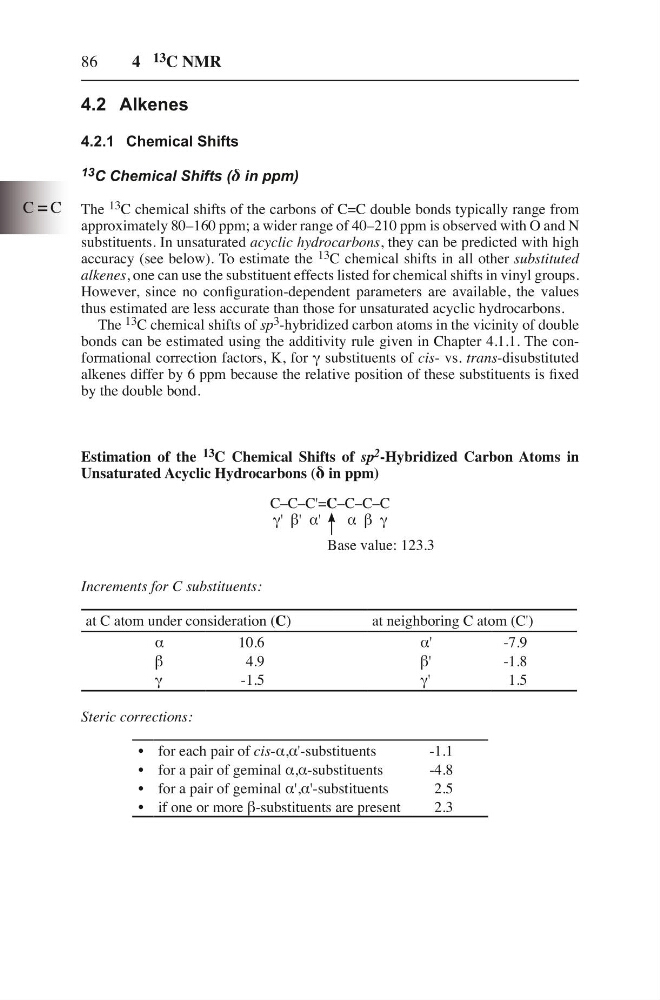
The 13 C chemical shifts of the carbons of C=C double bonds typically range from
approximately 80–160 ppm; a wider range of 40–210 ppm is observed with O and N
substituents. In unsaturated acyclic hydrocarbons, they can be predicted with high
accuracy (see below). To estimate the 13 C chemical shifts in all other substituted
alkenes, one can use the substituent effects listed for chemical shifts in vinyl groups.
However, since no configuration-dependent parameters are available, the values
thus estimated are less accurate than those for unsaturated acyclic hydrocarbons.
The 13 C chemical shifts of sp 3 -hybridized carbon atoms in the vicinity of double
bonds can be estimated using the additivity rule given in Chapter 4.1.1. The conformational correction factors, K, for γ substituents of cis- vs. trans-disubstituted
alkenes differ by 6 ppm because the relative position of these substituents is fixed
by the double bond.
Estimation of the 13 C Chemical Shifts of sp 2 -Hybridized Carbon Atoms in
Unsaturated Acyclic Hydrocarbons (δ in ppm)
C–C–C'=C–C–C–C
γ' β' α'
α β γ
Base value: 123.3
Increments for C substituents:
at C atom under consideration (C)
at neighboring C atom (C')
α
10.6
α'
-7.9
β
4.9
β'
-1.8
γ
-1.5
γ'
1.5
Steric corrections:
• for each pair of cis-α,α'-substituents
-1.1
• for a pair of geminal α,α-substituents
-4.8
• for a pair of geminal α',α'-substituents
2.5
• if one or more β-substituents are present
2.3
X
C
O
N
S
Hal
Solvents
Natural
Products
P Si
C
C
C C
C
C
86
4 13 C NMR
4.2 Alkenes
4.2.1 Chemical Shifts
13 C Chemical Shifts (δ in ppm)
The 13 C chemical shifts of the carbons of C=C double bonds typically range from
approximately 80–160 ppm; a wider range of 40–210 ppm is observed with O and N
substituents. In unsaturated acyclic hydrocarbons, they can be predicted with high
accuracy (see below). To estimate the 13 C chemical shifts in all other substituted
alkenes, one can use the substituent effects listed for chemical shifts in vinyl groups.
However, since no configuration-dependent parameters are available, the values
thus estimated are less accurate than those for unsaturated acyclic hydrocarbons.
The 13 C chemical shifts of sp 3 -hybridized carbon atoms in the vicinity of double
bonds can be estimated using the additivity rule given in Chapter 4.1.1. The conformational correction factors, K, for γ substituents of cis- vs. trans-disubstituted
alkenes differ by 6 ppm because the relative position of these substituents is fixed
by the double bond.
Estimation of the 13 C Chemical Shifts of sp 2 -Hybridized Carbon Atoms in
Unsaturated Acyclic Hydrocarbons (δ in ppm)
C–C–C'=C–C–C–C
γ' β' α'
α β γ
Base value: 123.3
Increments for C substituents:
at C atom under consideration (C)
at neighboring C atom (C')
α
10.6
α'
-7.9
β
4.9
β'
-1.8
γ
-1.5
γ'
1.5
Steric corrections:
• for each pair of cis-α,α'-substituents
-1.1
• for a pair of geminal α,α-substituents
-4.8
• for a pair of geminal α',α'-substituents
2.5
• if one or more β-substituents are present
2.3