

3.10 Carbonyl Compounds
73
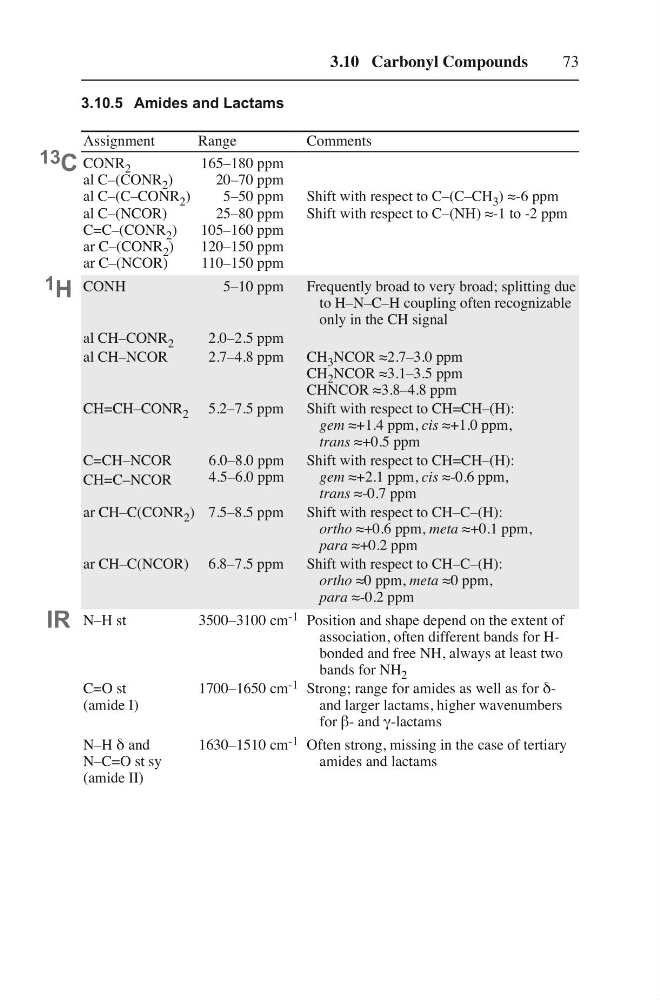
3.10.5 Amides and Lactams
Assignment
Range
Comments
CONR 2
al C–(CONR 2 )
al C–(C–CONR 2 )
165–180 ppm
20–70 ppm
5–50 ppm
Shift with respect to C–(C–CH 3 ) ≈-6 ppm
al C–(NCOR)
C=C–(CONR 2 )
ar C–(CONR 2 )
ar C–(NCOR)
25–80 ppm
105–160 ppm
120–150 ppm
110–150 ppm
Shift with respect to C–(NH) ≈-1 to -2 ppm
CONH
5–10 ppm
Frequently broad to very broad; splitting due
to H–N–C–H coupling often recognizable
only in the CH signal
al CH–CONR 2
2.0–2.5 ppm
al CH–NCOR
2.7–4.8 ppm
CH 3 NCOR ≈2.7–3.0 ppm
CH 2 NCOR ≈3.1–3.5 ppm
CHNCOR ≈3.8–4.8 ppm
CH=CH–CONR 2 5.2–7.5 ppm
Shift with respect to CH=CH–(H):
gem ≈+1.4 ppm, cis ≈+1.0 ppm,
trans ≈+0.5 ppm
C=CH–NCOR
CH=C–NCOR
6.0–8.0 ppm
4.5–6.0 ppm
Shift with respect to CH=CH–(H):
gem ≈+2.1 ppm, cis ≈-0.6 ppm,
trans ≈-0.7 ppm
ar CH–C(CONR 2 ) 7.5–8.5 ppm
Shift with respect to CH–C–(H):
ortho ≈+0.6 ppm, meta ≈+0.1 ppm,
para ≈+0.2 ppm
ar CH–C(NCOR) 6.8–7.5 ppm
Shift with respect to CH–C–(H):
ortho ≈0 ppm, meta ≈0 ppm,
para ≈-0.2 ppm
N–H st
3500–3100 cm -1 Position and shape depend on the extent of
association, often different bands for Hbonded and free NH, always at least two
bands for NH 2
C=O st
(amide I)
1700–1650 cm -1 Strong; range for amides as well as for δand larger lactams, higher wavenumbers
for β- and γ-lactams
N–H δ and
N–C=O st sy
(amide II)
1630–1510 cm -1 Often strong, missing in the case of tertiary
amides and lactams
13 C
1 H
IR
73
3.10.5 Amides and Lactams
Assignment
Range
Comments
CONR 2
al C–(CONR 2 )
al C–(C–CONR 2 )
165–180 ppm
20–70 ppm
5–50 ppm
Shift with respect to C–(C–CH 3 ) ≈-6 ppm
al C–(NCOR)
C=C–(CONR 2 )
ar C–(CONR 2 )
ar C–(NCOR)
25–80 ppm
105–160 ppm
120–150 ppm
110–150 ppm
Shift with respect to C–(NH) ≈-1 to -2 ppm
CONH
5–10 ppm
Frequently broad to very broad; splitting due
to H–N–C–H coupling often recognizable
only in the CH signal
al CH–CONR 2
2.0–2.5 ppm
al CH–NCOR
2.7–4.8 ppm
CH 3 NCOR ≈2.7–3.0 ppm
CH 2 NCOR ≈3.1–3.5 ppm
CHNCOR ≈3.8–4.8 ppm
CH=CH–CONR 2 5.2–7.5 ppm
Shift with respect to CH=CH–(H):
gem ≈+1.4 ppm, cis ≈+1.0 ppm,
trans ≈+0.5 ppm
C=CH–NCOR
CH=C–NCOR
6.0–8.0 ppm
4.5–6.0 ppm
Shift with respect to CH=CH–(H):
gem ≈+2.1 ppm, cis ≈-0.6 ppm,
trans ≈-0.7 ppm
ar CH–C(CONR 2 ) 7.5–8.5 ppm
Shift with respect to CH–C–(H):
ortho ≈+0.6 ppm, meta ≈+0.1 ppm,
para ≈+0.2 ppm
ar CH–C(NCOR) 6.8–7.5 ppm
Shift with respect to CH–C–(H):
ortho ≈0 ppm, meta ≈0 ppm,
para ≈-0.2 ppm
N–H st
3500–3100 cm -1 Position and shape depend on the extent of
association, often different bands for Hbonded and free NH, always at least two
bands for NH 2
C=O st
(amide I)
1700–1650 cm -1 Strong; range for amides as well as for δand larger lactams, higher wavenumbers
for β- and γ-lactams
N–H δ and
N–C=O st sy
(amide II)
1630–1510 cm -1 Often strong, missing in the case of tertiary
amides and lactams
13 C
1 H
IR