

70
3 Combination Tables
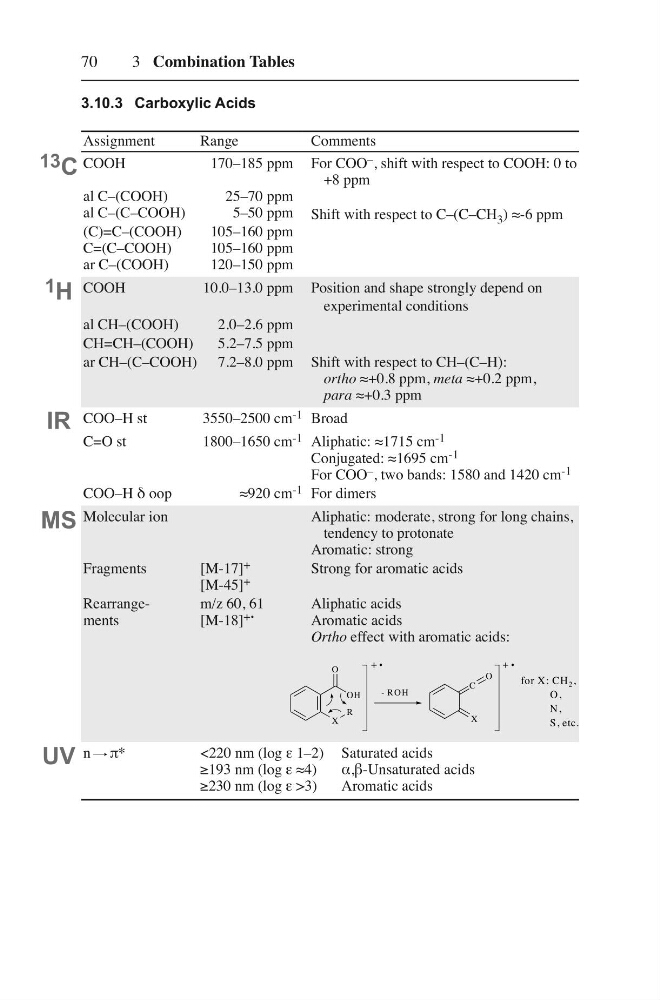
3.10.3 Carboxylic Acids
Assignment
Range
Comments
COOH
al C–(COOH)
al C–(C–COOH)
170–185 ppm
25–70 ppm
5–50 ppm
For COO – , shift with respect to COOH: 0 to
+8 ppm
Shift with respect to C–(C–CH 3 ) ≈-6 ppm
(C)=C–(COOH)
C=(C–COOH)
ar C–(COOH)
105–160 ppm
105–160 ppm
120–150 ppm
COOH
10.0–13.0 ppm Position and shape strongly depend on
experimental conditions
al CH–(COOH)
2.0–2.6 ppm
CH=CH–(COOH)
5.2–7.5 ppm
ar CH–(C–COOH) 7.2–8.0 ppm Shift with respect to CH–(C–H):
ortho ≈+0.8 ppm, meta ≈+0.2 ppm,
para ≈+0.3 ppm
COO–H st
3550–2500 cm -1 Broad
C=O st
1800–1650 cm -1 Aliphatic: ≈1715 cm -1
Conjugated: ≈1695 cm -1
For COO – , two bands: 1580 and 1420 cm -1
COO–H δ oop
≈920 cm -1 For dimers
Molecular ion
Aliphatic: moderate, strong for long chains,
tendency to protonate
Aromatic: strong
Fragments
[M-17] +
[M-45] +
Strong for aromatic acids
Rearrangements
m/z 60, 61
[M-18] +·
Aliphatic acids
Aromatic acids
Ortho effect with aromatic acids:
X
R
O
OH
- R O H
X
C
O
for X : CH 2 ,
O ,
N ,
S, etc.
+ .
+ .
n π*
<220 nm (log ε 1–2) Saturated acids
≥193 nm (log ε ≈4)
α,β-Unsaturated acids
≥230 nm (log ε >3)
Aromatic acids
13 C
1 H
IR
MS
UV
3 Combination Tables
3.10.3 Carboxylic Acids
Assignment
Range
Comments
COOH
al C–(COOH)
al C–(C–COOH)
170–185 ppm
25–70 ppm
5–50 ppm
For COO – , shift with respect to COOH: 0 to
+8 ppm
Shift with respect to C–(C–CH 3 ) ≈-6 ppm
(C)=C–(COOH)
C=(C–COOH)
ar C–(COOH)
105–160 ppm
105–160 ppm
120–150 ppm
COOH
10.0–13.0 ppm Position and shape strongly depend on
experimental conditions
al CH–(COOH)
2.0–2.6 ppm
CH=CH–(COOH)
5.2–7.5 ppm
ar CH–(C–COOH) 7.2–8.0 ppm Shift with respect to CH–(C–H):
ortho ≈+0.8 ppm, meta ≈+0.2 ppm,
para ≈+0.3 ppm
COO–H st
3550–2500 cm -1 Broad
C=O st
1800–1650 cm -1 Aliphatic: ≈1715 cm -1
Conjugated: ≈1695 cm -1
For COO – , two bands: 1580 and 1420 cm -1
COO–H δ oop
≈920 cm -1 For dimers
Molecular ion
Aliphatic: moderate, strong for long chains,
tendency to protonate
Aromatic: strong
Fragments
[M-17] +
[M-45] +
Strong for aromatic acids
Rearrangements
m/z 60, 61
[M-18] +·
Aliphatic acids
Aromatic acids
Ortho effect with aromatic acids:
X
R
O
OH
- R O H
X
C
O
for X : CH 2 ,
O ,
N ,
S, etc.
+ .
+ .
n π*
<220 nm (log ε 1–2) Saturated acids
≥193 nm (log ε ≈4)
α,β-Unsaturated acids
≥230 nm (log ε >3)
Aromatic acids
13 C
1 H
IR
MS
UV