

66
3 Combination Tables
Assignment
Range
Comments
Molecular ion
Odd nominal mass number for odd number
of N atoms
Aliphatic: weak, tendency to protonate,
[M+H] + is often important
Aromatic: strong, no tendency to protonate
Fragments
Aliphatic:
m/z 30, 44, 58, …
Base peak of aliphatic amines generally due
to fragmentation of the bond next to the
amine bond:
N CH 2 R 3
- R 3
.
N CH 2
+
R 1
R 2
R 2
R 1
+ .
Rearrangements
Elimination of alkenes following amine
cleavage:
N CH 2
+
R 2
R 1
R 1 NH CH 2
+
Aliphatic
Aromatic
No absorption above 200 nm
In acidic solutions, shift to lower wavelength
and decrease in intensity
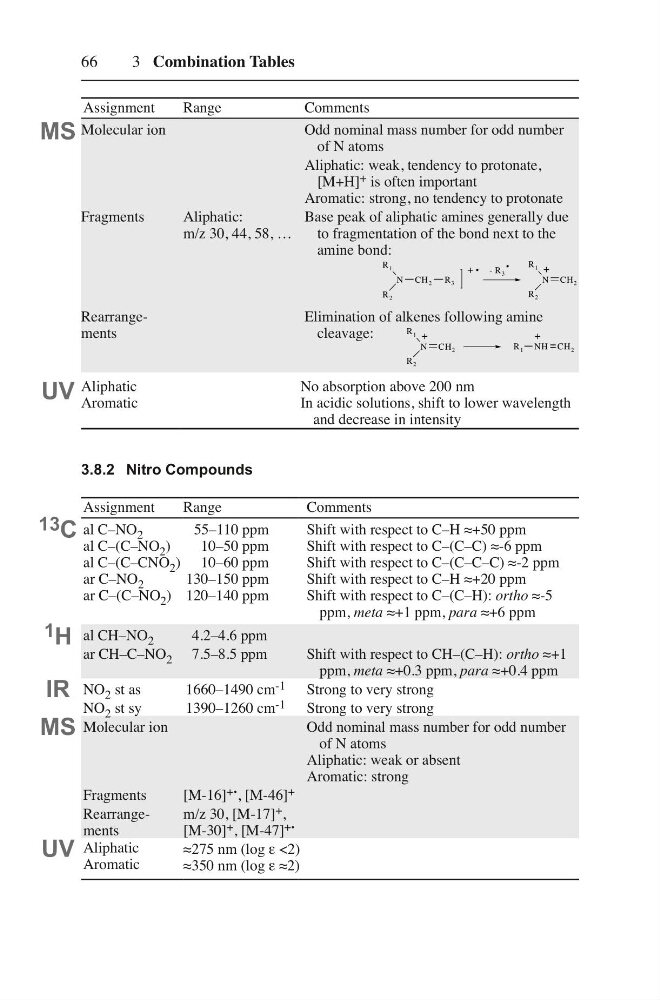
3.8.2 Nitro Compounds
Assignment
Range
Comments
al C–NO 2
al C–(C–NO 2 )
al C–(C–CNO 2 )
ar C–NO 2
ar C–(C–NO 2 )
55–110 ppm
10–50 ppm
10–60 ppm
130–150 ppm
120–140 ppm
Shift with respect to C–H ≈+50 ppm
Shift with respect to C–(C–C) ≈-6 ppm
Shift with respect to C–(C–C–C) ≈-2 ppm
Shift with respect to C–H ≈+20 ppm
Shift with respect to C–(C–H): ortho ≈-5
ppm, meta ≈+1 ppm, para ≈+6 ppm
al CH–NO 2
4.2–4.6 ppm
ar CH–C–NO 2 7.5–8.5 ppm
Shift with respect to CH–(C–H): ortho ≈+1
ppm, meta ≈+0.3 ppm, para ≈+0.4 ppm
NO 2 st as
1660–1490 cm -1 Strong to very strong
NO 2 st sy
1390–1260 cm -1 Strong to very strong
Molecular ion
Odd nominal mass number for odd number
of N atoms
Aliphatic: weak or absent
Aromatic: strong
Fragments
[M-16] +· , [M-46] +
Rearrangements
m/z 30, [M-17] + ,
[M-30] + , [M-47] +·
Aliphatic
Aromatic
≈275 nm (log ε <2)
≈350 nm (log ε ≈2)
MS
UV
13 C
1 H
IR
MS
UV
3 Combination Tables
Assignment
Range
Comments
Molecular ion
Odd nominal mass number for odd number
of N atoms
Aliphatic: weak, tendency to protonate,
[M+H] + is often important
Aromatic: strong, no tendency to protonate
Fragments
Aliphatic:
m/z 30, 44, 58, …
Base peak of aliphatic amines generally due
to fragmentation of the bond next to the
amine bond:
N CH 2 R 3
- R 3
.
N CH 2
+
R 1
R 2
R 2
R 1
+ .
Rearrangements
Elimination of alkenes following amine
cleavage:
N CH 2
+
R 2
R 1
R 1 NH CH 2
+
Aliphatic
Aromatic
No absorption above 200 nm
In acidic solutions, shift to lower wavelength
and decrease in intensity
3.8.2 Nitro Compounds
Assignment
Range
Comments
al C–NO 2
al C–(C–NO 2 )
al C–(C–CNO 2 )
ar C–NO 2
ar C–(C–NO 2 )
55–110 ppm
10–50 ppm
10–60 ppm
130–150 ppm
120–140 ppm
Shift with respect to C–H ≈+50 ppm
Shift with respect to C–(C–C) ≈-6 ppm
Shift with respect to C–(C–C–C) ≈-2 ppm
Shift with respect to C–H ≈+20 ppm
Shift with respect to C–(C–H): ortho ≈-5
ppm, meta ≈+1 ppm, para ≈+6 ppm
al CH–NO 2
4.2–4.6 ppm
ar CH–C–NO 2 7.5–8.5 ppm
Shift with respect to CH–(C–H): ortho ≈+1
ppm, meta ≈+0.3 ppm, para ≈+0.4 ppm
NO 2 st as
1660–1490 cm -1 Strong to very strong
NO 2 st sy
1390–1260 cm -1 Strong to very strong
Molecular ion
Odd nominal mass number for odd number
of N atoms
Aliphatic: weak or absent
Aromatic: strong
Fragments
[M-16] +· , [M-46] +
Rearrangements
m/z 30, [M-17] + ,
[M-30] + , [M-47] +·
Aliphatic
Aromatic
≈275 nm (log ε <2)
≈350 nm (log ε ≈2)
MS
UV
13 C
1 H
IR
MS
UV