

48
2 Summary Tables
2.5.11 Common Fragmentations of [M+H] + in ESI- and API-MS/
MS-Spectra [5–7]
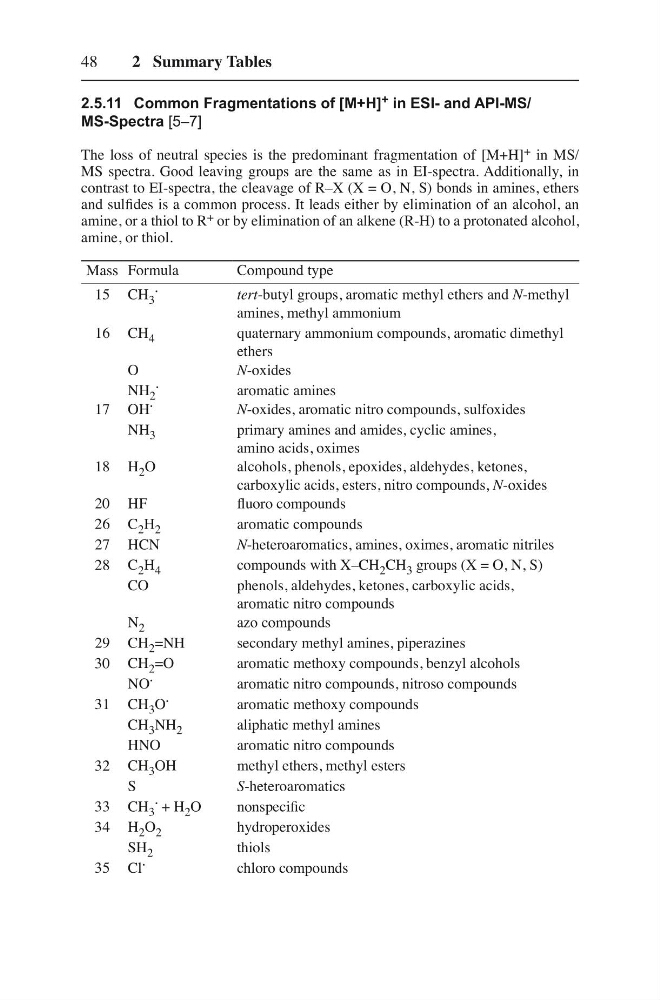
The loss of neutral species is the predominant fragmentation of [M+H] + in MS/
MS spectra. Good leaving groups are the same as in EI-spectra. Additionally, in
contrast to EI-spectra, the cleavage of R–X (X = O, N, S) bonds in amines, ethers
and sulfides is a common process. It leads either by elimination of an alcohol, an
amine, or a thiol to R + or by elimination of an alkene (R-H) to a protonated alcohol,
amine, or thiol.
Mass Formula
Compound type
15 CH 3
·
tert-butyl groups, aromatic methyl ethers and N-methyl
amines, methyl ammonium
16 CH 4
quaternary ammonium compounds, aromatic dimethyl
ethers
O
N-oxides
NH 2
·
aromatic amines
17 OH ·
N-oxides, aromatic nitro compounds, sulfoxides
NH 3
primary amines and amides, cyclic amines,
amino acids, oximes
18 H 2 O
alcohols, phenols, epoxides, aldehydes, ketones,
carboxylic acids, esters, nitro compounds, N-oxides
20 HF
fluoro compounds
26 C 2 H 2
aromatic compounds
27 HCN
N-heteroaromatics, amines, oximes, aromatic nitriles
28 C 2 H 4
compounds with X–CH 2 CH 3 groups (X = O, N, S)
CO
phenols, aldehydes, ketones, carboxylic acids,
aromatic nitro compounds
N 2
azo compounds
29 CH 2 =NH
secondary methyl amines, piperazines
30 CH 2 =O
aromatic methoxy compounds, benzyl alcohols
NO ·
aromatic nitro compounds, nitroso compounds
31 CH 3 O ·
aromatic methoxy compounds
CH 3 NH 2
aliphatic methyl amines
HNO
aromatic nitro compounds
32 CH 3 OH
methyl ethers, methyl esters
S
S-heteroaromatics
33 CH 3
· + H 2 O
nonspecific
34 H 2 O 2
hydroperoxides
SH 2
thiols
35 Cl ·
chloro compounds
2 Summary Tables
2.5.11 Common Fragmentations of [M+H] + in ESI- and API-MS/
MS-Spectra [5–7]
The loss of neutral species is the predominant fragmentation of [M+H] + in MS/
MS spectra. Good leaving groups are the same as in EI-spectra. Additionally, in
contrast to EI-spectra, the cleavage of R–X (X = O, N, S) bonds in amines, ethers
and sulfides is a common process. It leads either by elimination of an alcohol, an
amine, or a thiol to R + or by elimination of an alkene (R-H) to a protonated alcohol,
amine, or thiol.
Mass Formula
Compound type
15 CH 3
·
tert-butyl groups, aromatic methyl ethers and N-methyl
amines, methyl ammonium
16 CH 4
quaternary ammonium compounds, aromatic dimethyl
ethers
O
N-oxides
NH 2
·
aromatic amines
17 OH ·
N-oxides, aromatic nitro compounds, sulfoxides
NH 3
primary amines and amides, cyclic amines,
amino acids, oximes
18 H 2 O
alcohols, phenols, epoxides, aldehydes, ketones,
carboxylic acids, esters, nitro compounds, N-oxides
20 HF
fluoro compounds
26 C 2 H 2
aromatic compounds
27 HCN
N-heteroaromatics, amines, oximes, aromatic nitriles
28 C 2 H 4
compounds with X–CH 2 CH 3 groups (X = O, N, S)
CO
phenols, aldehydes, ketones, carboxylic acids,
aromatic nitro compounds
N 2
azo compounds
29 CH 2 =NH
secondary methyl amines, piperazines
30 CH 2 =O
aromatic methoxy compounds, benzyl alcohols
NO ·
aromatic nitro compounds, nitroso compounds
31 CH 3 O ·
aromatic methoxy compounds
CH 3 NH 2
aliphatic methyl amines
HNO
aromatic nitro compounds
32 CH 3 OH
methyl ethers, methyl esters
S
S-heteroaromatics
33 CH 3
· + H 2 O
nonspecific
34 H 2 O 2
hydroperoxides
SH 2
thiols
35 Cl ·
chloro compounds