

36
2 Summary Tables
2.5.8 Rules for Determining the Relative Molecular Weight (M r )
The molecular ion (M +· ) is defined as the ion that comprises the most abundant
isotopes of the elements in the molecule. Interestingly, the lightest isotopes of most
elements frequently occurring in organic compounds and their common salts (H, C,
N, O, F, Si, P, S, Cl, As, Br, I, Na, Mg, Al, K, Ca, Rb, Cs) are also the most abundant
ones. Notable exceptions are B, Li, Se, Sr, and Ba.
M +· is always accompanied by isotope peaks. Their relative abundance depends
on the number and kind of the elements present and their natural isotopic distribution.
The abundance of [M+1] +· indicates the maximum number of carbon atoms (C max )
according to the following relationship:
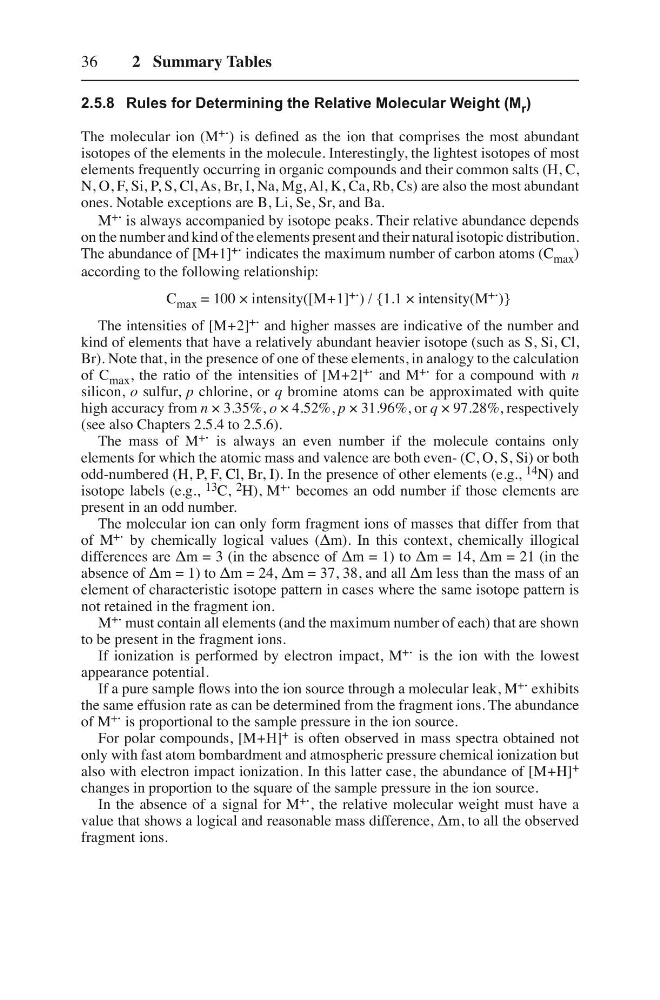
C max = 100 × intensity([M + 1] +· ) / {1.1 × intensity(M +· )}
The intensities of [M + 2] +· and higher masses are indicative of the number and
kind of elements that have a relatively abundant heavier isotope (such as S, Si, Cl,
Br). Note that, in the presence of one of these elements, in analogy to the calculation
of C max , the ratio of the intensities of [M + 2] +· and M +· for a compound with n
silicon, o sulfur, p chlorine, or q bromine atoms can be approximated with quite
high accuracy from n × 3.35%, o × 4.52%, p × 31.96%, or q × 97.28%, respectively
(see also Chapters 2.5.4 to 2.5.6).
The mass of M +· is always an even number if the molecule contains only
elements for which the atomic mass and valence are both even- (C, O, S, Si) or both
odd-numbered (H, P, F, Cl, Br, I). In the presence of other elements (e.g., 14 N) and
isotope labels (e.g., 13 C, 2 H), M +· becomes an odd number if those elements are
present in an odd number.
The molecular ion can only form fragment ions of masses that differ from that
of M +· by chemically logical values (Δm). In this context, chemically illogical
differences are Δm = 3 (in the absence of Δm = 1) to Δm = 14, Δm = 21 (in the
absence of Δm = 1) to Δm = 24, Δm = 37, 38, and all Δm less than the mass of an
element of characteristic isotope pattern in cases where the same isotope pattern is
not retained in the fragment ion.
M +· must contain all elements (and the maximum number of each) that are shown
to be present in the fragment ions.
If ionization is performed by electron impact, M +· is the ion with the lowest
appearance potential.
If a pure sample flows into the ion source through a molecular leak, M +· exhibits
the same effusion rate as can be determined from the fragment ions. The abundance
of M +· is proportional to the sample pressure in the ion source.
For polar compounds, [M + H] + is often observed in mass spectra obtained not
only with fast atom bombardment and atmospheric pressure chemical ionization but
also with electron impact ionization. In this latter case, the abundance of [M + H] +
changes in proportion to the square of the sample pressure in the ion source.
In the absence of a signal for M +· , the relative molecular weight must have a
value that shows a logical and reasonable mass difference, Δm, to all the observed
fragment ions.
2 Summary Tables
2.5.8 Rules for Determining the Relative Molecular Weight (M r )
The molecular ion (M +· ) is defined as the ion that comprises the most abundant
isotopes of the elements in the molecule. Interestingly, the lightest isotopes of most
elements frequently occurring in organic compounds and their common salts (H, C,
N, O, F, Si, P, S, Cl, As, Br, I, Na, Mg, Al, K, Ca, Rb, Cs) are also the most abundant
ones. Notable exceptions are B, Li, Se, Sr, and Ba.
M +· is always accompanied by isotope peaks. Their relative abundance depends
on the number and kind of the elements present and their natural isotopic distribution.
The abundance of [M+1] +· indicates the maximum number of carbon atoms (C max )
according to the following relationship:
C max = 100 × intensity([M + 1] +· ) / {1.1 × intensity(M +· )}
The intensities of [M + 2] +· and higher masses are indicative of the number and
kind of elements that have a relatively abundant heavier isotope (such as S, Si, Cl,
Br). Note that, in the presence of one of these elements, in analogy to the calculation
of C max , the ratio of the intensities of [M + 2] +· and M +· for a compound with n
silicon, o sulfur, p chlorine, or q bromine atoms can be approximated with quite
high accuracy from n × 3.35%, o × 4.52%, p × 31.96%, or q × 97.28%, respectively
(see also Chapters 2.5.4 to 2.5.6).
The mass of M +· is always an even number if the molecule contains only
elements for which the atomic mass and valence are both even- (C, O, S, Si) or both
odd-numbered (H, P, F, Cl, Br, I). In the presence of other elements (e.g., 14 N) and
isotope labels (e.g., 13 C, 2 H), M +· becomes an odd number if those elements are
present in an odd number.
The molecular ion can only form fragment ions of masses that differ from that
of M +· by chemically logical values (Δm). In this context, chemically illogical
differences are Δm = 3 (in the absence of Δm = 1) to Δm = 14, Δm = 21 (in the
absence of Δm = 1) to Δm = 24, Δm = 37, 38, and all Δm less than the mass of an
element of characteristic isotope pattern in cases where the same isotope pattern is
not retained in the fragment ion.
M +· must contain all elements (and the maximum number of each) that are shown
to be present in the fragment ions.
If ionization is performed by electron impact, M +· is the ion with the lowest
appearance potential.
If a pure sample flows into the ion source through a molecular leak, M +· exhibits
the same effusion rate as can be determined from the fragment ions. The abundance
of M +· is proportional to the sample pressure in the ion source.
For polar compounds, [M + H] + is often observed in mass spectra obtained not
only with fast atom bombardment and atmospheric pressure chemical ionization but
also with electron impact ionization. In this latter case, the abundance of [M + H] +
changes in proportion to the square of the sample pressure in the ion source.
In the absence of a signal for M +· , the relative molecular weight must have a
value that shows a logical and reasonable mass difference, Δm, to all the observed
fragment ions.