

N
X
C
Hal
O
N
S
P Si
Natural
Products
Solvents
C
C
C
C C
C
8.12 Miscellaneous Compounds
431
8.12 Miscellaneous Compounds
8.12.1 Trialkylsilyl Ethers [1,2]
Fragmentation: Loss of alkyl attached to Si (preferential loss of larger groups).
Cleavage of the C–C bond adjacent to O, followed by alkene elimination. Loss
of alkoxyl, followed by alkene eliminations. Elimination of trialkylsilanol. The
R 2 Si–OR' cation has the tendency to attack, in an electrophilic manner and even
over long distances, free electron pairs and π-electron centers, causing the expulsion
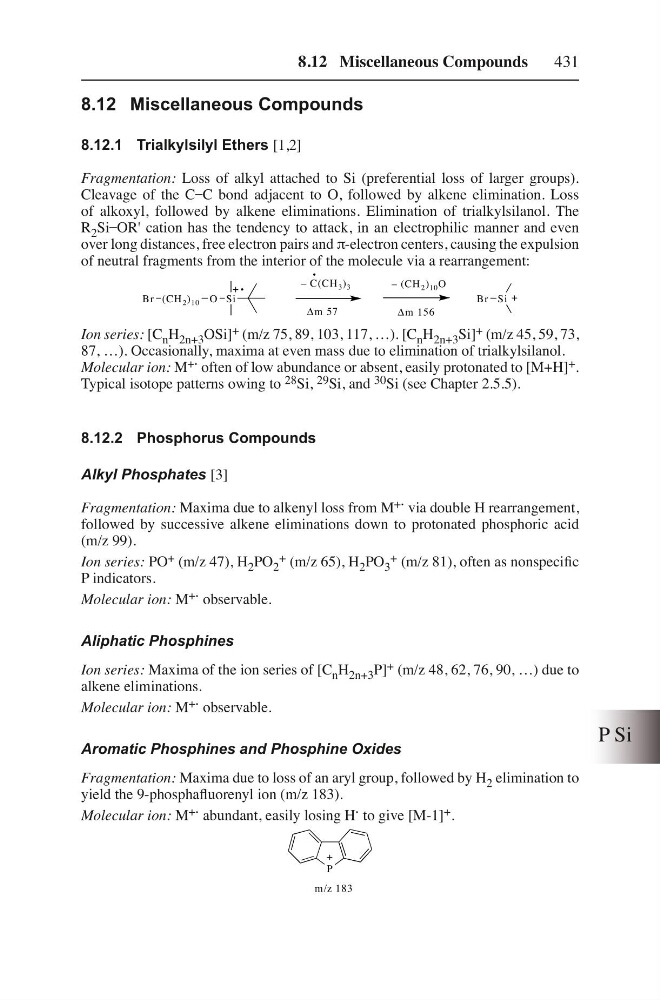
of neutral fragments from the interior of the molecule via a rearrangement:
O Si
(CH 2 ) 10
Br
Br Si +
– C(CH 3 ) 3
∆m 57
– (CH 2 ) 10 O
∆m 156
+ .
.
Ion series: [C n H 2n+3 OSi] + (m/z 75, 89, 103, 117, …). [C n H 2n+3 Si] + (m/z 45, 59, 73,
87, …). Occasionally, maxima at even mass due to elimination of trialkylsilanol.
Molecular ion: M +· often of low abundance or absent, easily protonated to [M+H] + .
Typical isotope patterns owing to 28 Si, 29 Si, and 30 Si (see Chapter 2.5.5).
8.12.2 Phosphorus Compounds
Alkyl Phosphates [3]
Fragmentation: Maxima due to alkenyl loss from M +· via double H rearrangement,
followed by successive alkene eliminations down to protonated phosphoric acid
(m/z 99).
Ion series: PO + (m/z 47), H 2 PO 2
+ (m/z 65), H 2 PO 3
+ (m/z 81), often as nonspecific
P indicators.
Molecular ion: M +· observable.
Aliphatic Phosphines
Ion series: Maxima of the ion series of [C n H 2n+3 P] + (m/z 48, 62, 76, 90, …) due to
alkene eliminations.
Molecular ion: M +· observable.
Aromatic Phosphines and Phosphine Oxides
Fragmentation: Maxima due to loss of an aryl group, followed by H 2 elimination to
yield the 9-phosphafluorenyl ion (m/z 183).
Molecular ion: M +· abundant, easily losing H · to give [M-1] + .
P
m/z 183
+
X
C
Hal
O
N
S
P Si
Natural
Products
Solvents
C
C
C
C C
C
8.12 Miscellaneous Compounds
431
8.12 Miscellaneous Compounds
8.12.1 Trialkylsilyl Ethers [1,2]
Fragmentation: Loss of alkyl attached to Si (preferential loss of larger groups).
Cleavage of the C–C bond adjacent to O, followed by alkene elimination. Loss
of alkoxyl, followed by alkene eliminations. Elimination of trialkylsilanol. The
R 2 Si–OR' cation has the tendency to attack, in an electrophilic manner and even
over long distances, free electron pairs and π-electron centers, causing the expulsion
of neutral fragments from the interior of the molecule via a rearrangement:
O Si
(CH 2 ) 10
Br
Br Si +
– C(CH 3 ) 3
∆m 57
– (CH 2 ) 10 O
∆m 156
+ .
.
Ion series: [C n H 2n+3 OSi] + (m/z 75, 89, 103, 117, …). [C n H 2n+3 Si] + (m/z 45, 59, 73,
87, …). Occasionally, maxima at even mass due to elimination of trialkylsilanol.
Molecular ion: M +· often of low abundance or absent, easily protonated to [M+H] + .
Typical isotope patterns owing to 28 Si, 29 Si, and 30 Si (see Chapter 2.5.5).
8.12.2 Phosphorus Compounds
Alkyl Phosphates [3]
Fragmentation: Maxima due to alkenyl loss from M +· via double H rearrangement,
followed by successive alkene eliminations down to protonated phosphoric acid
(m/z 99).
Ion series: PO + (m/z 47), H 2 PO 2
+ (m/z 65), H 2 PO 3
+ (m/z 81), often as nonspecific
P indicators.
Molecular ion: M +· observable.
Aliphatic Phosphines
Ion series: Maxima of the ion series of [C n H 2n+3 P] + (m/z 48, 62, 76, 90, …) due to
alkene eliminations.
Molecular ion: M +· observable.
Aromatic Phosphines and Phosphine Oxides
Fragmentation: Maxima due to loss of an aryl group, followed by H 2 elimination to
yield the 9-phosphafluorenyl ion (m/z 183).
Molecular ion: M +· abundant, easily losing H · to give [M-1] + .
P
m/z 183
+