

N
X
C
Hal
O
N
S
P Si
Natural
Products
Solvents
C
C
C
C C
C
8.11 Carbonyl Compounds
427
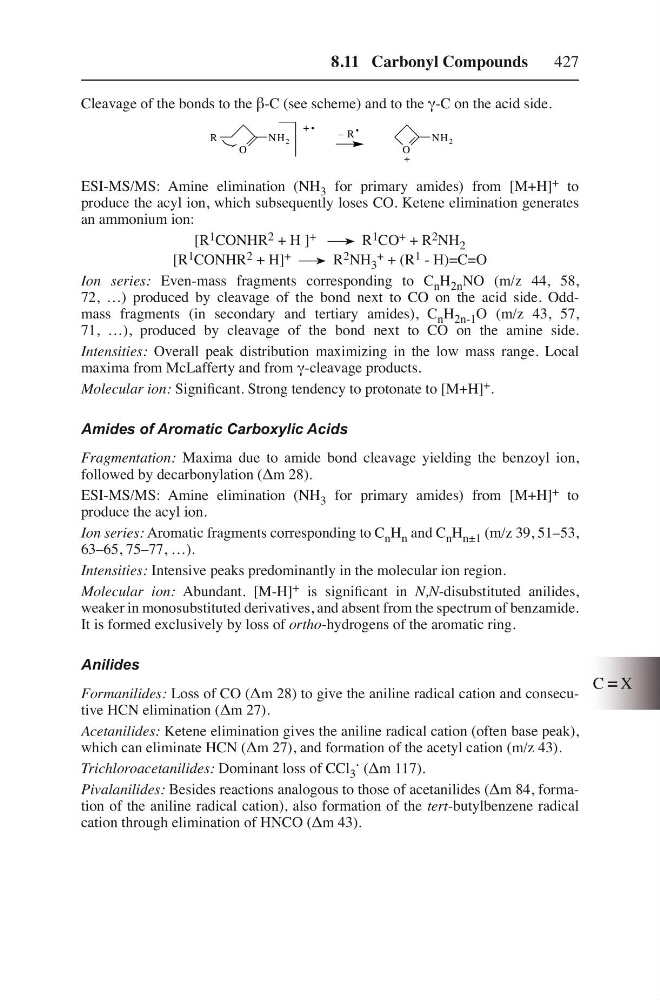
Cleavage of the bonds to the β-C (see scheme) and to the γ-C on the acid side.
O
R
N H 2
– R
.
O
NH 2
+
+ .
ESI-MS/MS: Amine elimination (NH 3 for primary amides) from [M+H] + to
produce the acyl ion, which subsequently loses CO. Ketene elimination generates
an ammonium ion:
[R 1 CONHR 2 + H ] +
R 1 CO + + R 2 NH 2
[R 1 CONHR 2 + H] +
R 2 NH 3
+ + (R 1 - H)=C=O
Ion series: Even-mass fragments corresponding to C n H 2n NO (m/z 44, 58,
72, …) produced by cleavage of the bond next to CO on the acid side. Oddmass fragments (in secondary and tertiary amides), C n H 2n-1 O (m/z 43, 57,
71, …), produced by cleavage of the bond next to CO on the amine side.
Intensities: Overall peak distribution maximizing in the low mass range. Local
maxima from McLafferty and from γ-cleavage products.
Molecular ion: Significant. Strong tendency to protonate to [M+H] + .
Amides of Aromatic Carboxylic Acids
Fragmentation: Maxima due to amide bond cleavage yielding the benzoyl ion,
followed by decarbonylation (Δm 28).
ESI-MS/MS: Amine elimination (NH 3 for primary amides) from [M+H] + to
produce the acyl ion.
Ion series: Aromatic fragments corresponding to C n H n and C n H n±1 (m/z 39, 51–53,
63–65, 75–77, …).
Intensities: Intensive peaks predominantly in the molecular ion region.
Molecular ion: Abundant. [M-H] + is significant in N,N-disubstituted anilides,
weaker in monosubstituted derivatives, and absent from the spectrum of benzamide.
It is formed exclusively by loss of ortho-hydrogens of the aromatic ring.
Anilides
Formanilides: Loss of CO (Δm 28) to give the aniline radical cation and consecutive HCN elimination (Δm 27).
Acetanilides: Ketene elimination gives the aniline radical cation (often base peak),
which can eliminate HCN (Δm 27), and formation of the acetyl cation (m/z 43).
Trichloroacetanilides: Dominant loss of CCl 3
· (Δm 117).
Pivalanilides: Besides reactions analogous to those of acetanilides (Δm 84, formation of the aniline radical cation), also formation of the tert-butylbenzene radical
cation through elimination of HNCO (Δm 43).
X
C
Hal
O
N
S
P Si
Natural
Products
Solvents
C
C
C
C C
C
8.11 Carbonyl Compounds
427
Cleavage of the bonds to the β-C (see scheme) and to the γ-C on the acid side.
O
R
N H 2
– R
.
O
NH 2
+
+ .
ESI-MS/MS: Amine elimination (NH 3 for primary amides) from [M+H] + to
produce the acyl ion, which subsequently loses CO. Ketene elimination generates
an ammonium ion:
[R 1 CONHR 2 + H ] +
R 1 CO + + R 2 NH 2
[R 1 CONHR 2 + H] +
R 2 NH 3
+ + (R 1 - H)=C=O
Ion series: Even-mass fragments corresponding to C n H 2n NO (m/z 44, 58,
72, …) produced by cleavage of the bond next to CO on the acid side. Oddmass fragments (in secondary and tertiary amides), C n H 2n-1 O (m/z 43, 57,
71, …), produced by cleavage of the bond next to CO on the amine side.
Intensities: Overall peak distribution maximizing in the low mass range. Local
maxima from McLafferty and from γ-cleavage products.
Molecular ion: Significant. Strong tendency to protonate to [M+H] + .
Amides of Aromatic Carboxylic Acids
Fragmentation: Maxima due to amide bond cleavage yielding the benzoyl ion,
followed by decarbonylation (Δm 28).
ESI-MS/MS: Amine elimination (NH 3 for primary amides) from [M+H] + to
produce the acyl ion.
Ion series: Aromatic fragments corresponding to C n H n and C n H n±1 (m/z 39, 51–53,
63–65, 75–77, …).
Intensities: Intensive peaks predominantly in the molecular ion region.
Molecular ion: Abundant. [M-H] + is significant in N,N-disubstituted anilides,
weaker in monosubstituted derivatives, and absent from the spectrum of benzamide.
It is formed exclusively by loss of ortho-hydrogens of the aromatic ring.
Anilides
Formanilides: Loss of CO (Δm 28) to give the aniline radical cation and consecutive HCN elimination (Δm 27).
Acetanilides: Ketene elimination gives the aniline radical cation (often base peak),
which can eliminate HCN (Δm 27), and formation of the acetyl cation (m/z 43).
Trichloroacetanilides: Dominant loss of CCl 3
· (Δm 117).
Pivalanilides: Besides reactions analogous to those of acetanilides (Δm 84, formation of the aniline radical cation), also formation of the tert-butylbenzene radical
cation through elimination of HNCO (Δm 43).