

30
2 Summary Tables
{p
12 C
Α
0
+ p
13 C
Α
1
} × {p
79 Br
Α
0
+ p
81 Br
Α
2
}
2
× {p
35 Cl
Α
0
+ p
37 Cl
Α
2
}
2
=
{ p
12 C
p
2
7 9 Br
p
2
3 5 Cl
} Α
0
+
{ p
13 C
p
2
7 9 Br
p
2
3 5 Cl
} Α
1
+
{ p
12 C
p
79 Br
p
81 Br
p
2
3 5 Cl
+ p
12 C
p
2
7 9 Br
p
35 Cl
p
37 Cl
} Α
2
+
{ p
13 C
p
79 Br
p
81 Br
p
2
3 5 Cl
+ p
13 C
p
2
7 9 Br
p
35 Cl
p
37 Cl
} Α
3
+
{ p
12 C
p
2
8 1 Br
p
2
3 5 Cl
+ 4 p
12 C
p
79 Br
p
81 Br
p
35 Cl
p
37 Cl
+ p
12 C
p
2
7 9 Br
p
2
3 7 Cl
} Α
4
+
{ p
13 C
p
2
8 1 Br
p
2
3 5 Cl
+ 4 p
13 C
p
79 Br
p
81 Br
p
35 Cl
p
37 Cl
+ p
13 C
p
2
7 9 Br
p
2
3 7 Cl
} Α
5
+
{ p
12 C
p
79 Br
p
81 Br
p
2
3 7 Cl
+ p
12 C
p
2
8 1 Br
p
35 Cl
p
37 Cl
} Α
6
+
{ p
13 C
p
79 Br
p
81 Br
p
2
3 7 Cl
+ p
13 C
p
2
8 1 Br
p
35 Cl
p
37 Cl
} Α
7
+
{ p
12 C
p
2
8 1 Br
p
2
3 7 Cl
} Α
8
+
{ p
13 C
p
2
8 1 Br
p
2
3 7 Cl
} Α
9
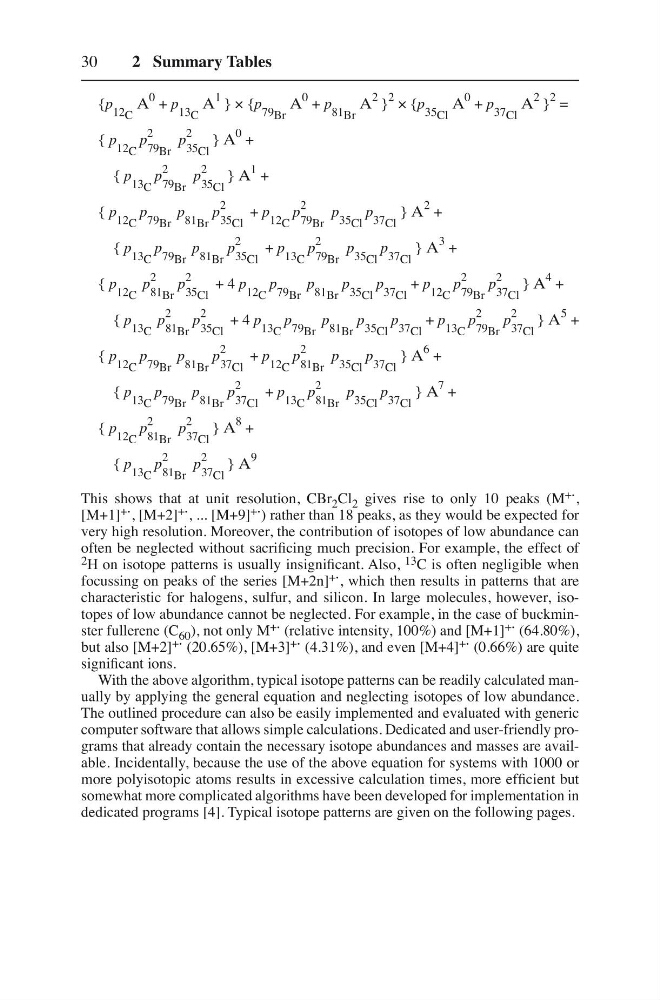
This shows that at unit resolution, CBr 2 Cl 2 gives rise to only 10 peaks (M +· ,
[M+1] +· , [M+2] +· , ... [M+9] +· ) rather than 18 peaks, as they would be expected for
very high resolution. Moreover, the contribution of isotopes of low abundance can
often be neglected without sacrificing much precision. For example, the effect of
2 H on isotope patterns is usually insignificant. Also, 13 C is often negligible when
focussing on peaks of the series [M+2n] +· , which then results in patterns that are
characteristic for halogens, sulfur, and silicon. In large molecules, however, isotopes of low abundance cannot be neglected. For example, in the case of buckminster fullerene (C 60 ), not only M +· (relative intensity, 100%) and [M+1] +· (64.80%),
but also [M+2] +· (20.65%), [M+3] +· (4.31%), and even [M+4] +· (0.66%) are quite
significant ions.
With the above algorithm, typical isotope patterns can be readily calculated manually by applying the general equation and neglecting isotopes of low abundance.
The outlined procedure can also be easily implemented and evaluated with generic
computer software that allows simple calculations. Dedicated and user-friendly programs that already contain the necessary isotope abundances and masses are available. Incidentally, because the use of the above equation for systems with 1000 or
more polyisotopic atoms results in excessive calculation times, more efficient but
somewhat more complicated algorithms have been developed for implementation in
dedicated programs [4]. Typical isotope patterns are given on the following pages.
2 Summary Tables
{p
12 C
Α
0
+ p
13 C
Α
1
} × {p
79 Br
Α
0
+ p
81 Br
Α
2
}
2
× {p
35 Cl
Α
0
+ p
37 Cl
Α
2
}
2
=
{ p
12 C
p
2
7 9 Br
p
2
3 5 Cl
} Α
0
+
{ p
13 C
p
2
7 9 Br
p
2
3 5 Cl
} Α
1
+
{ p
12 C
p
79 Br
p
81 Br
p
2
3 5 Cl
+ p
12 C
p
2
7 9 Br
p
35 Cl
p
37 Cl
} Α
2
+
{ p
13 C
p
79 Br
p
81 Br
p
2
3 5 Cl
+ p
13 C
p
2
7 9 Br
p
35 Cl
p
37 Cl
} Α
3
+
{ p
12 C
p
2
8 1 Br
p
2
3 5 Cl
+ 4 p
12 C
p
79 Br
p
81 Br
p
35 Cl
p
37 Cl
+ p
12 C
p
2
7 9 Br
p
2
3 7 Cl
} Α
4
+
{ p
13 C
p
2
8 1 Br
p
2
3 5 Cl
+ 4 p
13 C
p
79 Br
p
81 Br
p
35 Cl
p
37 Cl
+ p
13 C
p
2
7 9 Br
p
2
3 7 Cl
} Α
5
+
{ p
12 C
p
79 Br
p
81 Br
p
2
3 7 Cl
+ p
12 C
p
2
8 1 Br
p
35 Cl
p
37 Cl
} Α
6
+
{ p
13 C
p
79 Br
p
81 Br
p
2
3 7 Cl
+ p
13 C
p
2
8 1 Br
p
35 Cl
p
37 Cl
} Α
7
+
{ p
12 C
p
2
8 1 Br
p
2
3 7 Cl
} Α
8
+
{ p
13 C
p
2
8 1 Br
p
2
3 7 Cl
} Α
9
This shows that at unit resolution, CBr 2 Cl 2 gives rise to only 10 peaks (M +· ,
[M+1] +· , [M+2] +· , ... [M+9] +· ) rather than 18 peaks, as they would be expected for
very high resolution. Moreover, the contribution of isotopes of low abundance can
often be neglected without sacrificing much precision. For example, the effect of
2 H on isotope patterns is usually insignificant. Also, 13 C is often negligible when
focussing on peaks of the series [M+2n] +· , which then results in patterns that are
characteristic for halogens, sulfur, and silicon. In large molecules, however, isotopes of low abundance cannot be neglected. For example, in the case of buckminster fullerene (C 60 ), not only M +· (relative intensity, 100%) and [M+1] +· (64.80%),
but also [M+2] +· (20.65%), [M+3] +· (4.31%), and even [M+4] +· (0.66%) are quite
significant ions.
With the above algorithm, typical isotope patterns can be readily calculated manually by applying the general equation and neglecting isotopes of low abundance.
The outlined procedure can also be easily implemented and evaluated with generic
computer software that allows simple calculations. Dedicated and user-friendly programs that already contain the necessary isotope abundances and masses are available. Incidentally, because the use of the above equation for systems with 1000 or
more polyisotopic atoms results in excessive calculation times, more efficient but
somewhat more complicated algorithms have been developed for implementation in
dedicated programs [4]. Typical isotope patterns are given on the following pages.