

N
X
C
O
N
S
Hal
Solvents
Natural
Products
P Si
C
C
C C
C
C
406
8 Mass Spectrometry
Aromatic Azides [7]
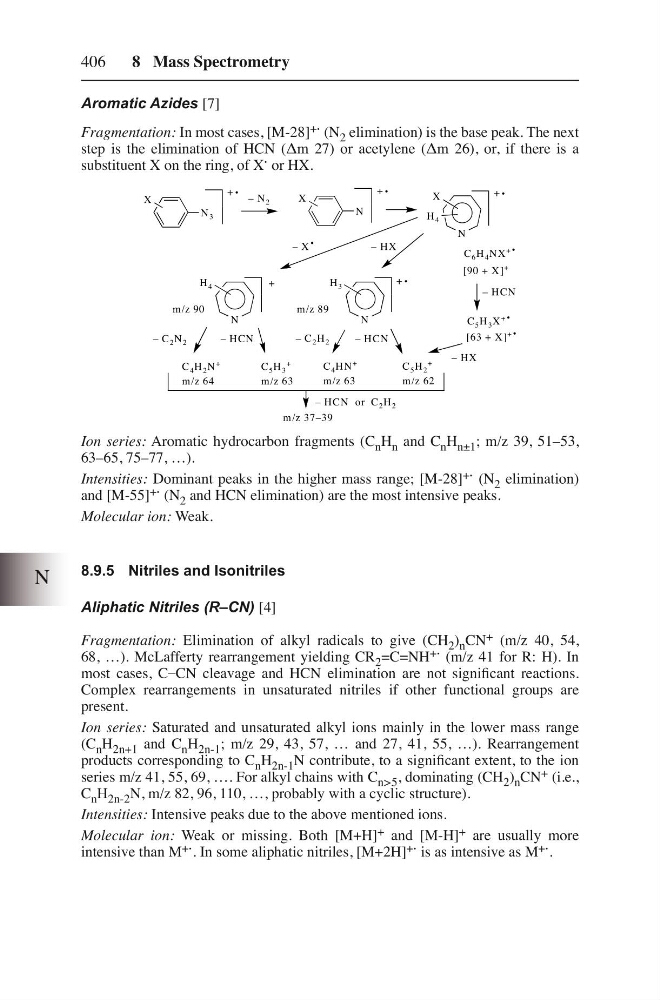
Fragmentation: In most cases, [M-28] +· (N 2 elimination) is the base peak. The next
step is the elimination of HCN (Δm 27) or acetylene (Δm 26), or, if there is a
substituent X on the ring, of X · or HX.
N 3
X
– N 2
N
X
N
X
N
+
H 4
N
H 3
C 6 H 4 N X
+ .
– H CN
C 5 H 3 X
+ .
m/z 90
m/z 89
– HX
– X
.
C 4 H 2 N
+
m/z 64
C 5 H 3
+
m/z 63
– C 2 N 2
– H CN
C 4 H N
+
m/z 63
C 5 H 2
+
m/z 62
– C 2 H 2
– H CN
– HX
– HCN or C 2 H 2
m /z 37–39
H 4
+ .
+ .
+ .
+ .
[63 + X ]
+ .
[90 + X ]
+
Ion series: Aromatic hydrocarbon fragments (C n H n and C n H n±1 ; m/z 39, 51–53,
63–65, 75–77, …).
Intensities: Dominant peaks in the higher mass range; [M-28] +· (N 2 elimination)
and [M-55] +· (N 2 and HCN elimination) are the most intensive peaks.
Molecular ion: Weak.
8.9.5 Nitriles and Isonitriles
Aliphatic Nitriles (R–CN) [4]
Fragmentation: Elimination of alkyl radicals to give (CH 2 ) n CN + (m/z 40, 54,
68, …). McLafferty rearrangement yielding CR 2 =C=NH +· (m/z 41 for R: H). In
most cases, C–CN cleavage and HCN elimination are not significant reactions.
Complex rearrangements in unsaturated nitriles if other functional groups are
present.
Ion series: Saturated and unsaturated alkyl ions mainly in the lower mass range
(C n H 2n+1 and C n H 2n-1 ; m/z 29, 43, 57, … and 27, 41, 55, …). Rearrangement
products corresponding to C n H 2n-1 N contribute, to a significant extent, to the ion
series m/z 41, 55, 69, …. For alkyl chains with C n > 5 , dominating (CH 2 ) n CN + (i.e.,
C n H 2n-2 N, m/z 82, 96, 110, …, probably with a cyclic structure).
Intensities: Intensive peaks due to the above mentioned ions.
Molecular ion: Weak or missing. Both [M+H] + and [M-H] + are usually more
intensive than M +· . In some aliphatic nitriles, [M+2H] +· is as intensive as M +· .
X
C
O
N
S
Hal
Solvents
Natural
Products
P Si
C
C
C C
C
C
406
8 Mass Spectrometry
Aromatic Azides [7]
Fragmentation: In most cases, [M-28] +· (N 2 elimination) is the base peak. The next
step is the elimination of HCN (Δm 27) or acetylene (Δm 26), or, if there is a
substituent X on the ring, of X · or HX.
N 3
X
– N 2
N
X
N
X
N
+
H 4
N
H 3
C 6 H 4 N X
+ .
– H CN
C 5 H 3 X
+ .
m/z 90
m/z 89
– HX
– X
.
C 4 H 2 N
+
m/z 64
C 5 H 3
+
m/z 63
– C 2 N 2
– H CN
C 4 H N
+
m/z 63
C 5 H 2
+
m/z 62
– C 2 H 2
– H CN
– HX
– HCN or C 2 H 2
m /z 37–39
H 4
+ .
+ .
+ .
+ .
[63 + X ]
+ .
[90 + X ]
+
Ion series: Aromatic hydrocarbon fragments (C n H n and C n H n±1 ; m/z 39, 51–53,
63–65, 75–77, …).
Intensities: Dominant peaks in the higher mass range; [M-28] +· (N 2 elimination)
and [M-55] +· (N 2 and HCN elimination) are the most intensive peaks.
Molecular ion: Weak.
8.9.5 Nitriles and Isonitriles
Aliphatic Nitriles (R–CN) [4]
Fragmentation: Elimination of alkyl radicals to give (CH 2 ) n CN + (m/z 40, 54,
68, …). McLafferty rearrangement yielding CR 2 =C=NH +· (m/z 41 for R: H). In
most cases, C–CN cleavage and HCN elimination are not significant reactions.
Complex rearrangements in unsaturated nitriles if other functional groups are
present.
Ion series: Saturated and unsaturated alkyl ions mainly in the lower mass range
(C n H 2n+1 and C n H 2n-1 ; m/z 29, 43, 57, … and 27, 41, 55, …). Rearrangement
products corresponding to C n H 2n-1 N contribute, to a significant extent, to the ion
series m/z 41, 55, 69, …. For alkyl chains with C n > 5 , dominating (CH 2 ) n CN + (i.e.,
C n H 2n-2 N, m/z 82, 96, 110, …, probably with a cyclic structure).
Intensities: Intensive peaks due to the above mentioned ions.
Molecular ion: Weak or missing. Both [M+H] + and [M-H] + are usually more
intensive than M +· . In some aliphatic nitriles, [M+2H] +· is as intensive as M +· .