

N
X
C
Hal
O
N
S
P Si
Natural
Products
Solvents
C
C
C
C C
C
8.8 Alcohols, Ethers, and Related Compounds
399
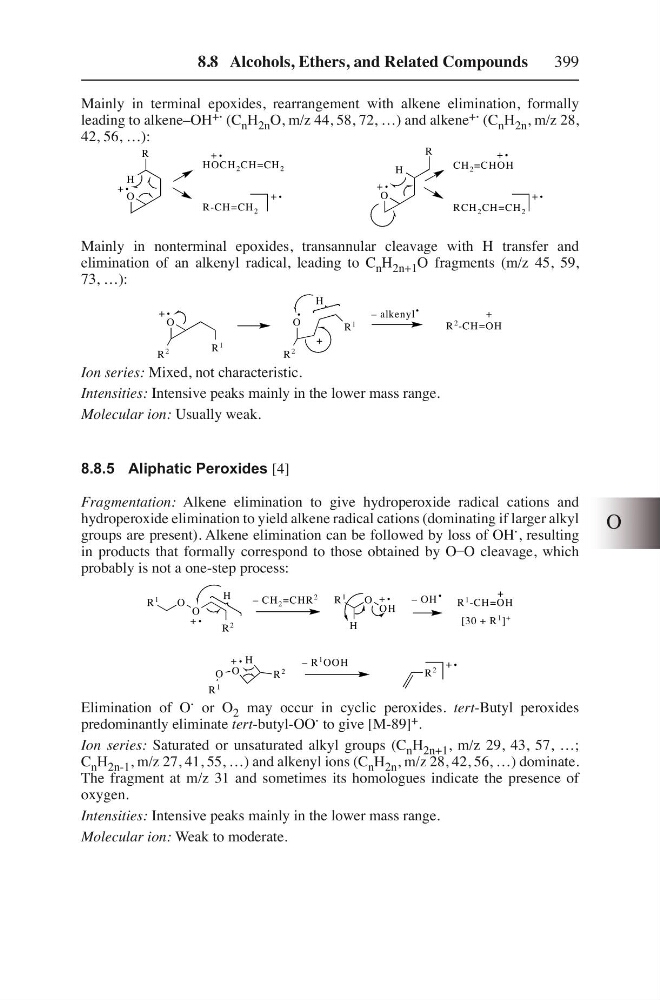
Mainly in terminal epoxides, rearrangement with alkene elimination, formally
leading to alkene–OH +· (C n H 2n O, m/z 44, 58, 72, …) and alkene +· (C n H 2n , m/z 28,
42, 56, …):
H
O
R
H OCH 2 CH =CH 2
R-CH =CH 2
H
O
CH 2 =CHO H
RCH 2 CH =CH 2
R
+ .
+ .
+ .
+ .
+ .
+ .
Mainly in nonterminal epoxides, transannular cleavage with H transfer and
elimination of an alkenyl radical, leading to C n H 2n+1 O fragments (m/z 45, 59,
73, …):
O
R
2
O
R
2
+
R
1
R
1
H
– alkenyl
.
R
2
-CH =OH
+
+ .
.
Ion series: Mixed, not characteristic.
Intensities: Intensive peaks mainly in the lower mass range.
Molecular ion: Usually weak.
8.8.5 Aliphatic Peroxides [4]
Fragmentation: Alkene elimination to give hydroperoxide radical cations and
hydroperoxide elimination to yield alkene radical cations (dominating if larger alkyl
groups are present). Alkene elimination can be followed by loss of OH · , resulting
in products that formally correspond to those obtained by O–O cleavage, which
probably is not a one-step process:
O O
R
2
R
1
-CH =OH
+
R
1
H
O O H
R
1
H
– CH 2 =CHR
2
[30 + R
1
]
+
– OH
.
– R
1
OO H
O
H
O
R
1
R
2
R
2
+ .
+ .
+ .
+ .
Elimination of O · or O 2 may occur in cyclic peroxides. tert-Butyl peroxides
predominantly eliminate tert-butyl-OO · to give [M-89] + .
Ion series: Saturated or unsaturated alkyl groups (C n H 2n+1 , m/z 29, 43, 57, …;
C n H 2n-1 , m/z 27, 41, 55, …) and alkenyl ions (C n H 2n , m/z 28, 42, 56, …) dominate.
The fragment at m/z 31 and sometimes its homologues indicate the presence of
oxygen.
Intensities: Intensive peaks mainly in the lower mass range.
Molecular ion: Weak to moderate.
X
C
Hal
O
N
S
P Si
Natural
Products
Solvents
C
C
C
C C
C
8.8 Alcohols, Ethers, and Related Compounds
399
Mainly in terminal epoxides, rearrangement with alkene elimination, formally
leading to alkene–OH +· (C n H 2n O, m/z 44, 58, 72, …) and alkene +· (C n H 2n , m/z 28,
42, 56, …):
H
O
R
H OCH 2 CH =CH 2
R-CH =CH 2
H
O
CH 2 =CHO H
RCH 2 CH =CH 2
R
+ .
+ .
+ .
+ .
+ .
+ .
Mainly in nonterminal epoxides, transannular cleavage with H transfer and
elimination of an alkenyl radical, leading to C n H 2n+1 O fragments (m/z 45, 59,
73, …):
O
R
2
O
R
2
+
R
1
R
1
H
– alkenyl
.
R
2
-CH =OH
+
+ .
.
Ion series: Mixed, not characteristic.
Intensities: Intensive peaks mainly in the lower mass range.
Molecular ion: Usually weak.
8.8.5 Aliphatic Peroxides [4]
Fragmentation: Alkene elimination to give hydroperoxide radical cations and
hydroperoxide elimination to yield alkene radical cations (dominating if larger alkyl
groups are present). Alkene elimination can be followed by loss of OH · , resulting
in products that formally correspond to those obtained by O–O cleavage, which
probably is not a one-step process:
O O
R
2
R
1
-CH =OH
+
R
1
H
O O H
R
1
H
– CH 2 =CHR
2
[30 + R
1
]
+
– OH
.
– R
1
OO H
O
H
O
R
1
R
2
R
2
+ .
+ .
+ .
+ .
Elimination of O · or O 2 may occur in cyclic peroxides. tert-Butyl peroxides
predominantly eliminate tert-butyl-OO · to give [M-89] + .
Ion series: Saturated or unsaturated alkyl groups (C n H 2n+1 , m/z 29, 43, 57, …;
C n H 2n-1 , m/z 27, 41, 55, …) and alkenyl ions (C n H 2n , m/z 28, 42, 56, …) dominate.
The fragment at m/z 31 and sometimes its homologues indicate the presence of
oxygen.
Intensities: Intensive peaks mainly in the lower mass range.
Molecular ion: Weak to moderate.