

N
X
C
Hal
O
N
S
P Si
Natural
Products
Solvents
C
C
C
C C
C
8.5 Aromatic Hydrocarbons
383
8.5 Aromatic Hydrocarbons [1–4]
Aromatic Hydrocarbons
Fragmentation: Weak tendency of fragmentation. Elimination of H · and successive
H 2 eliminations, yielding [M-1] + , [M-3] + , and [M-5] + of decreasing intensities. In
condensed aromatics, [M-2] +· can be a dominating fragment. Further typical fragmentation reactions are the eliminations of acetylene (Δm 26) and C 3 H 3 (Δm 39).
Some CH 3 elimination frequently occurs in pure aromatic compounds. In the case
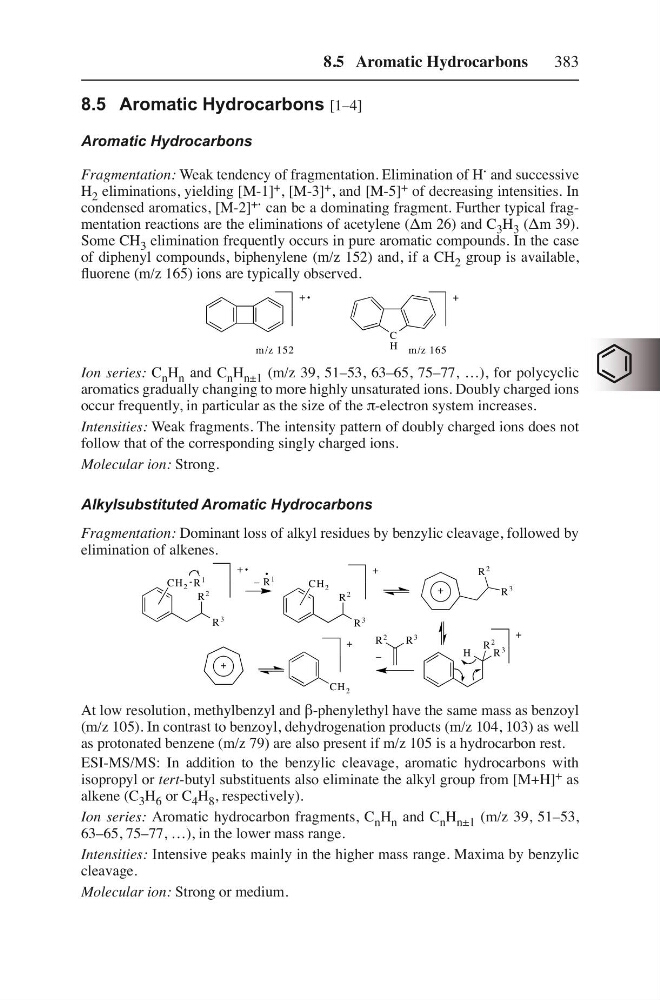
of diphenyl compounds, biphenylene (m/z 152) and, if a CH 2 group is available,
fluorene (m/z 165) ions are typically observed.
Ion series: C n H n and C n H n±1 (m/z 39, 51–53, 63–65, 75–77, …), for polycyclic
aromatics gradually changing to more highly unsaturated ions. Doubly charged ions
occur frequently, in particular as the size of the π-electron system increases.
Intensities: Weak fragments. The intensity pattern of doubly charged ions does not
follow that of the corresponding singly charged ions.
Molecular ion: Strong.
Alkylsubstituted Aromatic Hydrocarbons
Fragmentation: Dominant loss of alkyl residues by benzylic cleavage, followed by
elimination of alkenes.
CH 2 R
1
R
3
R
2
CH 2
R
3
R
2
+
– R
1
+
R
3
R
2
+
H
R
3
R
2
CH 2
+
–
R
2
R
3
+
+ . .
At low resolution, methylbenzyl and β-phenylethyl have the same mass as benzoyl
(m/z 105). In contrast to benzoyl, dehydrogenation products (m/z 104, 103) as well
as protonated benzene (m/z 79) are also present if m/z 105 is a hydrocarbon rest.
ESI-MS/MS: In addition to the benzylic cleavage, aromatic hydrocarbons with
isopropyl or tert-butyl substituents also eliminate the alkyl group from [M+H] + as
alkene (C 3 H 6 or C 4 H 8 , respectively).
Ion series: Aromatic hydrocarbon fragments, C n H n and C n H n±1 (m/z 39, 51–53,
63–65, 75–77, …), in the lower mass range.
Intensities: Intensive peaks mainly in the higher mass range. Maxima by benzylic
cleavage.
Molecular ion: Strong or medium.
C
+
m /z 152
m/z 165
H
+ .
X
C
Hal
O
N
S
P Si
Natural
Products
Solvents
C
C
C
C C
C
8.5 Aromatic Hydrocarbons
383
8.5 Aromatic Hydrocarbons [1–4]
Aromatic Hydrocarbons
Fragmentation: Weak tendency of fragmentation. Elimination of H · and successive
H 2 eliminations, yielding [M-1] + , [M-3] + , and [M-5] + of decreasing intensities. In
condensed aromatics, [M-2] +· can be a dominating fragment. Further typical fragmentation reactions are the eliminations of acetylene (Δm 26) and C 3 H 3 (Δm 39).
Some CH 3 elimination frequently occurs in pure aromatic compounds. In the case
of diphenyl compounds, biphenylene (m/z 152) and, if a CH 2 group is available,
fluorene (m/z 165) ions are typically observed.
Ion series: C n H n and C n H n±1 (m/z 39, 51–53, 63–65, 75–77, …), for polycyclic
aromatics gradually changing to more highly unsaturated ions. Doubly charged ions
occur frequently, in particular as the size of the π-electron system increases.
Intensities: Weak fragments. The intensity pattern of doubly charged ions does not
follow that of the corresponding singly charged ions.
Molecular ion: Strong.
Alkylsubstituted Aromatic Hydrocarbons
Fragmentation: Dominant loss of alkyl residues by benzylic cleavage, followed by
elimination of alkenes.
CH 2 R
1
R
3
R
2
CH 2
R
3
R
2
+
– R
1
+
R
3
R
2
+
H
R
3
R
2
CH 2
+
–
R
2
R
3
+
+ . .
At low resolution, methylbenzyl and β-phenylethyl have the same mass as benzoyl
(m/z 105). In contrast to benzoyl, dehydrogenation products (m/z 104, 103) as well
as protonated benzene (m/z 79) are also present if m/z 105 is a hydrocarbon rest.
ESI-MS/MS: In addition to the benzylic cleavage, aromatic hydrocarbons with
isopropyl or tert-butyl substituents also eliminate the alkyl group from [M+H] + as
alkene (C 3 H 6 or C 4 H 8 , respectively).
Ion series: Aromatic hydrocarbon fragments, C n H n and C n H n±1 (m/z 39, 51–53,
63–65, 75–77, …), in the lower mass range.
Intensities: Intensive peaks mainly in the higher mass range. Maxima by benzylic
cleavage.
Molecular ion: Strong or medium.
C
+
m /z 152
m/z 165
H
+ .