

N
X
C
Hal
O
N
S
P Si
Natural
Products
Solvents
C
C
C
C C
C
8.4 Alicyclics
381
Polycyclic Alicyclics
Fragmentation: Most important primary cleavage at highly branched carbon atoms,
followed by H rearrangements and complex fragmentations.
Ion series: With increasing number of rings, the position of unsaturated hydrocarbon
fragments in the upper m/z range shifts from C n H 2n-1 (m/z 41, 55, 69, 83, …) to
C n H 2n-3 (m/z 39, 53, 67, 81, …) and to C n H 2n-5 (m/z 51, 65, 79, 93, …). Typically,
maxima in the lower m/z range have a lower degree of unsaturation than those in
the upper m/z range.
Intensities: Major maxima evenly distributed, somewhat more intensive in the high
mass or M +· range.
Molecular ion: Strong.
Cyclohexenes
Fragmentation: Loss of larger ring substituents as well as retro-Diels–Alder reaction,
yielding fragments of even-mass maxima with one or two double-bond equivalents,
C n H 2n (m/z 42, 56, 70, 84, …) and C n H 2n-2 (m/z 40, 54, 68, 82, …), unless the
retro-Diels–Alder product corresponds to ethylene. Somewhat unexpectedly, the
base peak of cyclohexene is at [M-15] + .
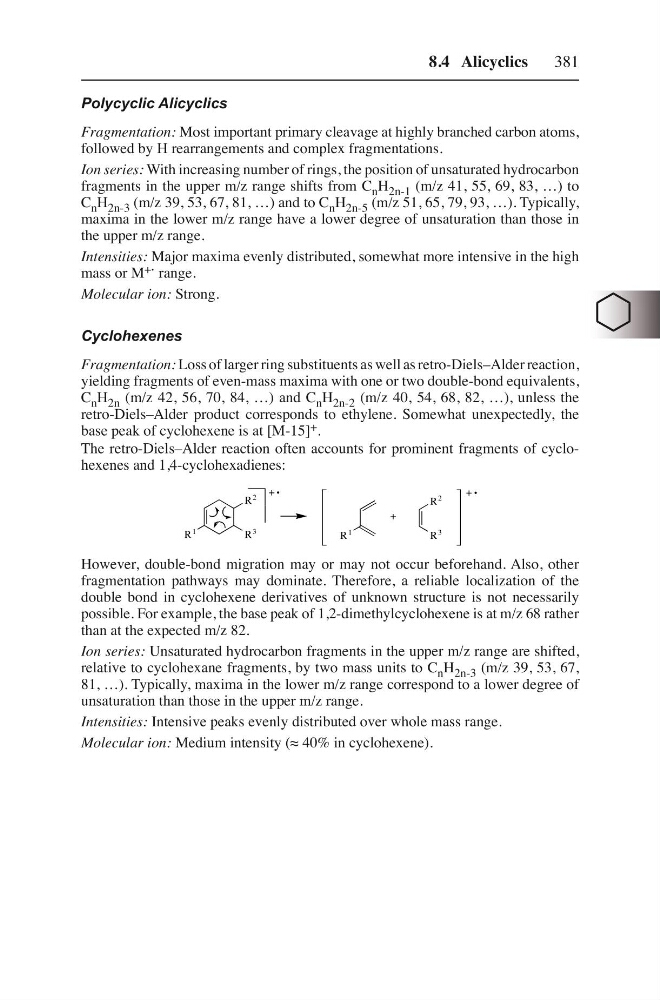
The retro-Diels–Alder reaction often accounts for prominent fragments of cyclohexenes and 1,4-cyclohexadienes:
R
2
+
R
2
R
1
R
3
R
3
R
1
+ .
+ .
However, double-bond migration may or may not occur beforehand. Also, other
fragmentation pathways may dominate. Therefore, a reliable localization of the
double bond in cyclohexene derivatives of unknown structure is not necessarily
possible. For example, the base peak of 1,2-dimethylcyclohexene is at m/z 68 rather
than at the expected m/z 82.
Ion series: Unsaturated hydrocarbon fragments in the upper m/z range are shifted,
relative to cyclohexane fragments, by two mass units to C n H 2n-3 (m/z 39, 53, 67,
81, …). Typically, maxima in the lower m/z range correspond to a lower degree of
unsaturation than those in the upper m/z range.
Intensities: Intensive peaks evenly distributed over whole mass range.
Molecular ion: Medium intensity (≈ 40% in cyclohexene).
X
C
Hal
O
N
S
P Si
Natural
Products
Solvents
C
C
C
C C
C
8.4 Alicyclics
381
Polycyclic Alicyclics
Fragmentation: Most important primary cleavage at highly branched carbon atoms,
followed by H rearrangements and complex fragmentations.
Ion series: With increasing number of rings, the position of unsaturated hydrocarbon
fragments in the upper m/z range shifts from C n H 2n-1 (m/z 41, 55, 69, 83, …) to
C n H 2n-3 (m/z 39, 53, 67, 81, …) and to C n H 2n-5 (m/z 51, 65, 79, 93, …). Typically,
maxima in the lower m/z range have a lower degree of unsaturation than those in
the upper m/z range.
Intensities: Major maxima evenly distributed, somewhat more intensive in the high
mass or M +· range.
Molecular ion: Strong.
Cyclohexenes
Fragmentation: Loss of larger ring substituents as well as retro-Diels–Alder reaction,
yielding fragments of even-mass maxima with one or two double-bond equivalents,
C n H 2n (m/z 42, 56, 70, 84, …) and C n H 2n-2 (m/z 40, 54, 68, 82, …), unless the
retro-Diels–Alder product corresponds to ethylene. Somewhat unexpectedly, the
base peak of cyclohexene is at [M-15] + .
The retro-Diels–Alder reaction often accounts for prominent fragments of cyclohexenes and 1,4-cyclohexadienes:
R
2
+
R
2
R
1
R
3
R
3
R
1
+ .
+ .
However, double-bond migration may or may not occur beforehand. Also, other
fragmentation pathways may dominate. Therefore, a reliable localization of the
double bond in cyclohexene derivatives of unknown structure is not necessarily
possible. For example, the base peak of 1,2-dimethylcyclohexene is at m/z 68 rather
than at the expected m/z 82.
Ion series: Unsaturated hydrocarbon fragments in the upper m/z range are shifted,
relative to cyclohexane fragments, by two mass units to C n H 2n-3 (m/z 39, 53, 67,
81, …). Typically, maxima in the lower m/z range correspond to a lower degree of
unsaturation than those in the upper m/z range.
Intensities: Intensive peaks evenly distributed over whole mass range.
Molecular ion: Medium intensity (≈ 40% in cyclohexene).