

N
X
C
Hal
O
N
S
P Si
Natural
Products
Solvents
C
C
C
C C
C
8.3 Alkynes
379
8.3 Alkynes [1]
Aliphatic Alkynes
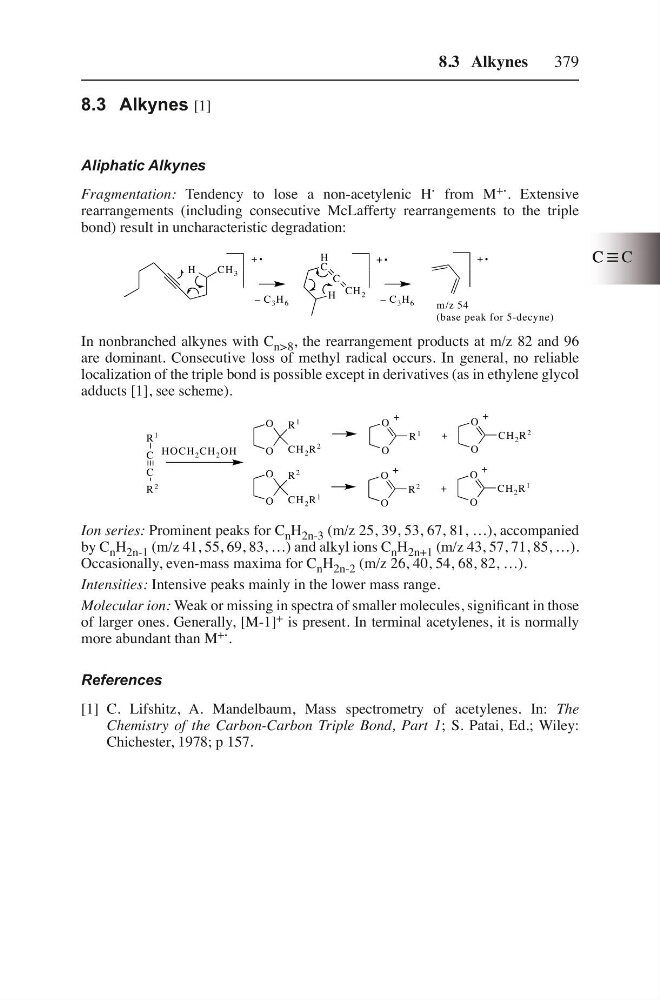
Fragmentation: Tendency to lose a non-acetylenic H · from M +· . Extensive
rearrangements (including consecutive McLafferty rearrangements to the triple
bond) result in uncharacteristic degradation:
H
CH 3
– C 3 H 6
CH 2
C
H
C
– C 3 H 6
H
m/z 54
(base peak for 5-decyne)
+ .
+ .
+ .
In nonbranched alkynes with C n > 8 , the rearrangement products at m/z 82 and 96
are dominant. Consecutive loss of methyl radical occurs. In general, no reliable
localization of the triple bond is possible except in derivatives (as in ethylene glycol
adducts [1], see scheme).
R
1
C
C
R
2
HO CH 2 CH 2 OH
O
O R
1
CH 2 R
2
O
O CH 2 R
1
R
2
+
O
O
R
1
+
O
O
CH 2 R
2
+
+
O
O
R
2
+
O
O
CH 2 R
1
+
Ion series: Prominent peaks for C n H 2n-3 (m/z 25, 39, 53, 67, 81, …), accompanied
by C n H 2n-1 (m/z 41, 55, 69, 83, …) and alkyl ions C n H 2n+1 (m/z 43, 57, 71, 85, …).
Occasionally, even-mass maxima for C n H 2n-2 (m/z 26, 40, 54, 68, 82, …).
Intensities: Intensive peaks mainly in the lower mass range.
Molecular ion: Weak or missing in spectra of smaller molecules, significant in those
of larger ones. Generally, [M-1] + is present. In terminal acetylenes, it is normally
more abundant than M +· .
References
[1] C. Lifshitz, A. Mandelbaum, Mass spectrometry of acetylenes. In: The
Chemistry of the Carbon-Carbon Triple Bond, Part 1; S. Patai, Ed.; Wiley:
Chichester, 1978; p 157.
X
C
Hal
O
N
S
P Si
Natural
Products
Solvents
C
C
C
C C
C
8.3 Alkynes
379
8.3 Alkynes [1]
Aliphatic Alkynes
Fragmentation: Tendency to lose a non-acetylenic H · from M +· . Extensive
rearrangements (including consecutive McLafferty rearrangements to the triple
bond) result in uncharacteristic degradation:
H
CH 3
– C 3 H 6
CH 2
C
H
C
– C 3 H 6
H
m/z 54
(base peak for 5-decyne)
+ .
+ .
+ .
In nonbranched alkynes with C n > 8 , the rearrangement products at m/z 82 and 96
are dominant. Consecutive loss of methyl radical occurs. In general, no reliable
localization of the triple bond is possible except in derivatives (as in ethylene glycol
adducts [1], see scheme).
R
1
C
C
R
2
HO CH 2 CH 2 OH
O
O R
1
CH 2 R
2
O
O CH 2 R
1
R
2
+
O
O
R
1
+
O
O
CH 2 R
2
+
+
O
O
R
2
+
O
O
CH 2 R
1
+
Ion series: Prominent peaks for C n H 2n-3 (m/z 25, 39, 53, 67, 81, …), accompanied
by C n H 2n-1 (m/z 41, 55, 69, 83, …) and alkyl ions C n H 2n+1 (m/z 43, 57, 71, 85, …).
Occasionally, even-mass maxima for C n H 2n-2 (m/z 26, 40, 54, 68, 82, …).
Intensities: Intensive peaks mainly in the lower mass range.
Molecular ion: Weak or missing in spectra of smaller molecules, significant in those
of larger ones. Generally, [M-1] + is present. In terminal acetylenes, it is normally
more abundant than M +· .
References
[1] C. Lifshitz, A. Mandelbaum, Mass spectrometry of acetylenes. In: The
Chemistry of the Carbon-Carbon Triple Bond, Part 1; S. Patai, Ed.; Wiley:
Chichester, 1978; p 157.