

N
X
C
Hal
O
N
S
P Si
Natural
Products
Solvents
C
C
C
C C
C
373
7.14 Solvents, Suspension Media, Interferences
373
7.14.3 Interferences in Infrared Spectra
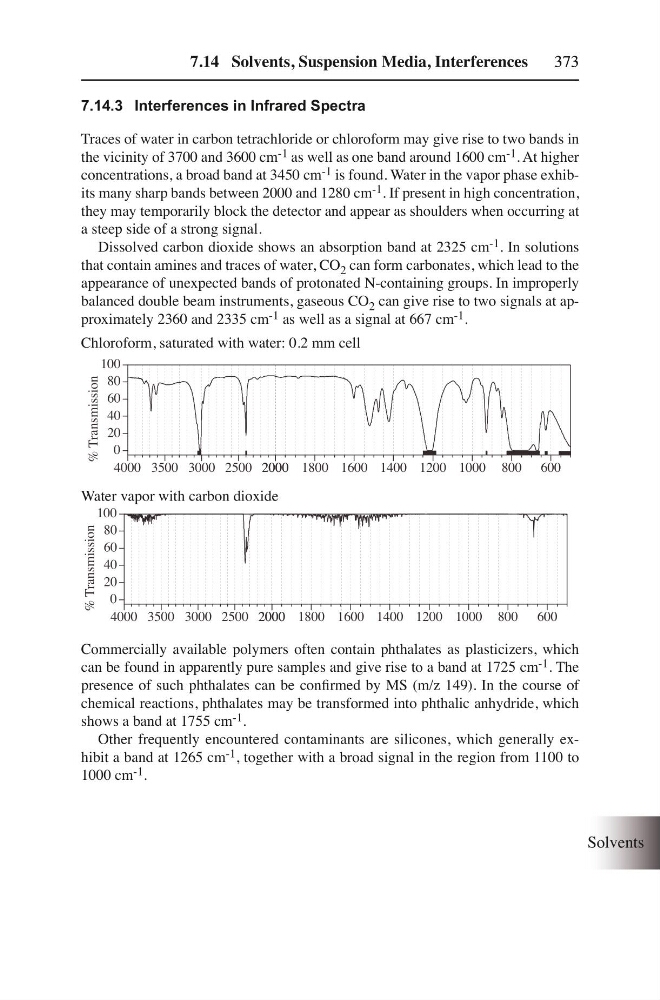
Traces of water in carbon tetrachloride or chloroform may give rise to two bands in
the vicinity of 3700 and 3600 cm -1 as well as one band around 1600 cm -1 . At higher
concentrations, a broad band at 3450 cm -1 is found. Water in the vapor phase exhibits many sharp bands between 2000 and 1280 cm -1 . If present in high concentration,
they may temporarily block the detector and appear as shoulders when occurring at
a steep side of a strong signal.
Dissolved carbon dioxide shows an absorption band at 2325 cm -1 . In solutions
that contain amines and traces of water, CO 2 can form carbonates, which lead to the
appearance of unexpected bands of protonated N-containing groups. In improperly
balanced double beam instruments, gaseous CO 2 can give rise to two signals at approximately 2360 and 2335 cm -1 as well as a signal at 667 cm -1 .
Chloroform, saturated with water: 0.2 mm cell
Water vapor with carbon dioxide
Commercially available polymers often contain phthalates as plasticizers, which
can be found in apparently pure samples and give rise to a band at 1725 cm -1 . The
presence of such phthalates can be confirmed by MS (m/z 149). In the course of
chemical reactions, phthalates may be transformed into phthalic anhydride, which
shows a band at 1755 cm -1 .
Other frequently encountered contaminants are silicones, which generally exhibit a band at 1265 cm -1 , together with a broad signal in the region from 1100 to
1000 cm -1 .
100
80
60
40
20
0
% Transmission
4000 3500 3000 2500 2000 2000 1800 1600 1400 1200 1000 800 600
100
80
60
40
20
0
% Transmission
4000 3500 3000 2500 2000 2000 1800 1600 1400 1200 1000 800 600
X
C
Hal
O
N
S
P Si
Natural
Products
Solvents
C
C
C
C C
C
373
7.14 Solvents, Suspension Media, Interferences
373
7.14.3 Interferences in Infrared Spectra
Traces of water in carbon tetrachloride or chloroform may give rise to two bands in
the vicinity of 3700 and 3600 cm -1 as well as one band around 1600 cm -1 . At higher
concentrations, a broad band at 3450 cm -1 is found. Water in the vapor phase exhibits many sharp bands between 2000 and 1280 cm -1 . If present in high concentration,
they may temporarily block the detector and appear as shoulders when occurring at
a steep side of a strong signal.
Dissolved carbon dioxide shows an absorption band at 2325 cm -1 . In solutions
that contain amines and traces of water, CO 2 can form carbonates, which lead to the
appearance of unexpected bands of protonated N-containing groups. In improperly
balanced double beam instruments, gaseous CO 2 can give rise to two signals at approximately 2360 and 2335 cm -1 as well as a signal at 667 cm -1 .
Chloroform, saturated with water: 0.2 mm cell
Water vapor with carbon dioxide
Commercially available polymers often contain phthalates as plasticizers, which
can be found in apparently pure samples and give rise to a band at 1725 cm -1 . The
presence of such phthalates can be confirmed by MS (m/z 149). In the course of
chemical reactions, phthalates may be transformed into phthalic anhydride, which
shows a band at 1755 cm -1 .
Other frequently encountered contaminants are silicones, which generally exhibit a band at 1265 cm -1 , together with a broad signal in the region from 1100 to
1000 cm -1 .
100
80
60
40
20
0
% Transmission
4000 3500 3000 2500 2000 2000 1800 1600 1400 1200 1000 800 600
100
80
60
40
20
0
% Transmission
4000 3500 3000 2500 2000 2000 1800 1600 1400 1200 1000 800 600