

N
X
C
O
N
S
Hal
Solvents
Natural
Products
P Si
C
C
C C
C
C
216
5 1 H NMR
5.9 Nitrogen Compounds
5.9.1 Amines
Amine and Ammonium Protons (δ in ppm, |J| in Hz)
Chemical shifts of amine protons lie around 0.5–6 ppm depending on solvent, concentration, and hydrogen bonding. Those of ammonium protons are found between
7 and 12 ppm. Neighboring H bond acceptors lead to deshielding in all cases.
Coupl ing of amine protons with vicinal H atoms is usually not seen in aliphatic
amines because of their rapid intermolecular exchange. However, for =C–NH–CH
moieties (enamines, aromatic amines, amides, etc.), the exchange rate is slower and
splitting (or line broadening at intermediate rates) is often observed. The H–C–N–H
coupling depends on the conformation in a similar way as the H–C–C–H coupling
(see Chapter 5.1.2). For N–CH 3 and N–CH 2 groups: 3 J HCNH ≈ 5–6 Hz.
In acidic media (e.g., in trifluoroacetic acid as solvent), the exchange of the ammonium protons is slowed down to such an extent that the vicinal coupling H–N + –
C–H generally becomes observable. In other media, signals are usually broad owing
to intermediate exchange rates.
The signals o f amine and especially of ammonium protons are often broadened additionally because the 14 N– 1 H coupling is only partly eliminated by the
quadrupole relaxation of 14 N (spin quantum number, I = 1; natural abundance,
99.6%; 1 J NH ≈ 60 Hz). This line broadening has no effect on the vicinal H–C–N–H
coupling so that sharp multiplets can be observed for neighboring H atoms even
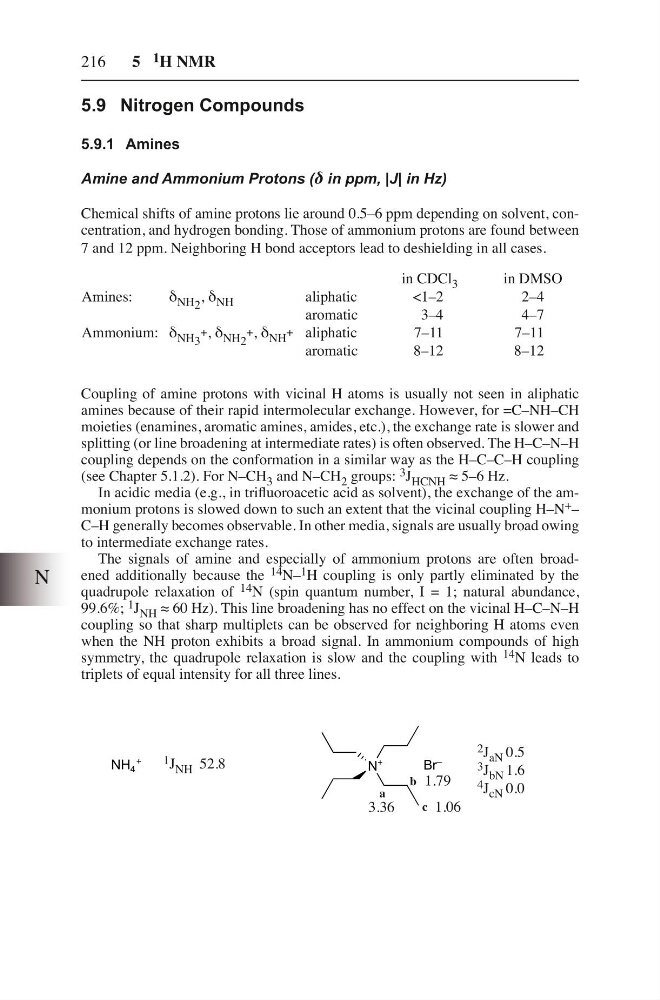
when the NH proton exhibits a broad signal. In ammonium compounds of high
symmetry, the quadrupole relaxation is slow and the coupling with 14 N leads to
triplets of equal intensity for all three lines.
Br
–
N
+
in CDCl 3
in DMSO
Amines:
δ NH 2
, δ NH
aliphatic
<1–2
2–4
aromatic
3–4
4–7
Ammonium: δ NH 3
+, δ NH 2
+, δ NH
+ aliphatic
7–11
7–11
aromatic
8–12
8–12
1 J NH 52.8
2 J aN 0.5
3 J bN 1.6
4 J cN 0.0
NH 4
+
3.36
1.79
1.06
a
b
c
X
C
O
N
S
Hal
Solvents
Natural
Products
P Si
C
C
C C
C
C
216
5 1 H NMR
5.9 Nitrogen Compounds
5.9.1 Amines
Amine and Ammonium Protons (δ in ppm, |J| in Hz)
Chemical shifts of amine protons lie around 0.5–6 ppm depending on solvent, concentration, and hydrogen bonding. Those of ammonium protons are found between
7 and 12 ppm. Neighboring H bond acceptors lead to deshielding in all cases.
Coupl ing of amine protons with vicinal H atoms is usually not seen in aliphatic
amines because of their rapid intermolecular exchange. However, for =C–NH–CH
moieties (enamines, aromatic amines, amides, etc.), the exchange rate is slower and
splitting (or line broadening at intermediate rates) is often observed. The H–C–N–H
coupling depends on the conformation in a similar way as the H–C–C–H coupling
(see Chapter 5.1.2). For N–CH 3 and N–CH 2 groups: 3 J HCNH ≈ 5–6 Hz.
In acidic media (e.g., in trifluoroacetic acid as solvent), the exchange of the ammonium protons is slowed down to such an extent that the vicinal coupling H–N + –
C–H generally becomes observable. In other media, signals are usually broad owing
to intermediate exchange rates.
The signals o f amine and especially of ammonium protons are often broadened additionally because the 14 N– 1 H coupling is only partly eliminated by the
quadrupole relaxation of 14 N (spin quantum number, I = 1; natural abundance,
99.6%; 1 J NH ≈ 60 Hz). This line broadening has no effect on the vicinal H–C–N–H
coupling so that sharp multiplets can be observed for neighboring H atoms even
when the NH proton exhibits a broad signal. In ammonium compounds of high
symmetry, the quadrupole relaxation is slow and the coupling with 14 N leads to
triplets of equal intensity for all three lines.
Br
–
N
+
in CDCl 3
in DMSO
Amines:
δ NH 2
, δ NH
aliphatic
<1–2
2–4
aromatic
3–4
4–7
Ammonium: δ NH 3
+, δ NH 2
+, δ NH
+ aliphatic
7–11
7–11
aromatic
8–12
8–12
1 J NH 52.8
2 J aN 0.5
3 J bN 1.6
4 J cN 0.0
NH 4
+
3.36
1.79
1.06
a
b
c