

N
X
C
Hal
O
N
S
P Si
Natural
Products
Solvents
C
C
C
C C
C
173
5.1 Alkanes
173
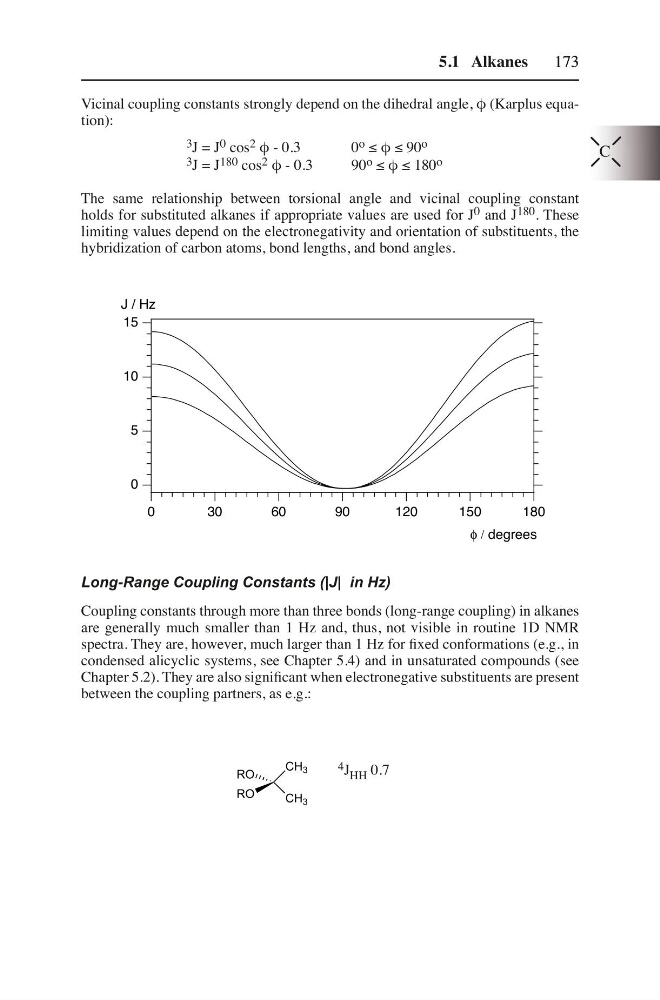
Vicinal coupling constants strongly depend on the dihedral angle, φ (Karplus equation):
3 J = J 0 cos 2 φ - 0.3
0 o ≤ φ ≤ 90 o
3 J = J 180 cos 2 φ - 0.3
90 o ≤ φ ≤ 180 o
The same relationship between torsional angle and vicinal coupling constant
holds for substituted alkanes if appropriate values are used for J 0 and J 180 . These
limiting values depend on the electronegativity and orientation of substituents, the
hybridization of carbon atoms, bond lengths, and bond angles.
Long-Range Coupling Constants (|J| in Hz)
Coupling constants through more than three bonds (long-range coupling) in alkanes
are generally much smaller than 1 Hz and, thus, not visible in routine 1D NMR
spectra. They are, however, much larger than 1 Hz for fixed conformations (e.g., in
condensed alicyclic systems, see Chapter 5.4) and in unsaturated compounds (see
Chapter 5.2). They are also significant when electronegative substituents are present
between the coupling partners, as e.g.:
4 J HH 0.7
CH 3
CH 3
RO
RO
15
10
5
0
J / Hz
180
150
120
90
60
30
0
φ / degrees
X
C
Hal
O
N
S
P Si
Natural
Products
Solvents
C
C
C
C C
C
173
5.1 Alkanes
173
Vicinal coupling constants strongly depend on the dihedral angle, φ (Karplus equation):
3 J = J 0 cos 2 φ - 0.3
0 o ≤ φ ≤ 90 o
3 J = J 180 cos 2 φ - 0.3
90 o ≤ φ ≤ 180 o
The same relationship between torsional angle and vicinal coupling constant
holds for substituted alkanes if appropriate values are used for J 0 and J 180 . These
limiting values depend on the electronegativity and orientation of substituents, the
hybridization of carbon atoms, bond lengths, and bond angles.
Long-Range Coupling Constants (|J| in Hz)
Coupling constants through more than three bonds (long-range coupling) in alkanes
are generally much smaller than 1 Hz and, thus, not visible in routine 1D NMR
spectra. They are, however, much larger than 1 Hz for fixed conformations (e.g., in
condensed alicyclic systems, see Chapter 5.4) and in unsaturated compounds (see
Chapter 5.2). They are also significant when electronegative substituents are present
between the coupling partners, as e.g.:
4 J HH 0.7
CH 3
CH 3
RO
RO
15
10
5
0
J / Hz
180
150
120
90
60
30
0
φ / degrees