

N
X
C
O
N
S
Hal
Solvents
Natural
Products
P Si
C
C
C C
C
C
88
4 13 C NMR
The values listed on the preceding page can also be used to estimate the 13 C chemical shifts of sp 2 -hybridized carbon atoms in alkenes with more than one substituent
(note that the cis/trans configuration is not taken into account):
δ C i
= 123.3 + ∑ Z i
Example: Estimation of chemical shifts of 1-bromo-1-propene
a base value
123.3
b base value
123.3
Z 1 (Br)
-8.6
Z 2 (Br)
-0.9
Z 2 (CH 3 )
-7.4
Z 1 (CH 3 )
12.9
estimated
107.3
estimated
135.3
exp
108.9 (cis)
exp
129.4 (cis)
104.7 (trans)
132.7 (trans)
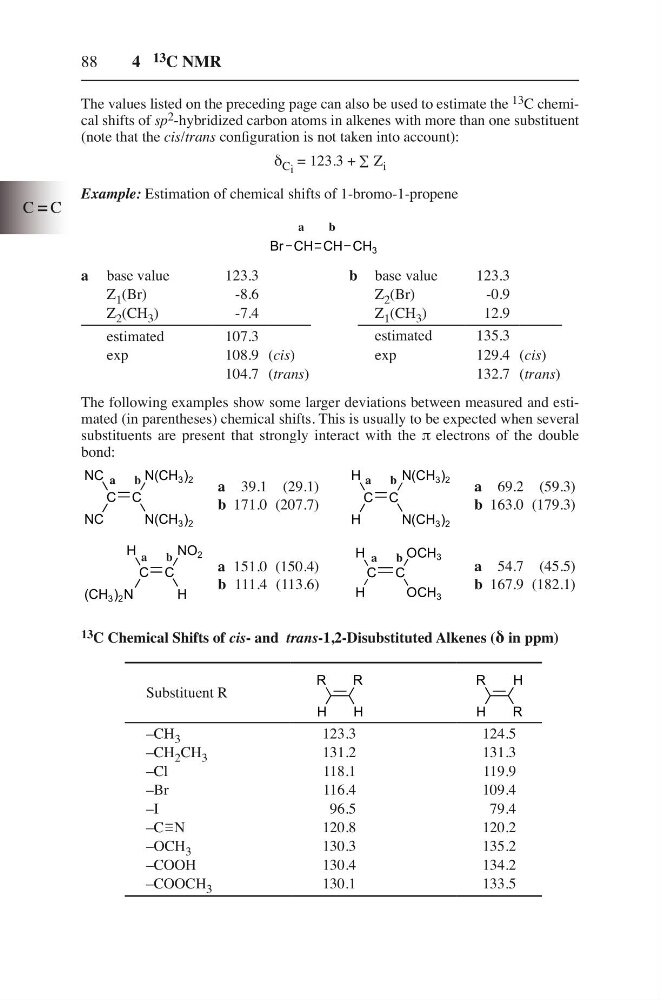
The following examples show some larger deviations between measured and estimated (in parentheses) chemical shifts. This is usually to be expected when several
substituents are present that strongly interact with the π electrons of the double
bond:
13 C Chemical Shifts of cis- and trans-1,2-Disubstituted Alkenes (δ in ppm)
C C
(CH 3 ) 2 N
H
NO 2
H
a
b
Substituent R
–CH 3
123.3
124.5
–CH 2 CH 3
131.2
131.3
–Cl
118.1
119.9
–Br
116.4
109.4
–I
96.5
79.4
–C– – – N
120.8
120.2
–OCH 3
130.3
135.2
–COOH
130.4
134.2
–COOCH 3
130.1
133.5
R
H
R
H
H
H
R
R
C C
NC
NC
N(CH 3 ) 2
N(CH 3 ) 2
C C
H
H
N(CH 3 ) 2
N(CH 3 ) 2
C C
H
H
OCH 3
OCH 3
a 39.1 (29.1)
b 171.0 (207.7)
a 69.2 (59.3)
b 163.0 (179.3)
a 151.0 (150.4)
b 111.4 (113.6)
a 54.7 (45.5)
b 167.9 (182.1)
a
b
a
b
a
b
a
b
Br CH CH CH 3
X
C
O
N
S
Hal
Solvents
Natural
Products
P Si
C
C
C C
C
C
88
4 13 C NMR
The values listed on the preceding page can also be used to estimate the 13 C chemical shifts of sp 2 -hybridized carbon atoms in alkenes with more than one substituent
(note that the cis/trans configuration is not taken into account):
δ C i
= 123.3 + ∑ Z i
Example: Estimation of chemical shifts of 1-bromo-1-propene
a base value
123.3
b base value
123.3
Z 1 (Br)
-8.6
Z 2 (Br)
-0.9
Z 2 (CH 3 )
-7.4
Z 1 (CH 3 )
12.9
estimated
107.3
estimated
135.3
exp
108.9 (cis)
exp
129.4 (cis)
104.7 (trans)
132.7 (trans)
The following examples show some larger deviations between measured and estimated (in parentheses) chemical shifts. This is usually to be expected when several
substituents are present that strongly interact with the π electrons of the double
bond:
13 C Chemical Shifts of cis- and trans-1,2-Disubstituted Alkenes (δ in ppm)
C C
(CH 3 ) 2 N
H
NO 2
H
a
b
Substituent R
–CH 3
123.3
124.5
–CH 2 CH 3
131.2
131.3
–Cl
118.1
119.9
–Br
116.4
109.4
–I
96.5
79.4
–C– – – N
120.8
120.2
–OCH 3
130.3
135.2
–COOH
130.4
134.2
–COOCH 3
130.1
133.5
R
H
R
H
H
H
R
R
C C
NC
NC
N(CH 3 ) 2
N(CH 3 ) 2
C C
H
H
N(CH 3 ) 2
N(CH 3 ) 2
C C
H
H
OCH 3
OCH 3
a 39.1 (29.1)
b 171.0 (207.7)
a 69.2 (59.3)
b 163.0 (179.3)
a 151.0 (150.4)
b 111.4 (113.6)
a 54.7 (45.5)
b 167.9 (182.1)
a
b
a
b
a
b
a
b
Br CH CH CH 3