

assessed by the criteria including investment cost, expansion possibility, closeness to
demand market, availability of acquirement material, and human resources.
Løken and Botterud (2005) solved the location problem of distribution centers in
an energy industry. To this end, first, the performance of alternatives in the five
criteria was separately calculated through the multi-criteria utility theory and AHP
methods, and then by comparison of the results of the two methods, the best location
was selected. Investment and operation costs, heat dump from plants to the environment, and NOx and CO 2 emissions were the criteria used in that study. Wang and
Kao (2007) in a research determined the best location of distribution centers in
logistics companies. The rank of alternatives in that research was calculated by the
fuzzy technique for order of preference by similarity to ideal solution (TOPSIS).
Climate conditions, demand quantity, expansion possibility, investment cost, labor
force quality, and transportation availability were among the criteria used to assess
places in that research.
Lee and Lin (2008) identified the best location of international distribution
centers in Asia using strengths, weaknesses, opportunities, and threats (SWOT)
analysis and AHP in fuzzy environment. Fifteen criteria including information
abilities, transshipment time, port and warehouse facilities, port operation legal
guarantee, export and import volume, density of shipping line, transshipment
volume, and political, economic, society stability were used to determine the performance of candidate places in that study. Anagnostopoulos et al. (2008) proposed a
multi-criteria algorithm based on linguistic variables to determine the optimal
location of distribution centers. The proposed algorithm works based on TOPSIS.
In that research, the rank of alternatives was analyzed by six criteria including
expansion possibility, square measure of area, investment cost, availability of
acquirement material, closeness to demand market, and human resources.
In a study conducted by Ou and Chou (2009), the location of an international
distribution center was determined based on six criteria including market potential,
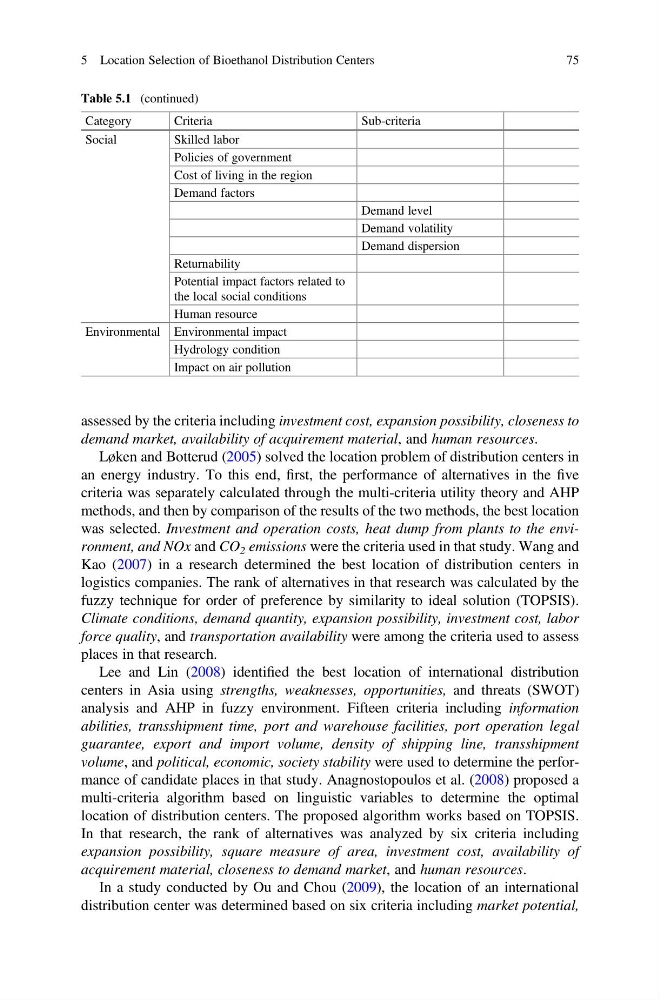
Table 5.1 (continued)
Category
Criteria
Sub-criteria
Social
Skilled labor
Policies of government
Cost of living in the region
Demand factors
Demand level
Demand volatility
Demand dispersion
Returnability
Potential impact factors related to
the local social conditions
Human resource
Environmental Environmental impact
Hydrology condition
Impact on air pollution
5 Location Selection of Bioethanol Distribution Centers
75
demand market, availability of acquirement material, and human resources.
Løken and Botterud (2005) solved the location problem of distribution centers in
an energy industry. To this end, first, the performance of alternatives in the five
criteria was separately calculated through the multi-criteria utility theory and AHP
methods, and then by comparison of the results of the two methods, the best location
was selected. Investment and operation costs, heat dump from plants to the environment, and NOx and CO 2 emissions were the criteria used in that study. Wang and
Kao (2007) in a research determined the best location of distribution centers in
logistics companies. The rank of alternatives in that research was calculated by the
fuzzy technique for order of preference by similarity to ideal solution (TOPSIS).
Climate conditions, demand quantity, expansion possibility, investment cost, labor
force quality, and transportation availability were among the criteria used to assess
places in that research.
Lee and Lin (2008) identified the best location of international distribution
centers in Asia using strengths, weaknesses, opportunities, and threats (SWOT)
analysis and AHP in fuzzy environment. Fifteen criteria including information
abilities, transshipment time, port and warehouse facilities, port operation legal
guarantee, export and import volume, density of shipping line, transshipment
volume, and political, economic, society stability were used to determine the performance of candidate places in that study. Anagnostopoulos et al. (2008) proposed a
multi-criteria algorithm based on linguistic variables to determine the optimal
location of distribution centers. The proposed algorithm works based on TOPSIS.
In that research, the rank of alternatives was analyzed by six criteria including
expansion possibility, square measure of area, investment cost, availability of
acquirement material, closeness to demand market, and human resources.
In a study conducted by Ou and Chou (2009), the location of an international
distribution center was determined based on six criteria including market potential,
Table 5.1 (continued)
Category
Criteria
Sub-criteria
Social
Skilled labor
Policies of government
Cost of living in the region
Demand factors
Demand level
Demand volatility
Demand dispersion
Returnability
Potential impact factors related to
the local social conditions
Human resource
Environmental Environmental impact
Hydrology condition
Impact on air pollution
5 Location Selection of Bioethanol Distribution Centers
75