

1 Introduction
Biofuel produced from urban and industrial waste, crops, and remains of forests is
generally categorized into three groups including gas, liquid, and solid (Ben-Iwo
et al. 2016). Coping with air pollution which usually originates from fossil fuels is
one of the most important features of biofuels (Prasad et al. 2012). From among the
three categories, the demand for liquid biofuels due to high flexibility in consumption and also the ability to use in transportation sector is significantly increasing in
today’s world. Ethanol is employed in a variety of industries such as chemical,
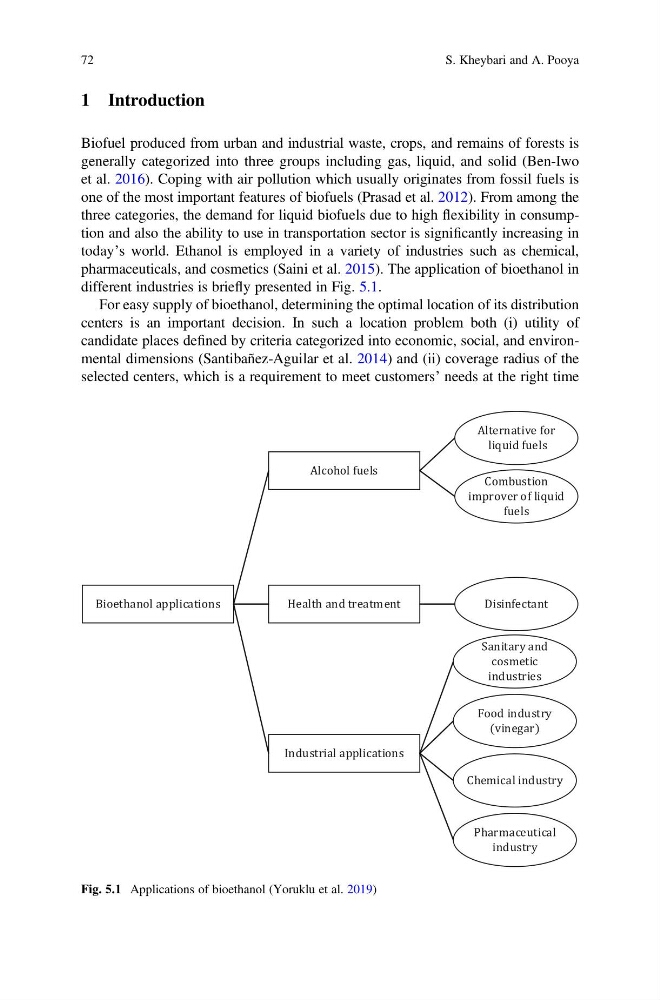
pharmaceuticals, and cosmetics (Saini et al. 2015). The application of bioethanol in
different industries is briefly presented in Fig. 5.1.
For easy supply of bioethanol, determining the optimal location of its distribution
centers is an important decision. In such a location problem both (i) utility of
candidate places defined by criteria categorized into economic, social, and environmental dimensions (Santibañez-Aguilar et al. 2014) and (ii) coverage radius of the
selected centers, which is a requirement to meet customers’ needs at the right time
Fig. 5.1 Applications of bioethanol (Yoruklu et al. 2019)
72
S. Kheybari and A. Pooya
Biofuel produced from urban and industrial waste, crops, and remains of forests is
generally categorized into three groups including gas, liquid, and solid (Ben-Iwo
et al. 2016). Coping with air pollution which usually originates from fossil fuels is
one of the most important features of biofuels (Prasad et al. 2012). From among the
three categories, the demand for liquid biofuels due to high flexibility in consumption and also the ability to use in transportation sector is significantly increasing in
today’s world. Ethanol is employed in a variety of industries such as chemical,
pharmaceuticals, and cosmetics (Saini et al. 2015). The application of bioethanol in
different industries is briefly presented in Fig. 5.1.
For easy supply of bioethanol, determining the optimal location of its distribution
centers is an important decision. In such a location problem both (i) utility of
candidate places defined by criteria categorized into economic, social, and environmental dimensions (Santibañez-Aguilar et al. 2014) and (ii) coverage radius of the
selected centers, which is a requirement to meet customers’ needs at the right time
Fig. 5.1 Applications of bioethanol (Yoruklu et al. 2019)
72
S. Kheybari and A. Pooya