

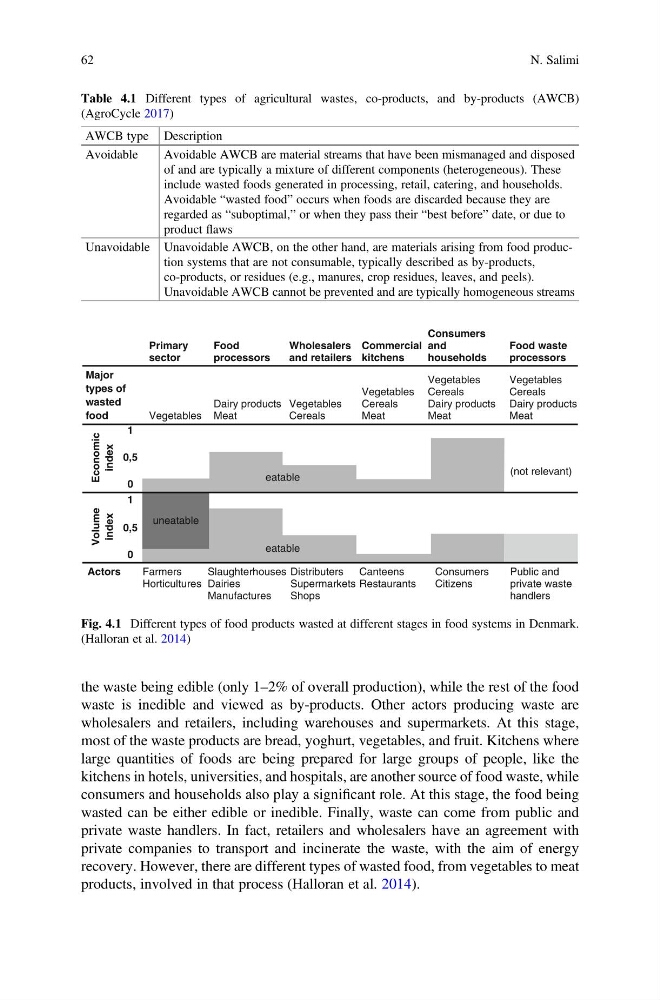
the waste being edible (only 1–2% of overall production), while the rest of the food
waste is inedible and viewed as by-products. Other actors producing waste are
wholesalers and retailers, including warehouses and supermarkets. At this stage,
most of the waste products are bread, yoghurt, vegetables, and fruit. Kitchens where
large quantities of foods are being prepared for large groups of people, like the
kitchens in hotels, universities, and hospitals, are another source of food waste, while
consumers and households also play a significant role. At this stage, the food being
wasted can be either edible or inedible. Finally, waste can come from public and
private waste handlers. In fact, retailers and wholesalers have an agreement with
private companies to transport and incinerate the waste, with the aim of energy
recovery. However, there are different types of wasted food, from vegetables to meat
products, involved in that process (Halloran et al. 2014).
Table 4.1 Different types of agricultural wastes, co-products, and by-products (AWCB)
(AgroCycle 2017)
AWCB type Description
Avoidable
Avoidable AWCB are material streams that have been mismanaged and disposed
of and are typically a mixture of different components (heterogeneous). These
include wasted foods generated in processing, retail, catering, and households.
Avoidable “wasted food” occurs when foods are discarded because they are
regarded as “suboptimal,” or when they pass their “best before” date, or due to
product flaws
Unavoidable Unavoidable AWCB, on the other hand, are materials arising from food production systems that are not consumable, typically described as by-products,
co-products, or residues (e.g., manures, crop residues, leaves, and peels).
Unavoidable AWCB cannot be prevented and are typically homogeneous streams
Major
types of
wasted
food
1
1
0
0,5
0
0,5
Primary
sector
Actors
Farmers
Horticultures
Slaughterhouses
Dairies
Manufactures
Canteens
Restaurants
Distributers
Supermarkets
Shops
Consumers
Citizens
Public and
private waste
handlers
(not relevant)
eatable
eatable
uneatable
Food
processors
Wholesalers
and retailers
Commercial
kitchens
Food waste
processors
Consumers
and
households
Vegetables
Dairy products
Meat
Vegetables
Cereals
Vegetables
Cereals
Meat
Vegetables
Cereals
Dairy products
Meat
Vegetables
Cereals
Dairy products
Meat
Economic
index
Volume
index
Fig. 4.1 Different types of food products wasted at different stages in food systems in Denmark.
(Halloran et al. 2014)
62
N. Salimi
waste is inedible and viewed as by-products. Other actors producing waste are
wholesalers and retailers, including warehouses and supermarkets. At this stage,
most of the waste products are bread, yoghurt, vegetables, and fruit. Kitchens where
large quantities of foods are being prepared for large groups of people, like the
kitchens in hotels, universities, and hospitals, are another source of food waste, while
consumers and households also play a significant role. At this stage, the food being
wasted can be either edible or inedible. Finally, waste can come from public and
private waste handlers. In fact, retailers and wholesalers have an agreement with
private companies to transport and incinerate the waste, with the aim of energy
recovery. However, there are different types of wasted food, from vegetables to meat
products, involved in that process (Halloran et al. 2014).
Table 4.1 Different types of agricultural wastes, co-products, and by-products (AWCB)
(AgroCycle 2017)
AWCB type Description
Avoidable
Avoidable AWCB are material streams that have been mismanaged and disposed
of and are typically a mixture of different components (heterogeneous). These
include wasted foods generated in processing, retail, catering, and households.
Avoidable “wasted food” occurs when foods are discarded because they are
regarded as “suboptimal,” or when they pass their “best before” date, or due to
product flaws
Unavoidable Unavoidable AWCB, on the other hand, are materials arising from food production systems that are not consumable, typically described as by-products,
co-products, or residues (e.g., manures, crop residues, leaves, and peels).
Unavoidable AWCB cannot be prevented and are typically homogeneous streams
Major
types of
wasted
food
1
1
0
0,5
0
0,5
Primary
sector
Actors
Farmers
Horticultures
Slaughterhouses
Dairies
Manufactures
Canteens
Restaurants
Distributers
Supermarkets
Shops
Consumers
Citizens
Public and
private waste
handlers
(not relevant)
eatable
eatable
uneatable
Food
processors
Wholesalers
and retailers
Commercial
kitchens
Food waste
processors
Consumers
and
households
Vegetables
Dairy products
Meat
Vegetables
Cereals
Vegetables
Cereals
Meat
Vegetables
Cereals
Dairy products
Meat
Vegetables
Cereals
Dairy products
Meat
Economic
index
Volume
index
Fig. 4.1 Different types of food products wasted at different stages in food systems in Denmark.
(Halloran et al. 2014)
62
N. Salimi