

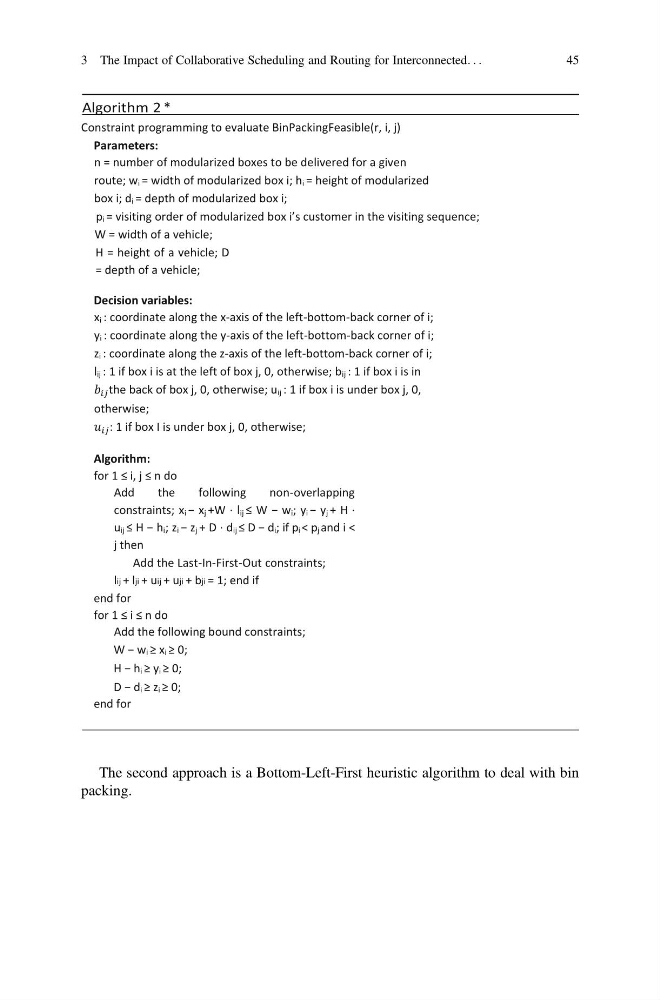
Constraint programming to evaluate BinPackingFeasible(r, i, j)
Parameters:
n = number of modularized boxes to be delivered for a given
route; wi = width of modularized box i; hi = height of modularized
box i; di = depth of modularized box i;
pi = visiting order of modularized box i’s customer in the visiting sequence;
W = width of a vehicle;
H = height of a vehicle; D
= depth of a vehicle;
Decision variables:
xi : coordinate along the x-axis of the left-bottom-back corner of i;
yi : coordinate along the y-axis of the left-bottom-back corner of i;
zi : coordinate along the z-axis of the left-bottom-back corner of i;
lij : 1 if box i is at the left of box j, 0, otherwise; bij : 1 if box i is in
the back of box j, 0, otherwise; uij : 1 if box i is under box j, 0,
otherwise;
: 1 if box I is under box j, 0, otherwise;
Algorithm:
for 1 ≤ i, j ≤ n do
Add
the
following
non-overlapping
constraints; xi − xj +W · lij ≤ W − wi; yi − yj + H ·
uij ≤ H − hi; zi − zj + D · dij ≤ D − di; if pi < pj and i <
j then
Add the Last-In-First-Out constraints;
lij + lji + uij + uji + bji = 1; end if
end for
for 1 ≤ i ≤ n do
Add the following bound constraints;
W − wi ≥ xi ≥ 0;
H − hi ≥ yi ≥ 0;
D − di ≥ zi ≥ 0;
end for
*
The second approach is a Bottom-Left-First heuristic algorithm to deal with bin
packing.
3 The Impact of Collaborative Scheduling and Routing for Interconnected. . .
45
Parameters:
n = number of modularized boxes to be delivered for a given
route; wi = width of modularized box i; hi = height of modularized
box i; di = depth of modularized box i;
pi = visiting order of modularized box i’s customer in the visiting sequence;
W = width of a vehicle;
H = height of a vehicle; D
= depth of a vehicle;
Decision variables:
xi : coordinate along the x-axis of the left-bottom-back corner of i;
yi : coordinate along the y-axis of the left-bottom-back corner of i;
zi : coordinate along the z-axis of the left-bottom-back corner of i;
lij : 1 if box i is at the left of box j, 0, otherwise; bij : 1 if box i is in
the back of box j, 0, otherwise; uij : 1 if box i is under box j, 0,
otherwise;
: 1 if box I is under box j, 0, otherwise;
Algorithm:
for 1 ≤ i, j ≤ n do
Add
the
following
non-overlapping
constraints; xi − xj +W · lij ≤ W − wi; yi − yj + H ·
uij ≤ H − hi; zi − zj + D · dij ≤ D − di; if pi < pj and i <
j then
Add the Last-In-First-Out constraints;
lij + lji + uij + uji + bji = 1; end if
end for
for 1 ≤ i ≤ n do
Add the following bound constraints;
W − wi ≥ xi ≥ 0;
H − hi ≥ yi ≥ 0;
D − di ≥ zi ≥ 0;
end for
*
The second approach is a Bottom-Left-First heuristic algorithm to deal with bin
packing.
3 The Impact of Collaborative Scheduling and Routing for Interconnected. . .
45