

1. Reduce demand for transport (in volume, weight, distance).
2. Increase the use of least polluting transport modes.
3. Optimize the utilization of transport capacity.
4. Improve fleet energy efficiency.
5. Reduce the carbon content of energy used for transport.
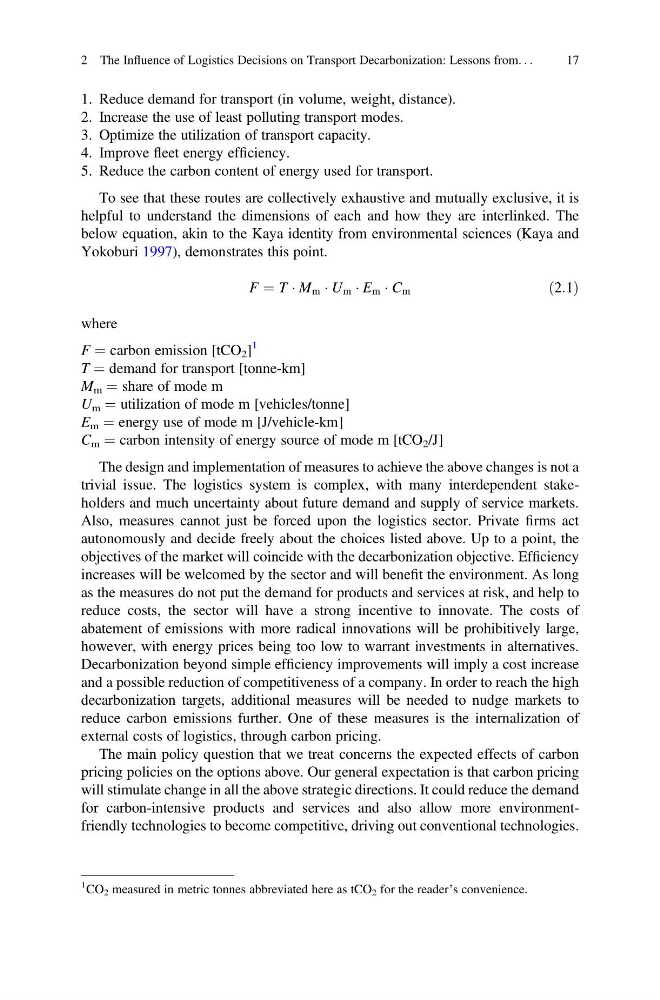
To see that these routes are collectively exhaustive and mutually exclusive, it is
helpful to understand the dimensions of each and how they are interlinked. The
below equation, akin to the Kaya identity from environmental sciences (Kaya and
Yokoburi 1997), demonstrates this point.
F ¼ T Á M m Á U m Á E m Á C m
ð2:1Þ
where
F ¼ carbon emission [tCO 2 ]
1
T ¼ demand for transport [tonne-km]
M m ¼ share of mode m
U m ¼ utilization of mode m [vehicles/tonne]
E m ¼ energy use of mode m [J/vehicle-km]
C m ¼ carbon intensity of energy source of mode m [tCO 2 /J]
The design and implementation of measures to achieve the above changes is not a
trivial issue. The logistics system is complex, with many interdependent stakeholders and much uncertainty about future demand and supply of service markets.
Also, measures cannot just be forced upon the logistics sector. Private firms act
autonomously and decide freely about the choices listed above. Up to a point, the
objectives of the market will coincide with the decarbonization objective. Efficiency
increases will be welcomed by the sector and will benefit the environment. As long
as the measures do not put the demand for products and services at risk, and help to
reduce costs, the sector will have a strong incentive to innovate. The costs of
abatement of emissions with more radical innovations will be prohibitively large,
however, with energy prices being too low to warrant investments in alternatives.
Decarbonization beyond simple efficiency improvements will imply a cost increase
and a possible reduction of competitiveness of a company. In order to reach the high
decarbonization targets, additional measures will be needed to nudge markets to
reduce carbon emissions further. One of these measures is the internalization of
external costs of logistics, through carbon pricing.
The main policy question that we treat concerns the expected effects of carbon
pricing policies on the options above. Our general expectation is that carbon pricing
will stimulate change in all the above strategic directions. It could reduce the demand
for carbon-intensive products and services and also allow more environmentfriendly technologies to become competitive, driving out conventional technologies.
1 CO 2 measured in metric tonnes abbreviated here as tCO 2 for the reader’s convenience.
2 The Influence of Logistics Decisions on Transport Decarbonization: Lessons from. . .
17
2. Increase the use of least polluting transport modes.
3. Optimize the utilization of transport capacity.
4. Improve fleet energy efficiency.
5. Reduce the carbon content of energy used for transport.
To see that these routes are collectively exhaustive and mutually exclusive, it is
helpful to understand the dimensions of each and how they are interlinked. The
below equation, akin to the Kaya identity from environmental sciences (Kaya and
Yokoburi 1997), demonstrates this point.
F ¼ T Á M m Á U m Á E m Á C m
ð2:1Þ
where
F ¼ carbon emission [tCO 2 ]
1
T ¼ demand for transport [tonne-km]
M m ¼ share of mode m
U m ¼ utilization of mode m [vehicles/tonne]
E m ¼ energy use of mode m [J/vehicle-km]
C m ¼ carbon intensity of energy source of mode m [tCO 2 /J]
The design and implementation of measures to achieve the above changes is not a
trivial issue. The logistics system is complex, with many interdependent stakeholders and much uncertainty about future demand and supply of service markets.
Also, measures cannot just be forced upon the logistics sector. Private firms act
autonomously and decide freely about the choices listed above. Up to a point, the
objectives of the market will coincide with the decarbonization objective. Efficiency
increases will be welcomed by the sector and will benefit the environment. As long
as the measures do not put the demand for products and services at risk, and help to
reduce costs, the sector will have a strong incentive to innovate. The costs of
abatement of emissions with more radical innovations will be prohibitively large,
however, with energy prices being too low to warrant investments in alternatives.
Decarbonization beyond simple efficiency improvements will imply a cost increase
and a possible reduction of competitiveness of a company. In order to reach the high
decarbonization targets, additional measures will be needed to nudge markets to
reduce carbon emissions further. One of these measures is the internalization of
external costs of logistics, through carbon pricing.
The main policy question that we treat concerns the expected effects of carbon
pricing policies on the options above. Our general expectation is that carbon pricing
will stimulate change in all the above strategic directions. It could reduce the demand
for carbon-intensive products and services and also allow more environmentfriendly technologies to become competitive, driving out conventional technologies.
1 CO 2 measured in metric tonnes abbreviated here as tCO 2 for the reader’s convenience.
2 The Influence of Logistics Decisions on Transport Decarbonization: Lessons from. . .
17