

about business decisions and allowing stakeholders and customers to play a role in
defining the business model. The shift towards greater sustainability lies in firms
expanding the scope of the business operations to include taking back products from
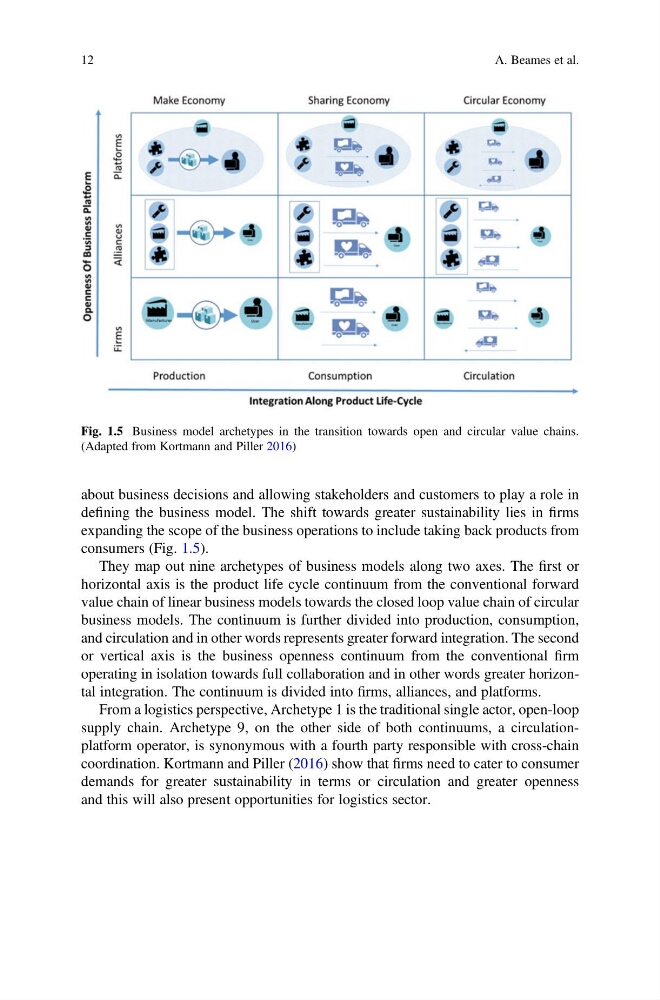
consumers (Fig. 1.5).
They map out nine archetypes of business models along two axes. The first or
horizontal axis is the product life cycle continuum from the conventional forward
value chain of linear business models towards the closed loop value chain of circular
business models. The continuum is further divided into production, consumption,
and circulation and in other words represents greater forward integration. The second
or vertical axis is the business openness continuum from the conventional firm
operating in isolation towards full collaboration and in other words greater horizontal integration. The continuum is divided into firms, alliances, and platforms.
From a logistics perspective, Archetype 1 is the traditional single actor, open-loop
supply chain. Archetype 9, on the other side of both continuums, a circulationplatform operator, is synonymous with a fourth party responsible with cross-chain
coordination. Kortmann and Piller (2016) show that firms need to cater to consumer
demands for greater sustainability in terms or circulation and greater openness
and this will also present opportunities for logistics sector.
Fig. 1.5 Business model archetypes in the transition towards open and circular value chains.
(Adapted from Kortmann and Piller 2016)
12
A. Beames et al.
defining the business model. The shift towards greater sustainability lies in firms
expanding the scope of the business operations to include taking back products from
consumers (Fig. 1.5).
They map out nine archetypes of business models along two axes. The first or
horizontal axis is the product life cycle continuum from the conventional forward
value chain of linear business models towards the closed loop value chain of circular
business models. The continuum is further divided into production, consumption,
and circulation and in other words represents greater forward integration. The second
or vertical axis is the business openness continuum from the conventional firm
operating in isolation towards full collaboration and in other words greater horizontal integration. The continuum is divided into firms, alliances, and platforms.
From a logistics perspective, Archetype 1 is the traditional single actor, open-loop
supply chain. Archetype 9, on the other side of both continuums, a circulationplatform operator, is synonymous with a fourth party responsible with cross-chain
coordination. Kortmann and Piller (2016) show that firms need to cater to consumer
demands for greater sustainability in terms or circulation and greater openness
and this will also present opportunities for logistics sector.
Fig. 1.5 Business model archetypes in the transition towards open and circular value chains.
(Adapted from Kortmann and Piller 2016)
12
A. Beames et al.