

Theoretically it is possible to create a software agent that registers what a manager
does every day in terms of appointments, what emails he processes, which documents he works on and what he has to do the next day. In doing so the agent learns a
pattern, and based upon this pattern, the software agent understands more which type
of information the manager prefers and how he would like it to be presented.
Information gets more relevant, accurate and understandable in this way. This is
an example of a product which tries to solve the problem of organizational information overload.
4 Conclusion
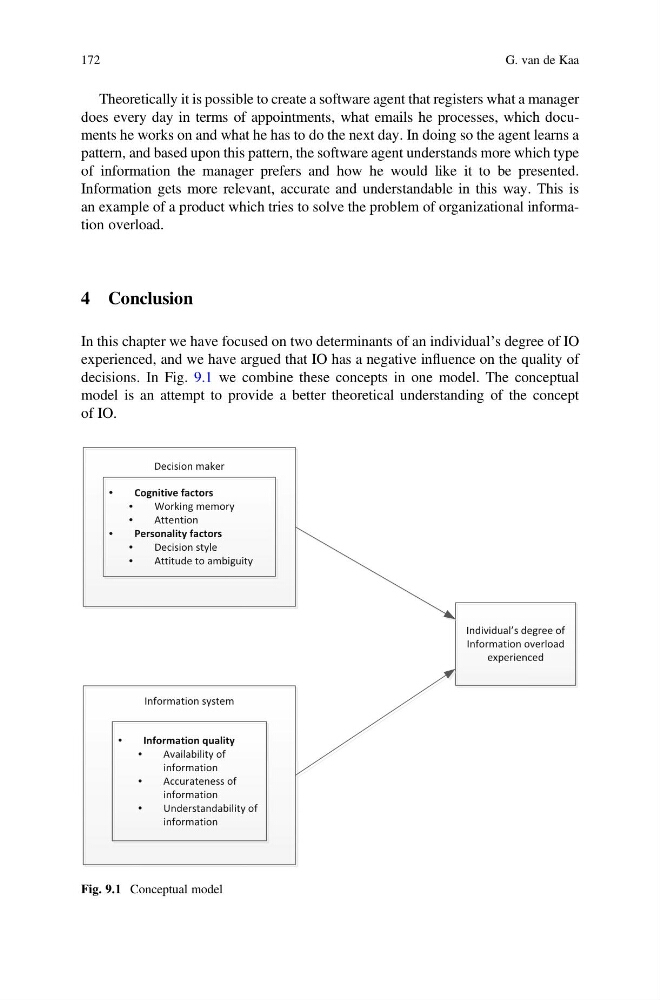
In this chapter we have focused on two determinants of an individual’s degree of IO
experienced, and we have argued that IO has a negative influence on the quality of
decisions. In Fig. 9.1 we combine these concepts in one model. The conceptual
model is an attempt to provide a better theoretical understanding of the concept
of IO.
Decision maker
Information system
• Cognitive factors
• Working memory
• Attention
• Personality factors
• Decision style
• Attitude to ambiguity
• Information quality
• Availability of
information
• Accurateness of
information
• Understandability of
information
Individual’s degree of
Information overload
experienced
Fig. 9.1 Conceptual model
172
G. van de Kaa
does every day in terms of appointments, what emails he processes, which documents he works on and what he has to do the next day. In doing so the agent learns a
pattern, and based upon this pattern, the software agent understands more which type
of information the manager prefers and how he would like it to be presented.
Information gets more relevant, accurate and understandable in this way. This is
an example of a product which tries to solve the problem of organizational information overload.
4 Conclusion
In this chapter we have focused on two determinants of an individual’s degree of IO
experienced, and we have argued that IO has a negative influence on the quality of
decisions. In Fig. 9.1 we combine these concepts in one model. The conceptual
model is an attempt to provide a better theoretical understanding of the concept
of IO.
Decision maker
Information system
• Cognitive factors
• Working memory
• Attention
• Personality factors
• Decision style
• Attitude to ambiguity
• Information quality
• Availability of
information
• Accurateness of
information
• Understandability of
information
Individual’s degree of
Information overload
experienced
Fig. 9.1 Conceptual model
172
G. van de Kaa