

3.5 Sustainable Supplier Segmentation Strategies
By reviewing the existing literature related to sustainability, it can be concluded that
the supplier improvement program is an issue which has been overlooked in the area
of research and even ignored by the companies (Zimmer et al. 2016). However, in
order to implement sustainability practices related to suppliers, companies must
adopt strategies to collaborate, support, and improve suppliers, since these collaborations facilitate the adoption of innovative environmental technologies (Zhu et al.
2007), adopting sustainability practices (Vachon and Mao 2008), communication,
trust, and long-term commitment (Cheung and Rowlinson 2011), adopting ethical
procedures in business, improving quality (Talluri et al. 2010), and gaining competitive advantage in marketing and profitability for both the buyer and the supplier
(Holt and Ghobadian 2009). In other words, improving suppliers’ abilities is needed
to increase their level of willingness for long-term cooperation (Rezaei et al. 2015).
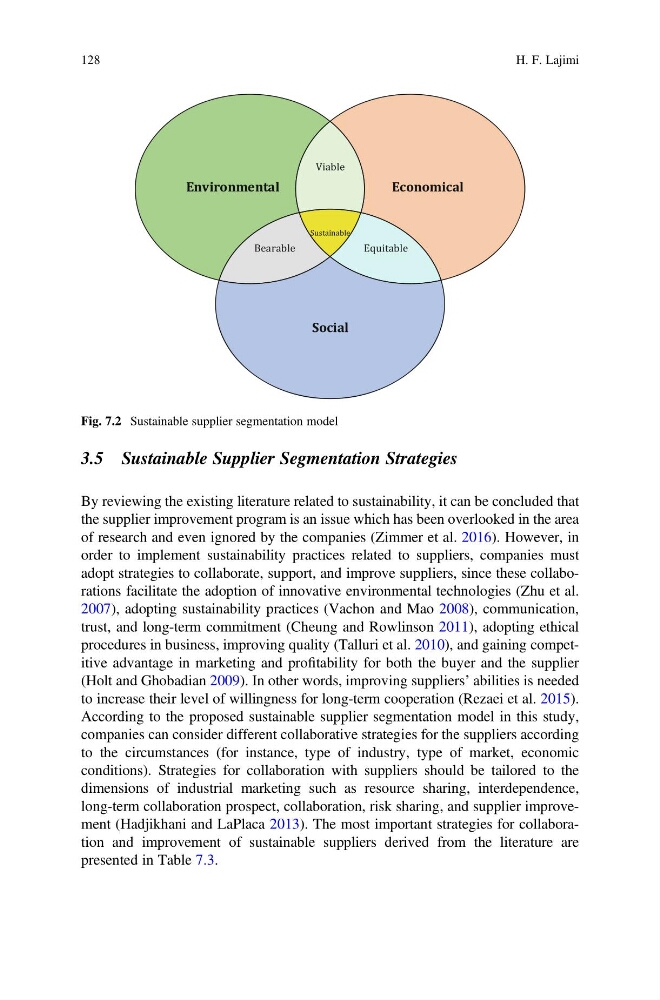
According to the proposed sustainable supplier segmentation model in this study,
companies can consider different collaborative strategies for the suppliers according
to the circumstances (for instance, type of industry, type of market, economic
conditions). Strategies for collaboration with suppliers should be tailored to the
dimensions of industrial marketing such as resource sharing, interdependence,
long-term collaboration prospect, collaboration, risk sharing, and supplier improvement (Hadjikhani and LaPlaca 2013). The most important strategies for collaboration and improvement of sustainable suppliers derived from the literature are
presented in Table 7.3.
Fig. 7.2 Sustainable supplier segmentation model
128
H. F. Lajimi
By reviewing the existing literature related to sustainability, it can be concluded that
the supplier improvement program is an issue which has been overlooked in the area
of research and even ignored by the companies (Zimmer et al. 2016). However, in
order to implement sustainability practices related to suppliers, companies must
adopt strategies to collaborate, support, and improve suppliers, since these collaborations facilitate the adoption of innovative environmental technologies (Zhu et al.
2007), adopting sustainability practices (Vachon and Mao 2008), communication,
trust, and long-term commitment (Cheung and Rowlinson 2011), adopting ethical
procedures in business, improving quality (Talluri et al. 2010), and gaining competitive advantage in marketing and profitability for both the buyer and the supplier
(Holt and Ghobadian 2009). In other words, improving suppliers’ abilities is needed
to increase their level of willingness for long-term cooperation (Rezaei et al. 2015).
According to the proposed sustainable supplier segmentation model in this study,
companies can consider different collaborative strategies for the suppliers according
to the circumstances (for instance, type of industry, type of market, economic
conditions). Strategies for collaboration with suppliers should be tailored to the
dimensions of industrial marketing such as resource sharing, interdependence,
long-term collaboration prospect, collaboration, risk sharing, and supplier improvement (Hadjikhani and LaPlaca 2013). The most important strategies for collaboration and improvement of sustainable suppliers derived from the literature are
presented in Table 7.3.
Fig. 7.2 Sustainable supplier segmentation model
128
H. F. Lajimi