

long-term potential-based segmentation, involvement of other business functions
beyond purchasing in segmentation process, and considering supplier segmentation
as one of the steps in selection process and relationship with suppliers. They
introduced a two-dimensional approach called the supplier potential matrix (SPM),
involving capability and willingness, along with their criteria. In another study,
Rezaei and Ortt (2013) applied a multi-criteria decision-making (MCDM) technique
to supplier segmentation, while Rezaei et al. (2015) later used a new method called
Best-Worst Method (BWM) to segment the suppliers. In the paper by Bai et al.
(2017), which dealt with supplier segmentation in green supply chain, using the
SPM approach, the criteria of these two dimensions were identified and used to
incorporate clustering techniques and VIKOR to segment the suppliers of a large
chemical company. A comprehensive review of the literature on supply chain
sustainability (see Martins and Pato (2019)) reveals that supplier segmentation has
not yet received enough attention in the context of sustainable supply chain.
3 Sustainable Supplier Segmentation
In the process of supplier relationship management, supplier segmentation is part of
this process. Supplier relationship process involves identifying, selecting,
segmenting, improving, and evaluating suppliers (Rezaei and Ortt 2012; Glock
et al. 2017). These activities cannot be done separately and independently, since
they must be carried out continuously, and the output of each step is considered as
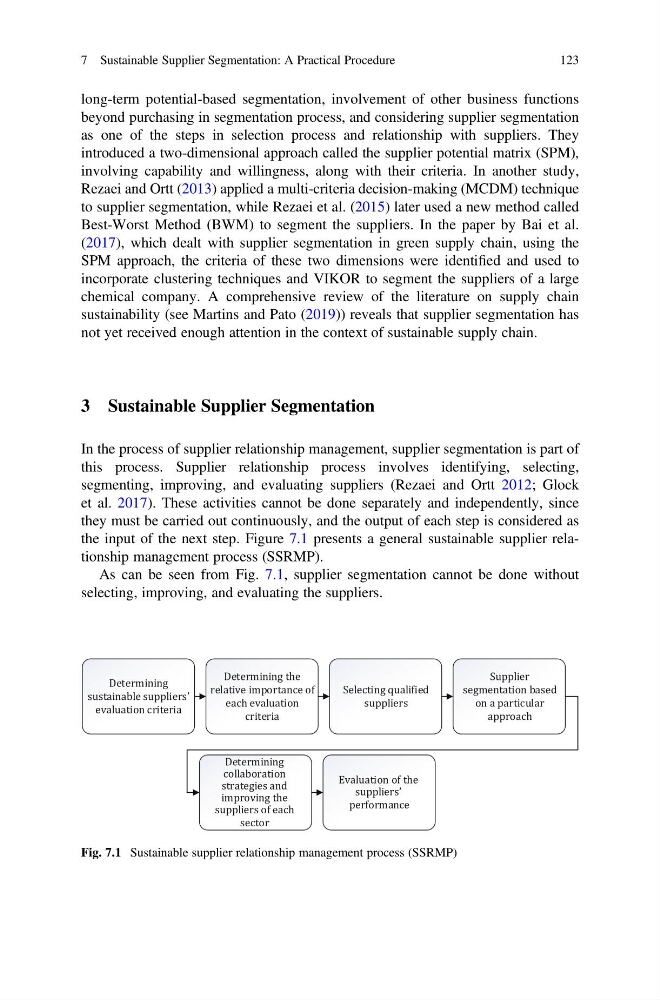
the input of the next step. Figure 7.1 presents a general sustainable supplier relationship management process (SSRMP).
As can be seen from Fig. 7.1, supplier segmentation cannot be done without
selecting, improving, and evaluating the suppliers.
Fig. 7.1 Sustainable supplier relationship management process (SSRMP)
7 Sustainable Supplier Segmentation: A Practical Procedure
123
beyond purchasing in segmentation process, and considering supplier segmentation
as one of the steps in selection process and relationship with suppliers. They
introduced a two-dimensional approach called the supplier potential matrix (SPM),
involving capability and willingness, along with their criteria. In another study,
Rezaei and Ortt (2013) applied a multi-criteria decision-making (MCDM) technique
to supplier segmentation, while Rezaei et al. (2015) later used a new method called
Best-Worst Method (BWM) to segment the suppliers. In the paper by Bai et al.
(2017), which dealt with supplier segmentation in green supply chain, using the
SPM approach, the criteria of these two dimensions were identified and used to
incorporate clustering techniques and VIKOR to segment the suppliers of a large
chemical company. A comprehensive review of the literature on supply chain
sustainability (see Martins and Pato (2019)) reveals that supplier segmentation has
not yet received enough attention in the context of sustainable supply chain.
3 Sustainable Supplier Segmentation
In the process of supplier relationship management, supplier segmentation is part of
this process. Supplier relationship process involves identifying, selecting,
segmenting, improving, and evaluating suppliers (Rezaei and Ortt 2012; Glock
et al. 2017). These activities cannot be done separately and independently, since
they must be carried out continuously, and the output of each step is considered as
the input of the next step. Figure 7.1 presents a general sustainable supplier relationship management process (SSRMP).
As can be seen from Fig. 7.1, supplier segmentation cannot be done without
selecting, improving, and evaluating the suppliers.
Fig. 7.1 Sustainable supplier relationship management process (SSRMP)
7 Sustainable Supplier Segmentation: A Practical Procedure
123