

4.8 Experimental Section
125
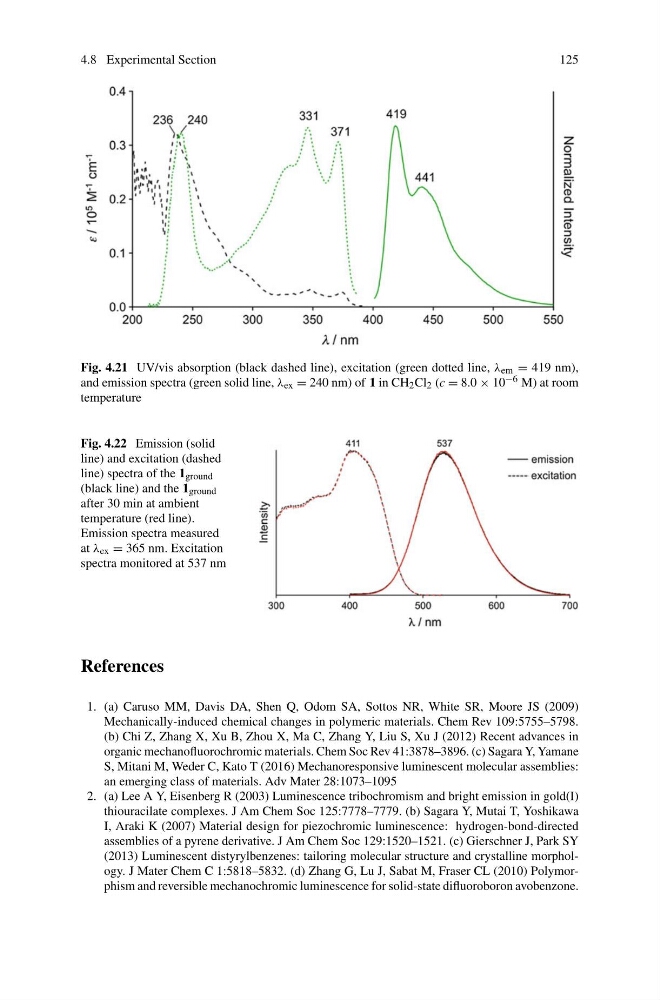
Fig. 4.21 UV/vis absorption (black dashed line), excitation (green dotted line, λ em = 419 nm),
and emission spectra (green solid line, λ ex = 240 nm) of 1 in CH 2 Cl 2 (c = 8.0 × 10 −6 M) at room
temperature
Fig. 4.22 Emission (solid
line) and excitation (dashed
line) spectra of the 1 ground
(black line) and the 1 ground
after 30 min at ambient
temperature (red line).
Emission spectra measured
at λ ex = 365 nm. Excitation
spectra monitored at 537 nm
References
1. (a) Caruso MM, Davis DA, Shen Q, Odom SA, Sottos NR, White SR, Moore JS (2009)
Mechanically-induced chemical changes in polymeric materials. Chem Rev 109:5755–5798.
(b) Chi Z, Zhang X, Xu B, Zhou X, Ma C, Zhang Y, Liu S, Xu J (2012) Recent advances in
organic mechanofluorochromic materials. Chem Soc Rev 41:3878–3896. (c) Sagara Y, Yamane
S, Mitani M, Weder C, Kato T (2016) Mechanoresponsive luminescent molecular assemblies:
an emerging class of materials. Adv Mater 28:1073–1095
2. (a) Lee A Y, Eisenberg R (2003) Luminescence tribochromism and bright emission in gold(I)
thiouracilate complexes. J Am Chem Soc 125:7778–7779. (b) Sagara Y, Mutai T, Yoshikawa
I, Araki K (2007) Material design for piezochromic luminescence: hydrogen-bond-directed
assemblies of a pyrene derivative. J Am Chem Soc 129:1520–1521. (c) Gierschner J, Park SY
(2013) Luminescent distyrylbenzenes: tailoring molecular structure and crystalline morphology. J Mater Chem C 1:5818–5832. (d) Zhang G, Lu J, Sabat M, Fraser CL (2010) Polymorphism and reversible mechanochromic luminescence for solid-state difluoroboron avobenzone.
125
Fig. 4.21 UV/vis absorption (black dashed line), excitation (green dotted line, λ em = 419 nm),
and emission spectra (green solid line, λ ex = 240 nm) of 1 in CH 2 Cl 2 (c = 8.0 × 10 −6 M) at room
temperature
Fig. 4.22 Emission (solid
line) and excitation (dashed
line) spectra of the 1 ground
(black line) and the 1 ground
after 30 min at ambient
temperature (red line).
Emission spectra measured
at λ ex = 365 nm. Excitation
spectra monitored at 537 nm
References
1. (a) Caruso MM, Davis DA, Shen Q, Odom SA, Sottos NR, White SR, Moore JS (2009)
Mechanically-induced chemical changes in polymeric materials. Chem Rev 109:5755–5798.
(b) Chi Z, Zhang X, Xu B, Zhou X, Ma C, Zhang Y, Liu S, Xu J (2012) Recent advances in
organic mechanofluorochromic materials. Chem Soc Rev 41:3878–3896. (c) Sagara Y, Yamane
S, Mitani M, Weder C, Kato T (2016) Mechanoresponsive luminescent molecular assemblies:
an emerging class of materials. Adv Mater 28:1073–1095
2. (a) Lee A Y, Eisenberg R (2003) Luminescence tribochromism and bright emission in gold(I)
thiouracilate complexes. J Am Chem Soc 125:7778–7779. (b) Sagara Y, Mutai T, Yoshikawa
I, Araki K (2007) Material design for piezochromic luminescence: hydrogen-bond-directed
assemblies of a pyrene derivative. J Am Chem Soc 129:1520–1521. (c) Gierschner J, Park SY
(2013) Luminescent distyrylbenzenes: tailoring molecular structure and crystalline morphology. J Mater Chem C 1:5818–5832. (d) Zhang G, Lu J, Sabat M, Fraser CL (2010) Polymorphism and reversible mechanochromic luminescence for solid-state difluoroboron avobenzone.