

120
4 Mechano-Responsive Luminescence via Crystal-to-Crystal Phase …
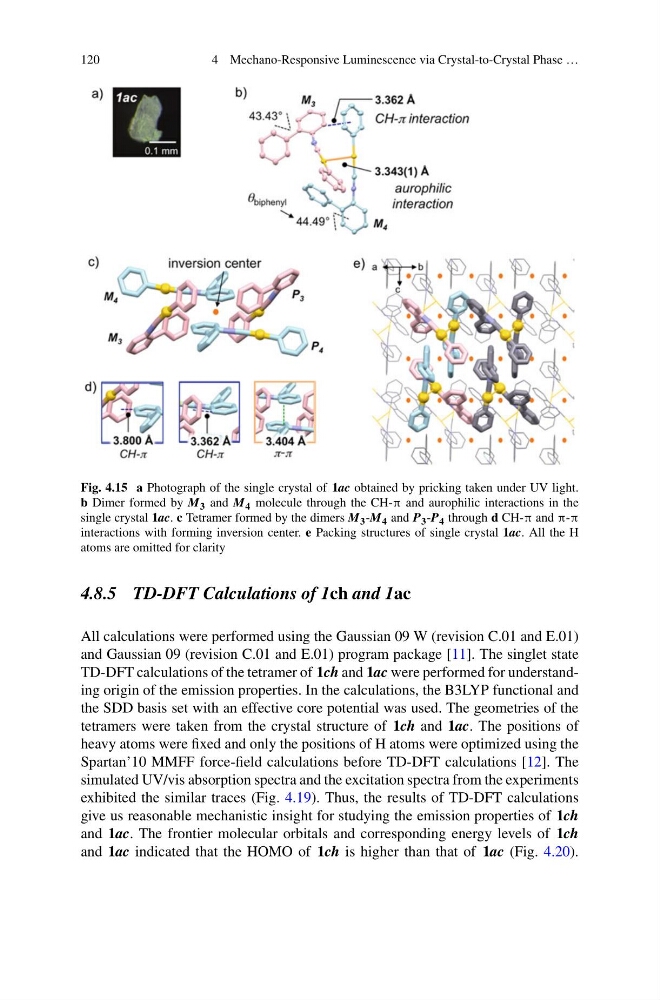
Fig. 4.15 a Photograph of the single crystal of 1ac obtained by pricking taken under UV light.
b Dimer formed by M 3 and M 4 molecule through the CH-π and aurophilic interactions in the
single crystal 1ac. c Tetramer formed by the dimers M 3 -M 4 and P 3 -P 4 through d CH-π and π-π
interactions with forming inversion center. e Packing structures of single crystal 1ac. All the H
atoms are omitted for clarity
4.8.5 TD-DFT Calculations of 1ch and 1ac
All calculations were performed using the Gaussian 09 W (revision C.01 and E.01)
and Gaussian 09 (revision C.01 and E.01) program package [11]. The singlet state
TD-DFT calculations of the tetramer of 1ch and 1ac were performed for understanding origin of the emission properties. In the calculations, the B3LYP functional and
the SDD basis set with an effective core potential was used. The geometries of the
tetramers were taken from the crystal structure of 1ch and 1ac. The positions of
heavy atoms were fixed and only the positions of H atoms were optimized using the
Spartan’10 MMFF force-field calculations before TD-DFT calculations [12]. The
simulated UV/vis absorption spectra and the excitation spectra from the experiments
exhibited the similar traces (Fig. 4.19). Thus, the results of TD-DFT calculations
give us reasonable mechanistic insight for studying the emission properties of 1ch
and 1ac. The frontier molecular orbitals and corresponding energy levels of 1ch
and 1ac indicated that the HOMO of 1ch is higher than that of 1ac (Fig. 4.20).
4 Mechano-Responsive Luminescence via Crystal-to-Crystal Phase …
Fig. 4.15 a Photograph of the single crystal of 1ac obtained by pricking taken under UV light.
b Dimer formed by M 3 and M 4 molecule through the CH-π and aurophilic interactions in the
single crystal 1ac. c Tetramer formed by the dimers M 3 -M 4 and P 3 -P 4 through d CH-π and π-π
interactions with forming inversion center. e Packing structures of single crystal 1ac. All the H
atoms are omitted for clarity
4.8.5 TD-DFT Calculations of 1ch and 1ac
All calculations were performed using the Gaussian 09 W (revision C.01 and E.01)
and Gaussian 09 (revision C.01 and E.01) program package [11]. The singlet state
TD-DFT calculations of the tetramer of 1ch and 1ac were performed for understanding origin of the emission properties. In the calculations, the B3LYP functional and
the SDD basis set with an effective core potential was used. The geometries of the
tetramers were taken from the crystal structure of 1ch and 1ac. The positions of
heavy atoms were fixed and only the positions of H atoms were optimized using the
Spartan’10 MMFF force-field calculations before TD-DFT calculations [12]. The
simulated UV/vis absorption spectra and the excitation spectra from the experiments
exhibited the similar traces (Fig. 4.19). Thus, the results of TD-DFT calculations
give us reasonable mechanistic insight for studying the emission properties of 1ch
and 1ac. The frontier molecular orbitals and corresponding energy levels of 1ch
and 1ac indicated that the HOMO of 1ch is higher than that of 1ac (Fig. 4.20).