

106
4 Mechano-Responsive Luminescence via Crystal-to-Crystal Phase …
4.2 Synthesis and Preparation
Gold(I) isocyanide complex 1 was prepared according to a slightly modified, previously described procedure. After chromatographic purification of 1 and removal of
the solvent, a viscous oil (1o) was obtained (Fig. 4.1b and the experimental section).
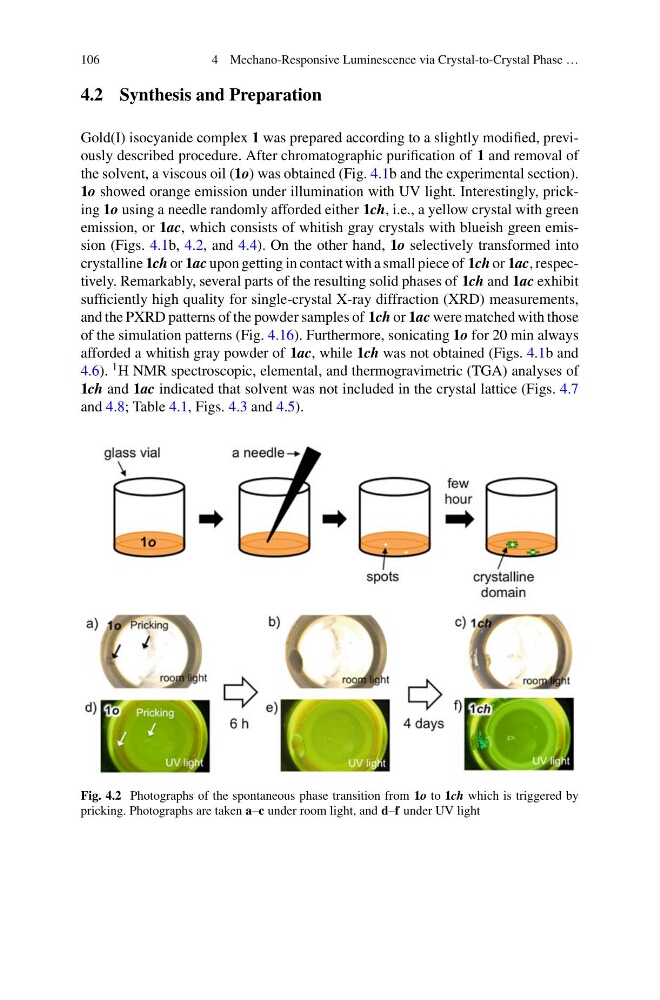
1o showed orange emission under illumination with UV light. Interestingly, pricking 1o using a needle randomly afforded either 1ch, i.e., a yellow crystal with green
emission, or 1ac, which consists of whitish gray crystals with blueish green emission (Figs. 4.1b, 4.2, and 4.4). On the other hand, 1o selectively transformed into
crystalline 1ch or 1ac upon getting in contact with a small piece of 1ch or 1ac, respectively. Remarkably, several parts of the resulting solid phases of 1ch and 1ac exhibit
sufficiently high quality for single-crystal X-ray diffraction (XRD) measurements,
and the PXRD patterns of the powder samples of 1ch or 1ac were matched with those
of the simulation patterns (Fig. 4.16). Furthermore, sonicating 1o for 20 min always
afforded a whitish gray powder of 1ac, while 1ch was not obtained (Figs. 4.1b and
4.6).
1 H NMR spectroscopic, elemental, and thermogravimetric (TGA) analyses of
1ch and 1ac indicated that solvent was not included in the crystal lattice (Figs. 4.7
and 4.8; Table 4.1, Figs. 4.3 and 4.5).
Fig. 4.2 Photographs of the spontaneous phase transition from 1o to 1ch which is triggered by
pricking. Photographs are taken a–c under room light, and d–f under UV light
4 Mechano-Responsive Luminescence via Crystal-to-Crystal Phase …
4.2 Synthesis and Preparation
Gold(I) isocyanide complex 1 was prepared according to a slightly modified, previously described procedure. After chromatographic purification of 1 and removal of
the solvent, a viscous oil (1o) was obtained (Fig. 4.1b and the experimental section).
1o showed orange emission under illumination with UV light. Interestingly, pricking 1o using a needle randomly afforded either 1ch, i.e., a yellow crystal with green
emission, or 1ac, which consists of whitish gray crystals with blueish green emission (Figs. 4.1b, 4.2, and 4.4). On the other hand, 1o selectively transformed into
crystalline 1ch or 1ac upon getting in contact with a small piece of 1ch or 1ac, respectively. Remarkably, several parts of the resulting solid phases of 1ch and 1ac exhibit
sufficiently high quality for single-crystal X-ray diffraction (XRD) measurements,
and the PXRD patterns of the powder samples of 1ch or 1ac were matched with those
of the simulation patterns (Fig. 4.16). Furthermore, sonicating 1o for 20 min always
afforded a whitish gray powder of 1ac, while 1ch was not obtained (Figs. 4.1b and
4.6).
1 H NMR spectroscopic, elemental, and thermogravimetric (TGA) analyses of
1ch and 1ac indicated that solvent was not included in the crystal lattice (Figs. 4.7
and 4.8; Table 4.1, Figs. 4.3 and 4.5).
Fig. 4.2 Photographs of the spontaneous phase transition from 1o to 1ch which is triggered by
pricking. Photographs are taken a–c under room light, and d–f under UV light