

3.7 Experimental Section
95
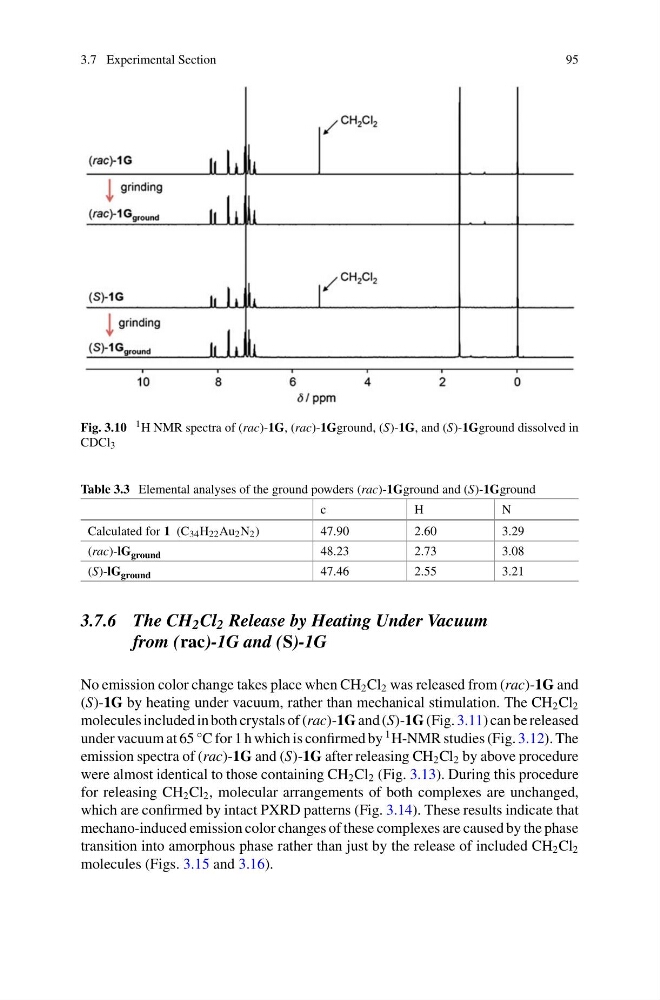
Fig. 3.10 1 H NMR spectra of (rac)-1G, (rac)-1Gground, (S)-1G, and (S)-1Gground dissolved in
CDCl 3
Table 3.3 Elemental analyses of the ground powders (rac)-1Gground and (S)-1Gground
c
H
N
Calculated for 1 (C 34 H 22 Au 2 N 2 )
47.90
2.60
3.29
(rac)-lG ground
48.23
2.73
3.08
(S)-lG ground
47.46
2.55
3.21
3.7.6 The CH 2 Cl 2 Release by Heating Under Vacuum
from (rac)-1G and (S)-1G
No emission color change takes place when CH 2 Cl 2 was released from (rac)-1G and
(S)-1G by heating under vacuum, rather than mechanical stimulation. The CH 2 Cl 2
molecules included in both crystals of (rac)-1G and (S)-1G (Fig. 3.11) can be released
under vacuum at 65 °C for 1 h which is confirmed by
1 H-NMR studies (Fig. 3.12). The
emission spectra of (rac)-1G and (S)-1G after releasing CH 2 Cl 2 by above procedure
were almost identical to those containing CH 2 Cl 2 (Fig. 3.13). During this procedure
for releasing CH 2 Cl 2 , molecular arrangements of both complexes are unchanged,
which are confirmed by intact PXRD patterns (Fig. 3.14). These results indicate that
mechano-induced emission color changes of these complexes are caused by the phase
transition into amorphous phase rather than just by the release of included CH 2 Cl 2
molecules (Figs. 3.15 and 3.16).
95
Fig. 3.10 1 H NMR spectra of (rac)-1G, (rac)-1Gground, (S)-1G, and (S)-1Gground dissolved in
CDCl 3
Table 3.3 Elemental analyses of the ground powders (rac)-1Gground and (S)-1Gground
c
H
N
Calculated for 1 (C 34 H 22 Au 2 N 2 )
47.90
2.60
3.29
(rac)-lG ground
48.23
2.73
3.08
(S)-lG ground
47.46
2.55
3.21
3.7.6 The CH 2 Cl 2 Release by Heating Under Vacuum
from (rac)-1G and (S)-1G
No emission color change takes place when CH 2 Cl 2 was released from (rac)-1G and
(S)-1G by heating under vacuum, rather than mechanical stimulation. The CH 2 Cl 2
molecules included in both crystals of (rac)-1G and (S)-1G (Fig. 3.11) can be released
under vacuum at 65 °C for 1 h which is confirmed by
1 H-NMR studies (Fig. 3.12). The
emission spectra of (rac)-1G and (S)-1G after releasing CH 2 Cl 2 by above procedure
were almost identical to those containing CH 2 Cl 2 (Fig. 3.13). During this procedure
for releasing CH 2 Cl 2 , molecular arrangements of both complexes are unchanged,
which are confirmed by intact PXRD patterns (Fig. 3.14). These results indicate that
mechano-induced emission color changes of these complexes are caused by the phase
transition into amorphous phase rather than just by the release of included CH 2 Cl 2
molecules (Figs. 3.15 and 3.16).