

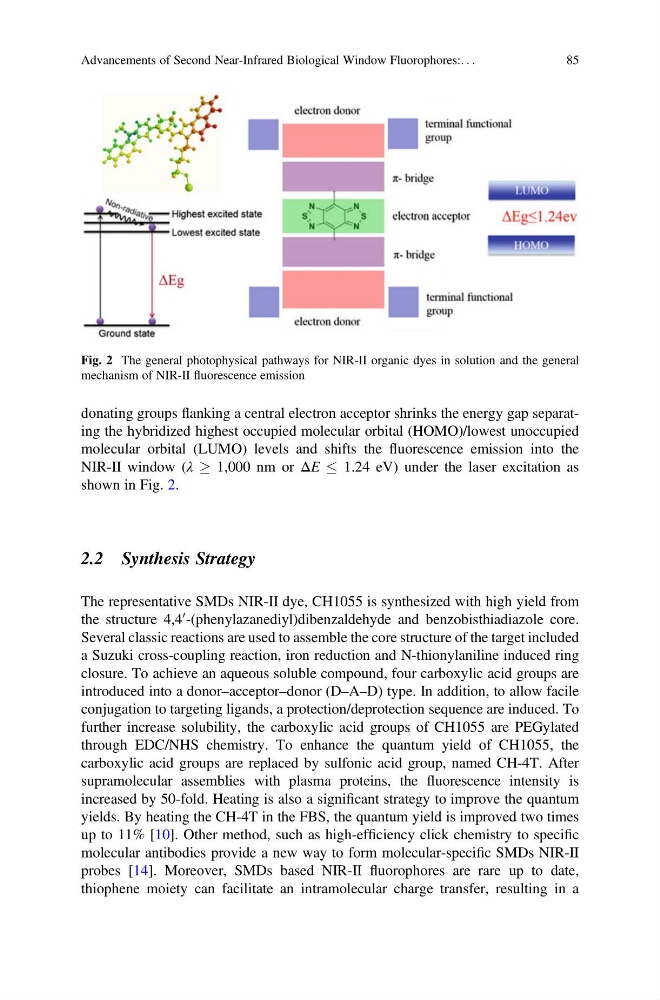
donating groups flanking a central electron acceptor shrinks the energy gap separating the hybridized highest occupied molecular orbital (HOMO)/lowest unoccupied
molecular orbital (LUMO) levels and shifts the fluorescence emission into the
NIR-II window (λ ! 1,000 nm or ΔE
1.24 eV) under the laser excitation as
shown in Fig. 2.
2.2 Synthesis Strategy
The representative SMDs NIR-II dye, CH1055 is synthesized with high yield from
the structure 4,4
0 -(phenylazanediyl)dibenzaldehyde and benzobisthiadiazole core.
Several classic reactions are used to assemble the core structure of the target included
a Suzuki cross-coupling reaction, iron reduction and N-thionylaniline induced ring
closure. To achieve an aqueous soluble compound, four carboxylic acid groups are
introduced into a donor–acceptor–donor (D–A–D) type. In addition, to allow facile
conjugation to targeting ligands, a protection/deprotection sequence are induced. To
further increase solubility, the carboxylic acid groups of CH1055 are PEGylated
through EDC/NHS chemistry. To enhance the quantum yield of CH1055, the
carboxylic acid groups are replaced by sulfonic acid group, named CH-4T. After
supramolecular assemblies with plasma proteins, the fluorescence intensity is
increased by 50-fold. Heating is also a significant strategy to improve the quantum
yields. By heating the CH-4T in the FBS, the quantum yield is improved two times
up to 11% [10]. Other method, such as high-efficiency click chemistry to specific
molecular antibodies provide a new way to form molecular-specific SMDs NIR-II
probes [14]. Moreover, SMDs based NIR-II fluorophores are rare up to date,
thiophene moiety can facilitate an intramolecular charge transfer, resulting in a
Fig. 2 The general photophysical pathways for NIR-II organic dyes in solution and the general
mechanism of NIR-II fluorescence emission
Advancements of Second Near-Infrared Biological Window Fluorophores:. . .
85
molecular orbital (LUMO) levels and shifts the fluorescence emission into the
NIR-II window (λ ! 1,000 nm or ΔE
1.24 eV) under the laser excitation as
shown in Fig. 2.
2.2 Synthesis Strategy
The representative SMDs NIR-II dye, CH1055 is synthesized with high yield from
the structure 4,4
0 -(phenylazanediyl)dibenzaldehyde and benzobisthiadiazole core.
Several classic reactions are used to assemble the core structure of the target included
a Suzuki cross-coupling reaction, iron reduction and N-thionylaniline induced ring
closure. To achieve an aqueous soluble compound, four carboxylic acid groups are
introduced into a donor–acceptor–donor (D–A–D) type. In addition, to allow facile
conjugation to targeting ligands, a protection/deprotection sequence are induced. To
further increase solubility, the carboxylic acid groups of CH1055 are PEGylated
through EDC/NHS chemistry. To enhance the quantum yield of CH1055, the
carboxylic acid groups are replaced by sulfonic acid group, named CH-4T. After
supramolecular assemblies with plasma proteins, the fluorescence intensity is
increased by 50-fold. Heating is also a significant strategy to improve the quantum
yields. By heating the CH-4T in the FBS, the quantum yield is improved two times
up to 11% [10]. Other method, such as high-efficiency click chemistry to specific
molecular antibodies provide a new way to form molecular-specific SMDs NIR-II
probes [14]. Moreover, SMDs based NIR-II fluorophores are rare up to date,
thiophene moiety can facilitate an intramolecular charge transfer, resulting in a
Fig. 2 The general photophysical pathways for NIR-II organic dyes in solution and the general
mechanism of NIR-II fluorescence emission
Advancements of Second Near-Infrared Biological Window Fluorophores:. . .
85