

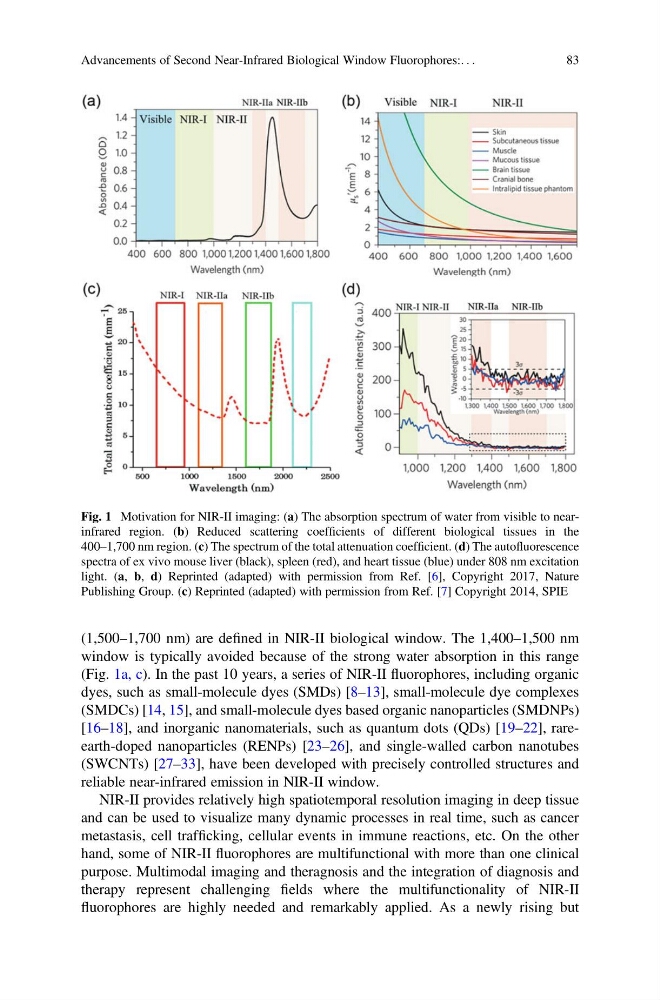
(1,500–1,700 nm) are defined in NIR-II biological window. The 1,400–1,500 nm
window is typically avoided because of the strong water absorption in this range
(Fig. 1a, c). In the past 10 years, a series of NIR-II fluorophores, including organic
dyes, such as small-molecule dyes (SMDs) [8–13], small-molecule dye complexes
(SMDCs) [14, 15], and small-molecule dyes based organic nanoparticles (SMDNPs)
[16–18], and inorganic nanomaterials, such as quantum dots (QDs) [19–22], rareearth-doped nanoparticles (RENPs) [23–26], and single-walled carbon nanotubes
(SWCNTs) [27–33], have been developed with precisely controlled structures and
reliable near-infrared emission in NIR-II window.
NIR-II provides relatively high spatiotemporal resolution imaging in deep tissue
and can be used to visualize many dynamic processes in real time, such as cancer
metastasis, cell trafficking, cellular events in immune reactions, etc. On the other
hand, some of NIR-II fluorophores are multifunctional with more than one clinical
purpose. Multimodal imaging and theragnosis and the integration of diagnosis and
therapy represent challenging fields where the multifunctionality of NIR-II
fluorophores are highly needed and remarkably applied. As a newly rising but
Fig. 1 Motivation for NIR-II imaging: (a) The absorption spectrum of water from visible to nearinfrared region. (b) Reduced scattering coefficients of different biological tissues in the
400–1,700 nm region. (c) The spectrum of the total attenuation coefficient. (d) The autofluorescence
spectra of ex vivo mouse liver (black), spleen (red), and heart tissue (blue) under 808 nm excitation
light. (a, b, d) Reprinted (adapted) with permission from Ref. [6], Copyright 2017, Nature
Publishing Group. (c) Reprinted (adapted) with permission from Ref. [7] Copyright 2014, SPIE
Advancements of Second Near-Infrared Biological Window Fluorophores:. . .
83
window is typically avoided because of the strong water absorption in this range
(Fig. 1a, c). In the past 10 years, a series of NIR-II fluorophores, including organic
dyes, such as small-molecule dyes (SMDs) [8–13], small-molecule dye complexes
(SMDCs) [14, 15], and small-molecule dyes based organic nanoparticles (SMDNPs)
[16–18], and inorganic nanomaterials, such as quantum dots (QDs) [19–22], rareearth-doped nanoparticles (RENPs) [23–26], and single-walled carbon nanotubes
(SWCNTs) [27–33], have been developed with precisely controlled structures and
reliable near-infrared emission in NIR-II window.
NIR-II provides relatively high spatiotemporal resolution imaging in deep tissue
and can be used to visualize many dynamic processes in real time, such as cancer
metastasis, cell trafficking, cellular events in immune reactions, etc. On the other
hand, some of NIR-II fluorophores are multifunctional with more than one clinical
purpose. Multimodal imaging and theragnosis and the integration of diagnosis and
therapy represent challenging fields where the multifunctionality of NIR-II
fluorophores are highly needed and remarkably applied. As a newly rising but
Fig. 1 Motivation for NIR-II imaging: (a) The absorption spectrum of water from visible to nearinfrared region. (b) Reduced scattering coefficients of different biological tissues in the
400–1,700 nm region. (c) The spectrum of the total attenuation coefficient. (d) The autofluorescence
spectra of ex vivo mouse liver (black), spleen (red), and heart tissue (blue) under 808 nm excitation
light. (a, b, d) Reprinted (adapted) with permission from Ref. [6], Copyright 2017, Nature
Publishing Group. (c) Reprinted (adapted) with permission from Ref. [7] Copyright 2014, SPIE
Advancements of Second Near-Infrared Biological Window Fluorophores:. . .
83