

ethyl alcohol. This study found that RDP exhibited nonfluorescent properties itself;
however, a new fluorescence spectrum peak of RDP at 560 nm was observed in the
presence of trivalent metal ions (M
3+ ) (where M
3+
¼ Fe
3+ , Al
3+ , and Cr
3+ ), with the
color change from colorless to pink, resulting from the ring-opened RDP-M
3+
complex [41].
2.6 NADH and FAD as Endogenous Fluorophores
Various endogenous chromophores existing in cells and tissues play important role
in metabolic activities and cell functions. Common endogenous fluorophores include
retinol, tryptophan, elastin, collagen, and porphyrins [42]. Among them, nicotinamide adenine dinucleotide (NADH) and flavin adenine dinucleotide (FAD) are
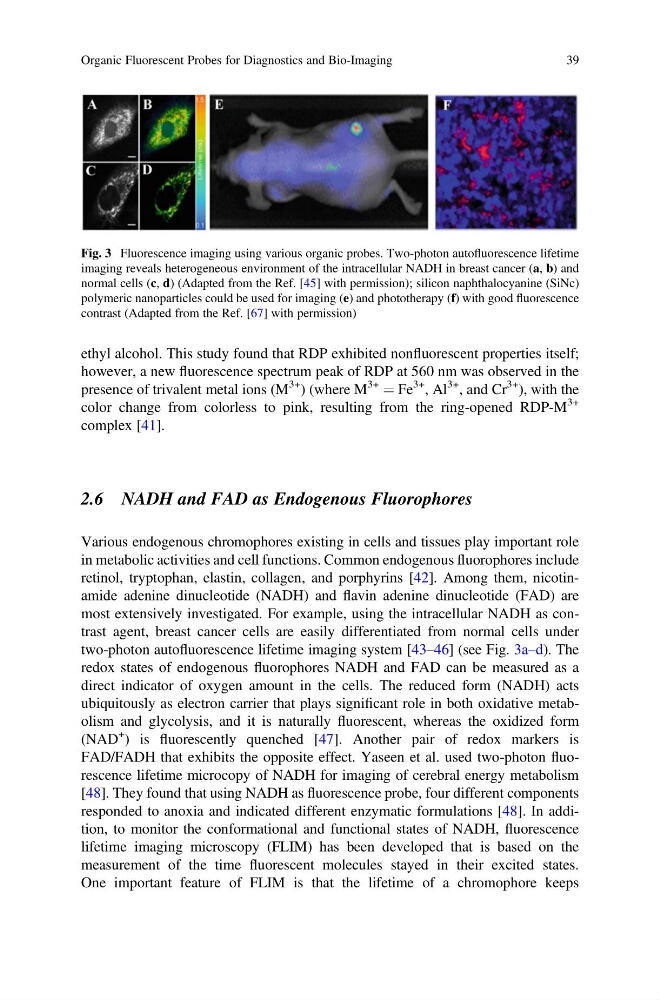
most extensively investigated. For example, using the intracellular NADH as contrast agent, breast cancer cells are easily differentiated from normal cells under
two-photon autofluorescence lifetime imaging system [43–46] (see Fig. 3a–d). The
redox states of endogenous fluorophores NADH and FAD can be measured as a
direct indicator of oxygen amount in the cells. The reduced form (NADH) acts
ubiquitously as electron carrier that plays significant role in both oxidative metabolism and glycolysis, and it is naturally fluorescent, whereas the oxidized form
(NAD
+
) is fluorescently quenched [47]. Another pair of redox markers is
FAD/FADH that exhibits the opposite effect. Yaseen et al. used two-photon fluorescence lifetime microcopy of NADH for imaging of cerebral energy metabolism
[48]. They found that using NADH as fluorescence probe, four different components
responded to anoxia and indicated different enzymatic formulations [48]. In addition, to monitor the conformational and functional states of NADH, fluorescence
lifetime imaging microscopy (FLIM) has been developed that is based on the
measurement of the time fluorescent molecules stayed in their excited states.
One important feature of FLIM is that the lifetime of a chromophore keeps
Fig. 3 Fluorescence imaging using various organic probes. Two-photon autofluorescence lifetime
imaging reveals heterogeneous environment of the intracellular NADH in breast cancer (a, b) and
normal cells (c, d) (Adapted from the Ref. [45] with permission); silicon naphthalocyanine (SiNc)
polymeric nanoparticles could be used for imaging (e) and phototherapy (f) with good fluorescence
contrast (Adapted from the Ref. [67] with permission)
Organic Fluorescent Probes for Diagnostics and Bio-Imaging
39
however, a new fluorescence spectrum peak of RDP at 560 nm was observed in the
presence of trivalent metal ions (M
3+ ) (where M
3+
¼ Fe
3+ , Al
3+ , and Cr
3+ ), with the
color change from colorless to pink, resulting from the ring-opened RDP-M
3+
complex [41].
2.6 NADH and FAD as Endogenous Fluorophores
Various endogenous chromophores existing in cells and tissues play important role
in metabolic activities and cell functions. Common endogenous fluorophores include
retinol, tryptophan, elastin, collagen, and porphyrins [42]. Among them, nicotinamide adenine dinucleotide (NADH) and flavin adenine dinucleotide (FAD) are
most extensively investigated. For example, using the intracellular NADH as contrast agent, breast cancer cells are easily differentiated from normal cells under
two-photon autofluorescence lifetime imaging system [43–46] (see Fig. 3a–d). The
redox states of endogenous fluorophores NADH and FAD can be measured as a
direct indicator of oxygen amount in the cells. The reduced form (NADH) acts
ubiquitously as electron carrier that plays significant role in both oxidative metabolism and glycolysis, and it is naturally fluorescent, whereas the oxidized form
(NAD
+
) is fluorescently quenched [47]. Another pair of redox markers is
FAD/FADH that exhibits the opposite effect. Yaseen et al. used two-photon fluorescence lifetime microcopy of NADH for imaging of cerebral energy metabolism
[48]. They found that using NADH as fluorescence probe, four different components
responded to anoxia and indicated different enzymatic formulations [48]. In addition, to monitor the conformational and functional states of NADH, fluorescence
lifetime imaging microscopy (FLIM) has been developed that is based on the
measurement of the time fluorescent molecules stayed in their excited states.
One important feature of FLIM is that the lifetime of a chromophore keeps
Fig. 3 Fluorescence imaging using various organic probes. Two-photon autofluorescence lifetime
imaging reveals heterogeneous environment of the intracellular NADH in breast cancer (a, b) and
normal cells (c, d) (Adapted from the Ref. [45] with permission); silicon naphthalocyanine (SiNc)
polymeric nanoparticles could be used for imaging (e) and phototherapy (f) with good fluorescence
contrast (Adapted from the Ref. [67] with permission)
Organic Fluorescent Probes for Diagnostics and Bio-Imaging
39