

2.2.6 Other Targeted Fluorescent Probes
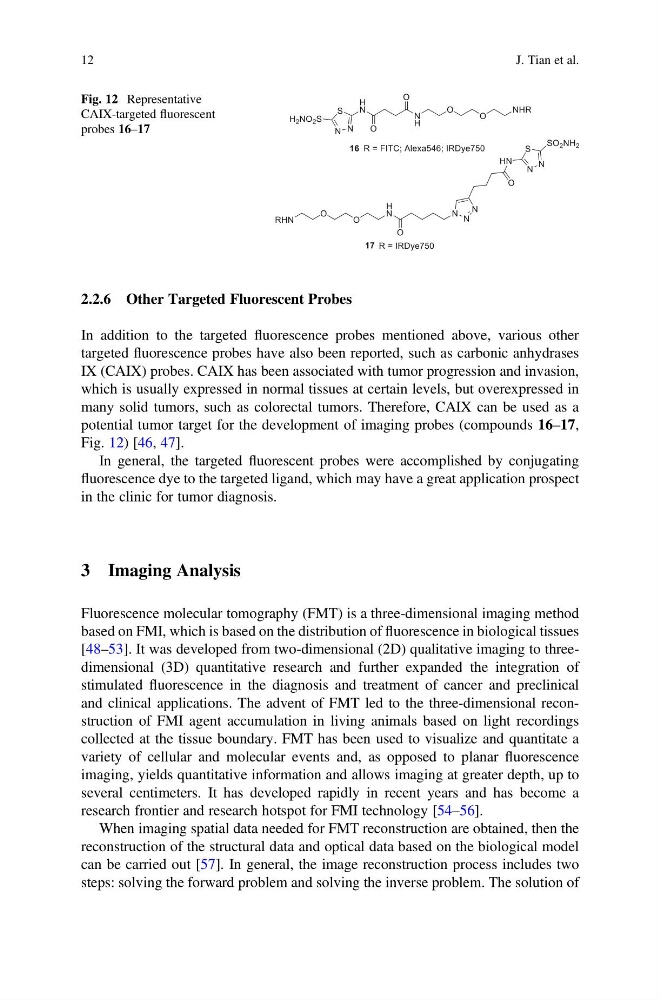
In addition to the targeted fluorescence probes mentioned above, various other
targeted fluorescence probes have also been reported, such as carbonic anhydrases
IX (CAIX) probes. CAIX has been associated with tumor progression and invasion,
which is usually expressed in normal tissues at certain levels, but overexpressed in
many solid tumors, such as colorectal tumors. Therefore, CAIX can be used as a
potential tumor target for the development of imaging probes (compounds 16–17,
Fig. 12) [46, 47].
In general, the targeted fluorescent probes were accomplished by conjugating
fluorescence dye to the targeted ligand, which may have a great application prospect
in the clinic for tumor diagnosis.
3 Imaging Analysis
Fluorescence molecular tomography (FMT) is a three-dimensional imaging method
based on FMI, which is based on the distribution of fluorescence in biological tissues
[48–53]. It was developed from two-dimensional (2D) qualitative imaging to threedimensional (3D) quantitative research and further expanded the integration of
stimulated fluorescence in the diagnosis and treatment of cancer and preclinical
and clinical applications. The advent of FMT led to the three-dimensional reconstruction of FMI agent accumulation in living animals based on light recordings
collected at the tissue boundary. FMT has been used to visualize and quantitate a
variety of cellular and molecular events and, as opposed to planar fluorescence
imaging, yields quantitative information and allows imaging at greater depth, up to
several centimeters. It has developed rapidly in recent years and has become a
research frontier and research hotspot for FMI technology [54–56].
When imaging spatial data needed for FMT reconstruction are obtained, then the
reconstruction of the structural data and optical data based on the biological model
can be carried out [57]. In general, the image reconstruction process includes two
steps: solving the forward problem and solving the inverse problem. The solution of
Fig. 12 Representative
CAIX-targeted fluorescent
probes 16–17
12
J. Tian et al.
In addition to the targeted fluorescence probes mentioned above, various other
targeted fluorescence probes have also been reported, such as carbonic anhydrases
IX (CAIX) probes. CAIX has been associated with tumor progression and invasion,
which is usually expressed in normal tissues at certain levels, but overexpressed in
many solid tumors, such as colorectal tumors. Therefore, CAIX can be used as a
potential tumor target for the development of imaging probes (compounds 16–17,
Fig. 12) [46, 47].
In general, the targeted fluorescent probes were accomplished by conjugating
fluorescence dye to the targeted ligand, which may have a great application prospect
in the clinic for tumor diagnosis.
3 Imaging Analysis
Fluorescence molecular tomography (FMT) is a three-dimensional imaging method
based on FMI, which is based on the distribution of fluorescence in biological tissues
[48–53]. It was developed from two-dimensional (2D) qualitative imaging to threedimensional (3D) quantitative research and further expanded the integration of
stimulated fluorescence in the diagnosis and treatment of cancer and preclinical
and clinical applications. The advent of FMT led to the three-dimensional reconstruction of FMI agent accumulation in living animals based on light recordings
collected at the tissue boundary. FMT has been used to visualize and quantitate a
variety of cellular and molecular events and, as opposed to planar fluorescence
imaging, yields quantitative information and allows imaging at greater depth, up to
several centimeters. It has developed rapidly in recent years and has become a
research frontier and research hotspot for FMI technology [54–56].
When imaging spatial data needed for FMT reconstruction are obtained, then the
reconstruction of the structural data and optical data based on the biological model
can be carried out [57]. In general, the image reconstruction process includes two
steps: solving the forward problem and solving the inverse problem. The solution of
Fig. 12 Representative
CAIX-targeted fluorescent
probes 16–17
12
J. Tian et al.