

compounds generally have high fluorescence quantum yield, large Stokes shift,
and dual-wavelength emission (emission of enol and ketone form). Hence ESIPTbased fluorophores are ideal candidates for acting as a signal component to
detect biomolecules [20]. In recent years, several ESIPT fluorophores, including
2-(benzothiazol-2
0 -yl)-phenols, and salicylaldehyde azine (SA) derivatives have
been developed to constitute fluorescent probes for the β-gal detection [21–
23]. For example, Otsubo et al. [21] selected 2-(benzothiazol-2-yl)-phenol derivatives as the substrates to synthesize a series of fluorescence dyes for β-gal detection.
At first, they found the fluorescent wavelength could be controlled by adjusting the
electronic character of phenol or benzothiazole ring. Compared with the compound
with no substituent, an electron-donating effect at the meta-position of phenolic
hydroxyl moiety could cause an obvious blue shift of the fluorescent wavelength. On
the contrary, the electron-donating effect at para-position made the fluorescent
wavelength shift toward the longer side. Moreover, the further shift to the longerwavelength end could be caused by the reduction of electron density of the
benzothiazole ring. Then, these substrates were coupled with 2,3,4,6-tetra-O-acetylD-galactopyranosyl bromide and converted to 2-(benzothiazol-2-yl)-phenyl-2,3,4,6tetra-O-acetyl-β-D-galactopyranoside derivatives; afterward, all the acetyl groups
were removed and the fluorescent probes for β-gal detection have been successfully
synthesized. These probes exhibited no or weak fluorescence in solution because
their ESIPT effect was blocked; however, after reacting with β-gal from Aspergillus
oryzae, the fluorescent probes were hydrolyzed and the ESIPT effect could be
restored, resulting in greatly enhanced fluorescence intensities. Their ratios of
fluorescence intensity before and after enzyme reaction were high enough to detect
β-gal accurately. In addition, it was worth mentioning that these probes could trace
β-gal at low pH, and because of their immobility or poor solubility to water, the
probes might stain live cells on the outer surface or interior of a cell membrane
without fixing or permeabilizing in the future.
In 2014, Cellier et al. [22] designed and synthesized a series of
2-arylbenzothiazole derivatives-enzyme substrates as fluorogenic probes in order
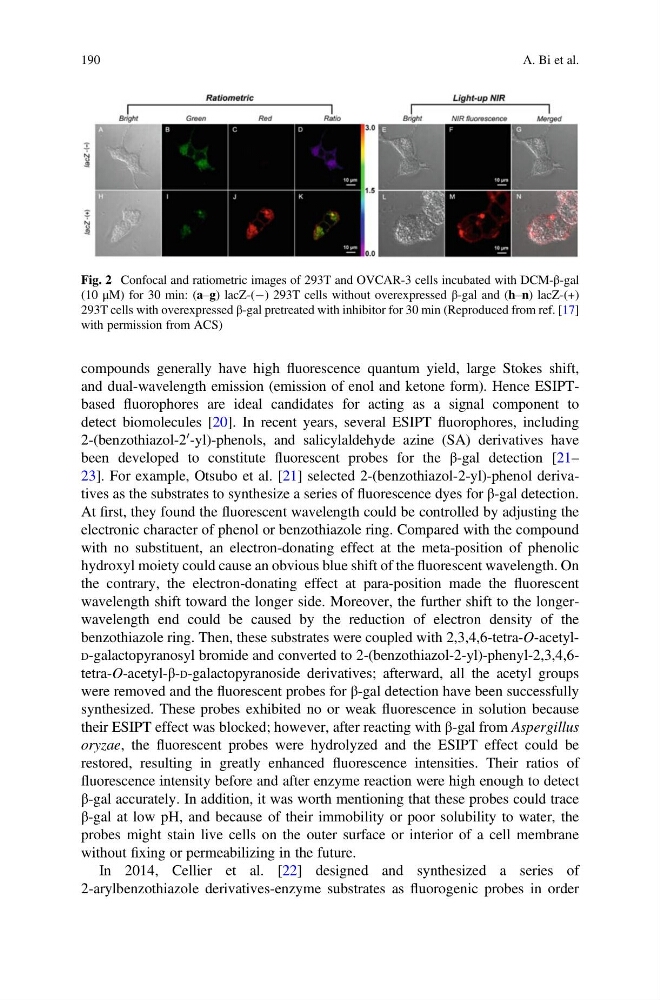
Fig. 2 Confocal and ratiometric images of 293T and OVCAR-3 cells incubated with DCM-β-gal
(10 μM) for 30 min: (a–g) lacZ-(À) 293T cells without overexpressed β-gal and (h–n) lacZ-(+)
293T cells with overexpressed β-gal pretreated with inhibitor for 30 min (Reproduced from ref. [17]
with permission from ACS)
190
A. Bi et al.
and dual-wavelength emission (emission of enol and ketone form). Hence ESIPTbased fluorophores are ideal candidates for acting as a signal component to
detect biomolecules [20]. In recent years, several ESIPT fluorophores, including
2-(benzothiazol-2
0 -yl)-phenols, and salicylaldehyde azine (SA) derivatives have
been developed to constitute fluorescent probes for the β-gal detection [21–
23]. For example, Otsubo et al. [21] selected 2-(benzothiazol-2-yl)-phenol derivatives as the substrates to synthesize a series of fluorescence dyes for β-gal detection.
At first, they found the fluorescent wavelength could be controlled by adjusting the
electronic character of phenol or benzothiazole ring. Compared with the compound
with no substituent, an electron-donating effect at the meta-position of phenolic
hydroxyl moiety could cause an obvious blue shift of the fluorescent wavelength. On
the contrary, the electron-donating effect at para-position made the fluorescent
wavelength shift toward the longer side. Moreover, the further shift to the longerwavelength end could be caused by the reduction of electron density of the
benzothiazole ring. Then, these substrates were coupled with 2,3,4,6-tetra-O-acetylD-galactopyranosyl bromide and converted to 2-(benzothiazol-2-yl)-phenyl-2,3,4,6tetra-O-acetyl-β-D-galactopyranoside derivatives; afterward, all the acetyl groups
were removed and the fluorescent probes for β-gal detection have been successfully
synthesized. These probes exhibited no or weak fluorescence in solution because
their ESIPT effect was blocked; however, after reacting with β-gal from Aspergillus
oryzae, the fluorescent probes were hydrolyzed and the ESIPT effect could be
restored, resulting in greatly enhanced fluorescence intensities. Their ratios of
fluorescence intensity before and after enzyme reaction were high enough to detect
β-gal accurately. In addition, it was worth mentioning that these probes could trace
β-gal at low pH, and because of their immobility or poor solubility to water, the
probes might stain live cells on the outer surface or interior of a cell membrane
without fixing or permeabilizing in the future.
In 2014, Cellier et al. [22] designed and synthesized a series of
2-arylbenzothiazole derivatives-enzyme substrates as fluorogenic probes in order
Fig. 2 Confocal and ratiometric images of 293T and OVCAR-3 cells incubated with DCM-β-gal
(10 μM) for 30 min: (a–g) lacZ-(À) 293T cells without overexpressed β-gal and (h–n) lacZ-(+)
293T cells with overexpressed β-gal pretreated with inhibitor for 30 min (Reproduced from ref. [17]
with permission from ACS)
190
A. Bi et al.