

4 Scatter and Attenuation Correction
In XFCT imaging, Compton scatter states one of the major problems and must be
dealt with adequately for high sensitivity. To reliably detect the fluorescence signal
and to eliminate the adverse effects of the Compton scatter photons, fundamental
strategies are required which estimate and correct scatter contamination or avoid
scatter in the first place. The signal created by Compton scatter of the primary
excitation X-rays interferes with the detection of fluorescent X-rays. For low concentrations of contrast agents, the scatter signal can be several times larger than the
fluorescent signal itself. The primary technique to reduce scatter content is the
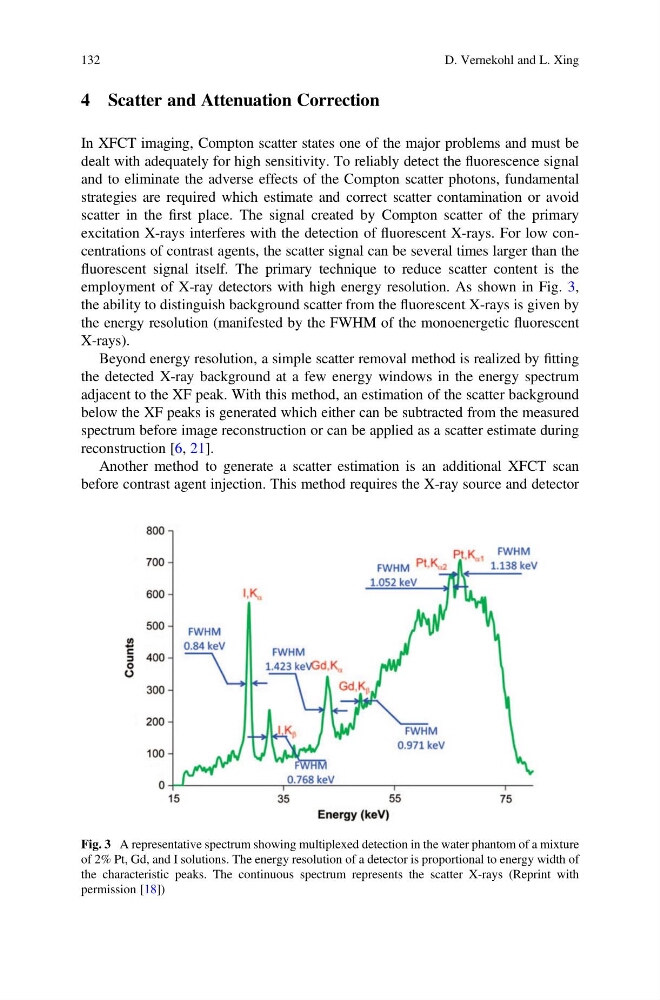
employment of X-ray detectors with high energy resolution. As shown in Fig. 3,
the ability to distinguish background scatter from the fluorescent X-rays is given by
the energy resolution (manifested by the FWHM of the monoenergetic fluorescent
X-rays).
Beyond energy resolution, a simple scatter removal method is realized by fitting
the detected X-ray background at a few energy windows in the energy spectrum
adjacent to the XF peak. With this method, an estimation of the scatter background
below the XF peaks is generated which either can be subtracted from the measured
spectrum before image reconstruction or can be applied as a scatter estimate during
reconstruction [6, 21].
Another method to generate a scatter estimation is an additional XFCT scan
before contrast agent injection. This method requires the X-ray source and detector
Fig. 3 A representative spectrum showing multiplexed detection in the water phantom of a mixture
of 2% Pt, Gd, and I solutions. The energy resolution of a detector is proportional to energy width of
the characteristic peaks. The continuous spectrum represents the scatter X-rays (Reprint with
permission [18])
132
D. Vernekohl and L. Xing
In XFCT imaging, Compton scatter states one of the major problems and must be
dealt with adequately for high sensitivity. To reliably detect the fluorescence signal
and to eliminate the adverse effects of the Compton scatter photons, fundamental
strategies are required which estimate and correct scatter contamination or avoid
scatter in the first place. The signal created by Compton scatter of the primary
excitation X-rays interferes with the detection of fluorescent X-rays. For low concentrations of contrast agents, the scatter signal can be several times larger than the
fluorescent signal itself. The primary technique to reduce scatter content is the
employment of X-ray detectors with high energy resolution. As shown in Fig. 3,
the ability to distinguish background scatter from the fluorescent X-rays is given by
the energy resolution (manifested by the FWHM of the monoenergetic fluorescent
X-rays).
Beyond energy resolution, a simple scatter removal method is realized by fitting
the detected X-ray background at a few energy windows in the energy spectrum
adjacent to the XF peak. With this method, an estimation of the scatter background
below the XF peaks is generated which either can be subtracted from the measured
spectrum before image reconstruction or can be applied as a scatter estimate during
reconstruction [6, 21].
Another method to generate a scatter estimation is an additional XFCT scan
before contrast agent injection. This method requires the X-ray source and detector
Fig. 3 A representative spectrum showing multiplexed detection in the water phantom of a mixture
of 2% Pt, Gd, and I solutions. The energy resolution of a detector is proportional to energy width of
the characteristic peaks. The continuous spectrum represents the scatter X-rays (Reprint with
permission [18])
132
D. Vernekohl and L. Xing