

contaminants like metal ions, inorganic anions, organic dyes, pesticides and
insecticides, radioactive elements, etc.
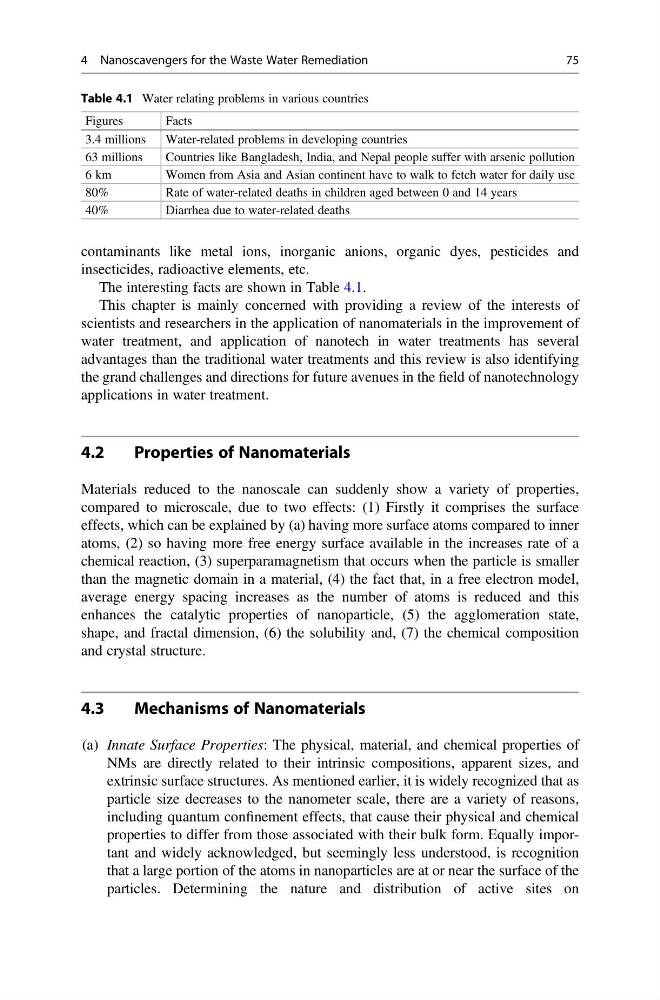
The interesting facts are shown in Table 4.1.
This chapter is mainly concerned with providing a review of the interests of
scientists and researchers in the application of nanomaterials in the improvement of
water treatment, and application of nanotech in water treatments has several
advantages than the traditional water treatments and this review is also identifying
the grand challenges and directions for future avenues in the field of nanotechnology
applications in water treatment.
4.2
Properties of Nanomaterials
Materials reduced to the nanoscale can suddenly show a variety of properties,
compared to microscale, due to two effects: (1) Firstly it comprises the surface
effects, which can be explained by (a) having more surface atoms compared to inner
atoms, (2) so having more free energy surface available in the increases rate of a
chemical reaction, (3) superparamagnetism that occurs when the particle is smaller
than the magnetic domain in a material, (4) the fact that, in a free electron model,
average energy spacing increases as the number of atoms is reduced and this
enhances the catalytic properties of nanoparticle, (5) the agglomeration state,
shape, and fractal dimension, (6) the solubility and, (7) the chemical composition
and crystal structure.
4.3
Mechanisms of Nanomaterials
(a) Innate Surface Properties: The physical, material, and chemical properties of
NMs are directly related to their intrinsic compositions, apparent sizes, and
extrinsic surface structures. As mentioned earlier, it is widely recognized that as
particle size decreases to the nanometer scale, there are a variety of reasons,
including quantum confinement effects, that cause their physical and chemical
properties to differ from those associated with their bulk form. Equally important and widely acknowledged, but seemingly less understood, is recognition
that a large portion of the atoms in nanoparticles are at or near the surface of the
particles. Determining the nature and distribution of active sites on
Table 4.1 Water relating problems in various countries
Figures
Facts
3.4 millions
Water-related problems in developing countries
63 millions
Countries like Bangladesh, India, and Nepal people suffer with arsenic pollution
6 km
Women from Asia and Asian continent have to walk to fetch water for daily use
80%
Rate of water-related deaths in children aged between 0 and 14 years
40%
Diarrhea due to water-related deaths
4 Nanoscavengers for the Waste Water Remediation
75
insecticides, radioactive elements, etc.
The interesting facts are shown in Table 4.1.
This chapter is mainly concerned with providing a review of the interests of
scientists and researchers in the application of nanomaterials in the improvement of
water treatment, and application of nanotech in water treatments has several
advantages than the traditional water treatments and this review is also identifying
the grand challenges and directions for future avenues in the field of nanotechnology
applications in water treatment.
4.2
Properties of Nanomaterials
Materials reduced to the nanoscale can suddenly show a variety of properties,
compared to microscale, due to two effects: (1) Firstly it comprises the surface
effects, which can be explained by (a) having more surface atoms compared to inner
atoms, (2) so having more free energy surface available in the increases rate of a
chemical reaction, (3) superparamagnetism that occurs when the particle is smaller
than the magnetic domain in a material, (4) the fact that, in a free electron model,
average energy spacing increases as the number of atoms is reduced and this
enhances the catalytic properties of nanoparticle, (5) the agglomeration state,
shape, and fractal dimension, (6) the solubility and, (7) the chemical composition
and crystal structure.
4.3
Mechanisms of Nanomaterials
(a) Innate Surface Properties: The physical, material, and chemical properties of
NMs are directly related to their intrinsic compositions, apparent sizes, and
extrinsic surface structures. As mentioned earlier, it is widely recognized that as
particle size decreases to the nanometer scale, there are a variety of reasons,
including quantum confinement effects, that cause their physical and chemical
properties to differ from those associated with their bulk form. Equally important and widely acknowledged, but seemingly less understood, is recognition
that a large portion of the atoms in nanoparticles are at or near the surface of the
particles. Determining the nature and distribution of active sites on
Table 4.1 Water relating problems in various countries
Figures
Facts
3.4 millions
Water-related problems in developing countries
63 millions
Countries like Bangladesh, India, and Nepal people suffer with arsenic pollution
6 km
Women from Asia and Asian continent have to walk to fetch water for daily use
80%
Rate of water-related deaths in children aged between 0 and 14 years
40%
Diarrhea due to water-related deaths
4 Nanoscavengers for the Waste Water Remediation
75