

Besides,
• Various elemental properties can be enhanced such as conductivity (Dongliang
et al. 2017; Abdel Aal et al. 2017), redox properties, magnetic, and thermal
(Pourgolmohammad et al. 2017; Tebaldi et al. 2018).
• In the preparation of advanced polymer solar cells (Shen et al. 2017),
dye-sensitized solar cells (Wu et al. 2016), and thin layer solar cells (Khanaki
et al. 2015; Choi et al. 2016; Jang et al. 2016; Kim et al. 2016; Park et al. 2016)
with high efficacies.
• NPs are utilized in decontamination (Gupta and Sengupta 2017; Walekar et al.
2017), dye adsorption (Wang et al. 2015), in gas sensors (Van Duy et al. 2016).
• Nano-silicon dioxide crystals are utilized in various fields, the finest example of
their use is in the formation of tennis racquets strings as these NPs gives extra
strength (Dolez 2015).
• Nanoporous graphene and doped graphene complexes are employed in environmental remediation (Thomas and Ramaswamy 2016).
• Other benefaction of the nanotechnology field includes the formation of powerefficient LED’S (Jeong et al. 2014), water-resistant coatings (Hassan et al. 2016),
solar stucco (Luévano-Hipólito and Martínez-de la Cruz 2018), and auto-cleaning
glasses (Rifai et al. 2017).
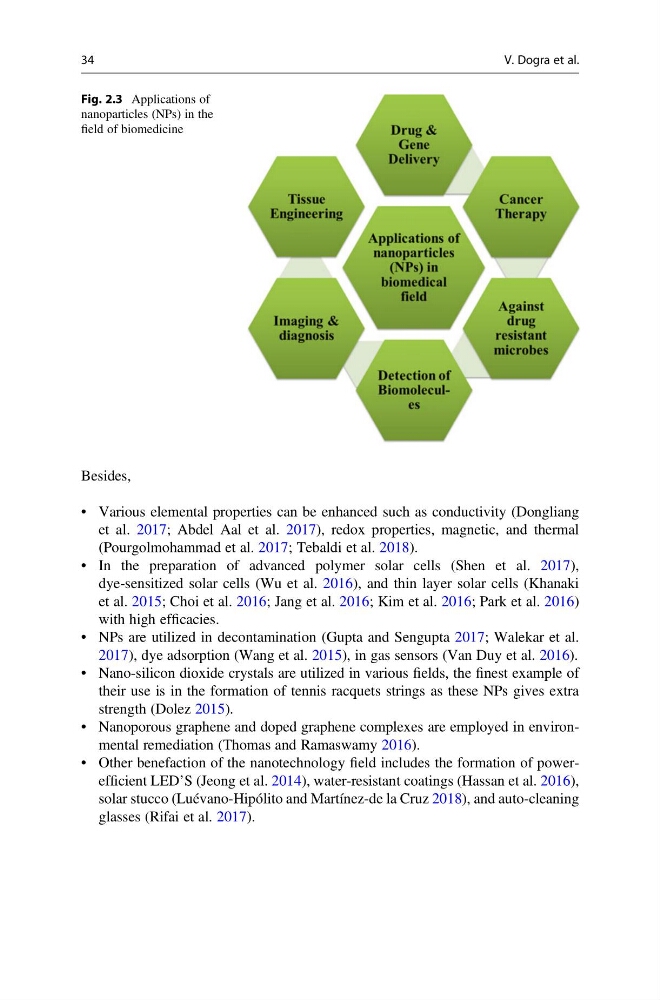
Fig. 2.3 Applications of
nanoparticles (NPs) in the
field of biomedicine
34
V. Dogra et al.
• Various elemental properties can be enhanced such as conductivity (Dongliang
et al. 2017; Abdel Aal et al. 2017), redox properties, magnetic, and thermal
(Pourgolmohammad et al. 2017; Tebaldi et al. 2018).
• In the preparation of advanced polymer solar cells (Shen et al. 2017),
dye-sensitized solar cells (Wu et al. 2016), and thin layer solar cells (Khanaki
et al. 2015; Choi et al. 2016; Jang et al. 2016; Kim et al. 2016; Park et al. 2016)
with high efficacies.
• NPs are utilized in decontamination (Gupta and Sengupta 2017; Walekar et al.
2017), dye adsorption (Wang et al. 2015), in gas sensors (Van Duy et al. 2016).
• Nano-silicon dioxide crystals are utilized in various fields, the finest example of
their use is in the formation of tennis racquets strings as these NPs gives extra
strength (Dolez 2015).
• Nanoporous graphene and doped graphene complexes are employed in environmental remediation (Thomas and Ramaswamy 2016).
• Other benefaction of the nanotechnology field includes the formation of powerefficient LED’S (Jeong et al. 2014), water-resistant coatings (Hassan et al. 2016),
solar stucco (Luévano-Hipólito and Martínez-de la Cruz 2018), and auto-cleaning
glasses (Rifai et al. 2017).
Fig. 2.3 Applications of
nanoparticles (NPs) in the
field of biomedicine
34
V. Dogra et al.