

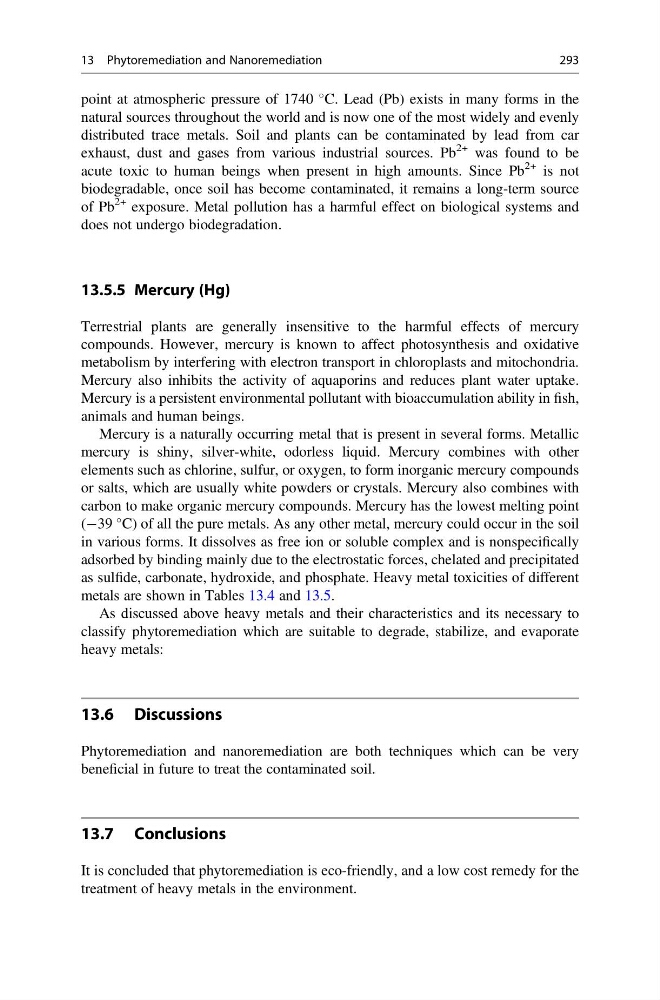
point at atmospheric pressure of 1740
C. Lead (Pb) exists in many forms in the
natural sources throughout the world and is now one of the most widely and evenly
distributed trace metals. Soil and plants can be contaminated by lead from car
exhaust, dust and gases from various industrial sources. Pb
2+ was found to be
acute toxic to human beings when present in high amounts. Since Pb
2+ is not
biodegradable, once soil has become contaminated, it remains a long-term source
of Pb
2+ exposure. Metal pollution has a harmful effect on biological systems and
does not undergo biodegradation.
13.5.5 Mercury (Hg)
Terrestrial plants are generally insensitive to the harmful effects of mercury
compounds. However, mercury is known to affect photosynthesis and oxidative
metabolism by interfering with electron transport in chloroplasts and mitochondria.
Mercury also inhibits the activity of aquaporins and reduces plant water uptake.
Mercury is a persistent environmental pollutant with bioaccumulation ability in fish,
animals and human beings.
Mercury is a naturally occurring metal that is present in several forms. Metallic
mercury is shiny, silver-white, odorless liquid. Mercury combines with other
elements such as chlorine, sulfur, or oxygen, to form inorganic mercury compounds
or salts, which are usually white powders or crystals. Mercury also combines with
carbon to make organic mercury compounds. Mercury has the lowest melting point
(À39
C) of all the pure metals. As any other metal, mercury could occur in the soil
in various forms. It dissolves as free ion or soluble complex and is nonspecifically
adsorbed by binding mainly due to the electrostatic forces, chelated and precipitated
as sulfide, carbonate, hydroxide, and phosphate. Heavy metal toxicities of different
metals are shown in Tables 13.4 and 13.5.
As discussed above heavy metals and their characteristics and its necessary to
classify phytoremediation which are suitable to degrade, stabilize, and evaporate
heavy metals:
13.6 Discussions
Phytoremediation and nanoremediation are both techniques which can be very
beneficial in future to treat the contaminated soil.
13.7 Conclusions
It is concluded that phytoremediation is eco-friendly, and a low cost remedy for the
treatment of heavy metals in the environment.
13 Phytoremediation and Nanoremediation
293
C. Lead (Pb) exists in many forms in the
natural sources throughout the world and is now one of the most widely and evenly
distributed trace metals. Soil and plants can be contaminated by lead from car
exhaust, dust and gases from various industrial sources. Pb
2+ was found to be
acute toxic to human beings when present in high amounts. Since Pb
2+ is not
biodegradable, once soil has become contaminated, it remains a long-term source
of Pb
2+ exposure. Metal pollution has a harmful effect on biological systems and
does not undergo biodegradation.
13.5.5 Mercury (Hg)
Terrestrial plants are generally insensitive to the harmful effects of mercury
compounds. However, mercury is known to affect photosynthesis and oxidative
metabolism by interfering with electron transport in chloroplasts and mitochondria.
Mercury also inhibits the activity of aquaporins and reduces plant water uptake.
Mercury is a persistent environmental pollutant with bioaccumulation ability in fish,
animals and human beings.
Mercury is a naturally occurring metal that is present in several forms. Metallic
mercury is shiny, silver-white, odorless liquid. Mercury combines with other
elements such as chlorine, sulfur, or oxygen, to form inorganic mercury compounds
or salts, which are usually white powders or crystals. Mercury also combines with
carbon to make organic mercury compounds. Mercury has the lowest melting point
(À39
C) of all the pure metals. As any other metal, mercury could occur in the soil
in various forms. It dissolves as free ion or soluble complex and is nonspecifically
adsorbed by binding mainly due to the electrostatic forces, chelated and precipitated
as sulfide, carbonate, hydroxide, and phosphate. Heavy metal toxicities of different
metals are shown in Tables 13.4 and 13.5.
As discussed above heavy metals and their characteristics and its necessary to
classify phytoremediation which are suitable to degrade, stabilize, and evaporate
heavy metals:
13.6 Discussions
Phytoremediation and nanoremediation are both techniques which can be very
beneficial in future to treat the contaminated soil.
13.7 Conclusions
It is concluded that phytoremediation is eco-friendly, and a low cost remedy for the
treatment of heavy metals in the environment.
13 Phytoremediation and Nanoremediation
293