

(degradation of chlorinated solvents and pesticides), and laccases (degradation of
anilines). Populus species and Myriophyllium spicatum are examples of plants that
have these enzymatic systems.
13.1.2.2 Phyto-stabilization (Phyto-immobilization)
This involves absorption by roots, adsorption to the surface of roots, or the production of biochemicals by the plants that are released into the soil or groundwater in the
immediate vicinity of the roots and can sequester, precipitate, or otherwise, immobilize nearby contaminants. The main objective is to avoid mobilization of
contaminants and limit their diffusion in the soil. Species of genera Haumaniastrum,
Eragrostis, Ascolepis, Gladiolus, and Alyssum are examples of plants cultivated for
this purpose.
13.1.2.3 Phyto-volatilization
Plants take up volatile compounds through their roots and transpire the same
compounds, or their metabolites, through the leaves, thereby releasing them into
the atmosphere. There are some species Astragalus bisulcatus and Stanleya pinnata
for Se or transgenic plants with bacterial genes of Arabidopsis thaliana, Nicotiana
tabacum, Liriodendron tulipifera, or Brassica napus for Hg can be mentioned. This
technique can also be used for organic compounds.
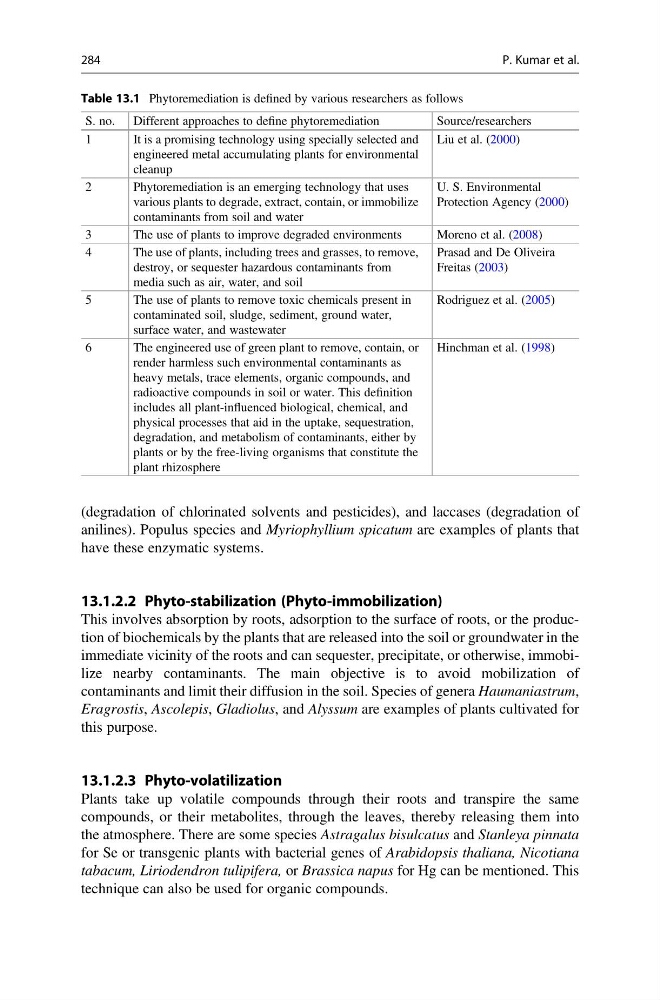
Table 13.1 Phytoremediation is defined by various researchers as follows
S. no. Different approaches to define phytoremediation
Source/researchers
1
It is a promising technology using specially selected and
engineered metal accumulating plants for environmental
cleanup
Liu et al. (2000)
2
Phytoremediation is an emerging technology that uses
various plants to degrade, extract, contain, or immobilize
contaminants from soil and water
U. S. Environmental
Protection Agency (2000)
3
The use of plants to improve degraded environments
Moreno et al. (2008)
4
The use of plants, including trees and grasses, to remove,
destroy, or sequester hazardous contaminants from
media such as air, water, and soil
Prasad and De Oliveira
Freitas (2003)
5
The use of plants to remove toxic chemicals present in
contaminated soil, sludge, sediment, ground water,
surface water, and wastewater
Rodriguez et al. (2005)
6
The engineered use of green plant to remove, contain, or
render harmless such environmental contaminants as
heavy metals, trace elements, organic compounds, and
radioactive compounds in soil or water. This definition
includes all plant-influenced biological, chemical, and
physical processes that aid in the uptake, sequestration,
degradation, and metabolism of contaminants, either by
plants or by the free-living organisms that constitute the
plant rhizosphere
Hinchman et al. (1998)
284
P. Kumar et al.
anilines). Populus species and Myriophyllium spicatum are examples of plants that
have these enzymatic systems.
13.1.2.2 Phyto-stabilization (Phyto-immobilization)
This involves absorption by roots, adsorption to the surface of roots, or the production of biochemicals by the plants that are released into the soil or groundwater in the
immediate vicinity of the roots and can sequester, precipitate, or otherwise, immobilize nearby contaminants. The main objective is to avoid mobilization of
contaminants and limit their diffusion in the soil. Species of genera Haumaniastrum,
Eragrostis, Ascolepis, Gladiolus, and Alyssum are examples of plants cultivated for
this purpose.
13.1.2.3 Phyto-volatilization
Plants take up volatile compounds through their roots and transpire the same
compounds, or their metabolites, through the leaves, thereby releasing them into
the atmosphere. There are some species Astragalus bisulcatus and Stanleya pinnata
for Se or transgenic plants with bacterial genes of Arabidopsis thaliana, Nicotiana
tabacum, Liriodendron tulipifera, or Brassica napus for Hg can be mentioned. This
technique can also be used for organic compounds.
Table 13.1 Phytoremediation is defined by various researchers as follows
S. no. Different approaches to define phytoremediation
Source/researchers
1
It is a promising technology using specially selected and
engineered metal accumulating plants for environmental
cleanup
Liu et al. (2000)
2
Phytoremediation is an emerging technology that uses
various plants to degrade, extract, contain, or immobilize
contaminants from soil and water
U. S. Environmental
Protection Agency (2000)
3
The use of plants to improve degraded environments
Moreno et al. (2008)
4
The use of plants, including trees and grasses, to remove,
destroy, or sequester hazardous contaminants from
media such as air, water, and soil
Prasad and De Oliveira
Freitas (2003)
5
The use of plants to remove toxic chemicals present in
contaminated soil, sludge, sediment, ground water,
surface water, and wastewater
Rodriguez et al. (2005)
6
The engineered use of green plant to remove, contain, or
render harmless such environmental contaminants as
heavy metals, trace elements, organic compounds, and
radioactive compounds in soil or water. This definition
includes all plant-influenced biological, chemical, and
physical processes that aid in the uptake, sequestration,
degradation, and metabolism of contaminants, either by
plants or by the free-living organisms that constitute the
plant rhizosphere
Hinchman et al. (1998)
284
P. Kumar et al.