

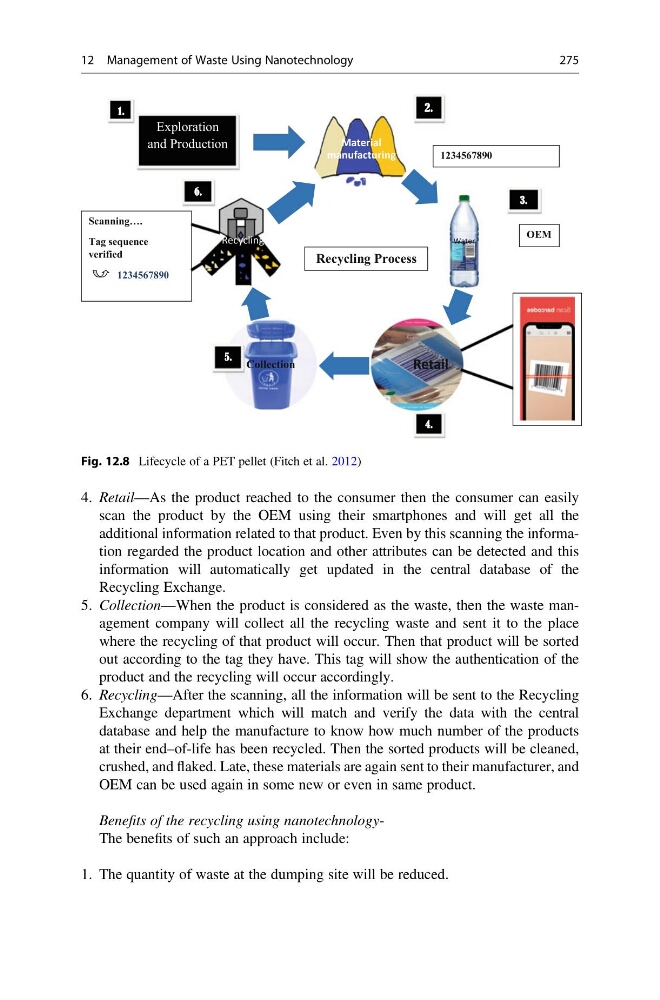
4. Retail—As the product reached to the consumer then the consumer can easily
scan the product by the OEM using their smartphones and will get all the
additional information related to that product. Even by this scanning the information regarded the product location and other attributes can be detected and this
information will automatically get updated in the central database of the
Recycling Exchange.
5. Collection—When the product is considered as the waste, then the waste management company will collect all the recycling waste and sent it to the place
where the recycling of that product will occur. Then that product will be sorted
out according to the tag they have. This tag will show the authentication of the
product and the recycling will occur accordingly.
6. Recycling—After the scanning, all the information will be sent to the Recycling
Exchange department which will match and verify the data with the central
database and help the manufacture to know how much number of the products
at their end–of-life has been recycled. Then the sorted products will be cleaned,
crushed, and flaked. Late, these materials are again sent to their manufacturer, and
OEM can be used again in some new or even in same product.
Benefits of the recycling using nanotechnologyThe benefits of such an approach include:
1. The quantity of waste at the dumping site will be reduced.
Material
manufacturing
Water
Retail
Collection
Recycling
Scanning….
Tag sequence
verified
1234567890
1234567890
Recycling Process
Exploration
and Production
OEM
Fig. 12.8 Lifecycle of a PET pellet (Fitch et al. 2012)
12 Management of Waste Using Nanotechnology
275
scan the product by the OEM using their smartphones and will get all the
additional information related to that product. Even by this scanning the information regarded the product location and other attributes can be detected and this
information will automatically get updated in the central database of the
Recycling Exchange.
5. Collection—When the product is considered as the waste, then the waste management company will collect all the recycling waste and sent it to the place
where the recycling of that product will occur. Then that product will be sorted
out according to the tag they have. This tag will show the authentication of the
product and the recycling will occur accordingly.
6. Recycling—After the scanning, all the information will be sent to the Recycling
Exchange department which will match and verify the data with the central
database and help the manufacture to know how much number of the products
at their end–of-life has been recycled. Then the sorted products will be cleaned,
crushed, and flaked. Late, these materials are again sent to their manufacturer, and
OEM can be used again in some new or even in same product.
Benefits of the recycling using nanotechnologyThe benefits of such an approach include:
1. The quantity of waste at the dumping site will be reduced.
Material
manufacturing
Water
Retail
Collection
Recycling
Scanning….
Tag sequence
verified
1234567890
1234567890
Recycling Process
Exploration
and Production
OEM
Fig. 12.8 Lifecycle of a PET pellet (Fitch et al. 2012)
12 Management of Waste Using Nanotechnology
275